Here, you will find a vast multitude of materials useful for the art and science
of Biblical textual criticism. Material is added regularly so be sure to visit often.
-- Scroll down (way down) to view my chart of Greek ligatures
and other minuscule script informations --
Wilcken Schubart Gardthausen Youtie Aland Metzger Tebtunis Karanis Tischendorf Tregelles Souter Sahidic Bohairic Palestinian Aramaic inspiration Pickering Husselman Mitteis Preisigke Philology Greco-Roman Inschriften Papyrusurkunden Chrestomathie
this page copyrighted by Mr. Gary S. Dykes © 2006
Wilbur N. Pickering family 35
To view some portions of this area of the website properly, you may want
to download and install the following fonts:
These are quality crafted, hinted and embeddable fonts, and are free to
use in any other way! Right click on each (above) to download,
then copy each into your fonts folder - [C:\windows\fonts], restart your computer,
and they are hopefully installed! (on some machines (XP) you may need to actually
install the font, more than just copying to the fonts folder, a free and easy to use
font installer is available on my "Softwares" page)
Schubart Hunger Wilcken Wessely Turner Husselman Preisigke Treu
|
Via over 100 manuscripts, all variants demonstrated - line by line, in a horizontal manner. Including Old Latin and Bohairic mss. !! Easy to use format!! SIZE: about 13 MB --- 21 pages -- PDF format editor: Mr. Gary S. Dykes file name: One_Ephesians_semi.pdf This one chapter required several months to format, so
enjoy the work, it includes many MANUSCRIPTS which the
IGNTP folks have NOT used in their massive effort on
Ephesians.
|
for years the TR and the
Majority Text have been my preferred Greek texts.
However Wilbur Pickering's Family 35 edition, with
its unique apparatus, supplants them. The printed
volume is a beautiful production
suitable for the wonderful contents. Read and enjoy
this genuine Greek text, based upon minuscule 35,
which now resides in Paris: it is of the 11th
century and contains the Pauline Epistles, as well
as the rest of the NT. Below I provide a digital
copy of this text. The entire actual manuscript (not
the printed book!) can be viewed here: Coislin
199 | Gallica (bnf.fr) I present 1/2 of a sample page here -- of
Ephesians chapter 1, page 267 --- click on thumbnail 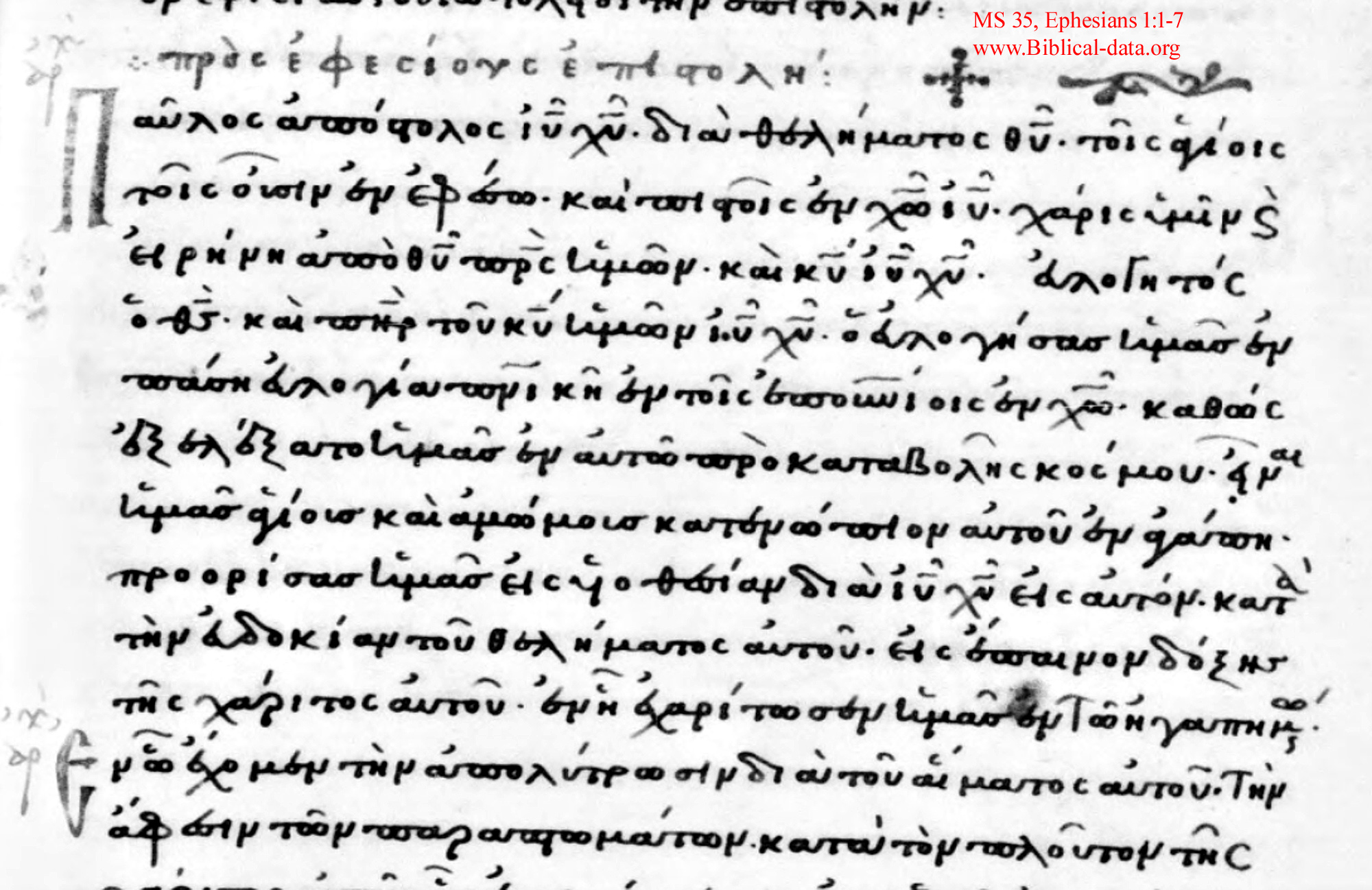 Manuscript 35 is part of a closely allied group (of at
least 50 mss) of manuscripts all displaying the majority
text-type. Some of the other related MSS are: ms 18, ms
2080, ms 876, ms 1765, ms 2243, ms 547, ms 1117. ms
2765, ms 201, et cetera. Fortunately it is one
of the manuscripts used in the on-going IGNT project on
Ephesians. Pickering's Greek text is available in a nice
softcover edition, available on Amazon: and the digital file is here, (this is the actual full Greek New Testament): the NT file is file is 12.5 MB and is about 345 pages.
THIS is the PREFERRED Greek NT. An important essay by Wilbur N. Pickering shows WHY a
correct Greek text is absolutely required: it is only 302 KB and is 30 pages - a great read!!!
|
|
|
SIZE: about 7 MB - - - 11 images in a PDF file author: R. Browning (Robert ?) Date, 1960. An authorative article in which the author illuminates the type of ancient materials Byzantine scribes would copy and archive. This article is well researched and is often overlooked. PDF file name: Browning_full.pdf |
||
|
author: Mr. Gary S. Dykes size: 382,582 bytes - - - 18 pages - - - PDF format I work hard at trying to produce materials which promote or clarify God's Word. And for me it is a lot of work. This essay is very important as it makes clear how any elected person (a believing Christian) can understand God's Word as it appears in nearly any translation, or as it appears scattered amongst numerous manuscripts or variant readings. It is encouraging to know that God's Word is there, in its entirety, for any believer to access; it is a supernatural gift from God to His children! Always and fully preserved.
|
Be inecke Emmel Welles Brice Jones Harvard Susan A. Stephens P 49 Yale NOTES ON THE THREE MAJOR TEXT-TYPES SIZE: 938,987 bytes -- CONTAINS 60 pages (PDF) author: Mr. Gary S. Dykes Blindly accepting Greek readings from ancient papyri from Egypt, is not always sane. These penetrating essays caution textual critics and translators! Introductory information on the Greek manuscript families of the New Testament is presented along with cutting edge data!!. This is part 2 of a larger work in progress. Contains three essays in a single file. file name: Text_types_part2.pdf ha, Jeffery John
|
|
|
SIZE: 484,241 bytes --- CONTAINS 44 pages (PDF) author: Mr. Gary S. Dykes All three essays collected into one pdf file with a new preface. These essays cover my views on Translation Ethics and the practice of Biblical Textual Criticism today. I hold no punches. A good reality check for those who make translations or who examine MS variants. A good handout for students as well! (Should generate valuable discussions!) See also, BUBBLES, below!!!
|
A Review of Jeffery John Kloha's Dissertation of 2006, titled: "A Textual Commentary on Paul's First Epistle to the Corinthians" size: 146,989 bytes - - - CONTAINS 8 pages (PDF) author: Mr. Gary S. Dykes This vast effort by Dr. Khola partly parallels my own on-going effort. Thus I am in a good position to review this disserataion.
|
|
|
On the Nature of Biblical Textual Criticism SIZE: 152,836 bytes --- CONTAINS 12 pages (PDF) author: Mr. Gary S. Dykes A short explosive essay which proposes a corrected paradigm, a true and edifying purpose for the craft of Biblical textual criticism. An indictment against the current state of Biblical textual criticism. A must read!! Written by a man who has practiced and observed Biblical textual criticism for over 20 years, and one who is also a man of faith. This file is also contained in the "Trilogy" pdf file, above. In response to a request, I provide some samples of "bubbles" (mentioned in the above essay). And yes, I have my helmet on! BUBBLES ---- 61,958 bytes, 8 pages PDF
|
Dating the Apostle John's Writings SIZE: 66,705 bytes ---- CONTAINS 2 pages (PDF) author: Mr. Gary S. Dykes A brief introduction to a larger work of mine (The Primary Audience of the Apostle John), this file has 15 reasons why John wrote in the A.D. 90-98 range. Again brief, but pointed. |
|
|
Borland's Collation of the Robinson/Pierpont and the Farstad/Hodges Majority Texts author: Jonathan Borland HTML file, circa 2003. Used via permission of Mr. Borland. A fine work and easy to use, instantly see all variations between these fine editions of the Majority Text. |
Ligatures and Tachygraphy: including numerous PRINTED ligatures
Manuscript Provenances and Locales [under construction]
SCRIPT MENSURATION (script analyses), NEW cutting-edge RESEARCH Did such and such a scribe write such and such a manuscript? How can you be sure? Did scribe X also write another manuscript? Via this revolutionary analysis method, you can determine for certain, if the same scribe wrote any of one or more manuscripts. Anyone with a computer monitor can begin to mensurate (measure) and analyze a scribe's writing. Currently the system only works for Greek minuscule scripts.
|
|
|
More Palaeographical Items, TOOLS, and ESSAYS - - (such as an archive copy of Kim's 1988 essay on the dating of papyrus P- 46, and charts of various Greek letter forms illustrating periods of Greek manuscript production, et al).
|
Modern Textual Criticism, Its Genesis and Retardation author: Mr. Gary S. Dykes SIZE: 1.5 MB - - - 41 pages - - - PDF My first award winning essay! (And perhaps my last). An interpretation of the history of Biblical TC, its rise and its problems. Lots of research contained herein.
|
|
|
More Tips on Dating Minuscule Mansucripts
|
In the PDF paper (below) it is seen that Mr. Gary Dykes was the first scholar to indicate that many of the distigmai in Codex Vaticanus (03) suggest/indicate variants seen only in the Byzantine text-type. I made this discovery in 2006, a year before Payne, Canart and P. Head saw the light. As usual no credit is given. In 2006, "umlaut" was the designation for many of these "double-dots". Later research has improved my initial observations. Using the "Umlauts" of Codex Vaticanus to Dig Deeper SIZE: 164,676 bytes ---- CONTAINS 10 pages (PDF) author: Mr. Gary S. Dykes DATE: 2006 The implications of this simple essay are profound! I believe the term "umlauts" has been made obsolete, and a newer term employed.
|
|
|
Palaeographical Dating of P-46 SIZE: 99,551 bytes ---- CONTAINS 11 pages (PDF) author: Dr. Bruce Griffin This is the paper delivered to the 1996 SBL meeting in New Orleans, which strongly opposes Kim's early dating of papyrus P46. Griffin shines herein!
|
IMPORTANT Textual Criticism TERMS defined a HTML file: by Mr. Gary S. Dykes Also a handy (printable) PDF file is available. Download it and print it, it is also handy for teaching situations as a handout. [Printed version has been greatly improved (2013).] Click on the PDF FILE icon below. PDF file, 17 pages, size: about 96 KB (small !)
PDF file of the above HTML file it is named ----TERMS_defined.pdf
|
|
|
H. von
Soden's MSS citation keys These charts enhance and correct works by Merk and others. |
The Doctrine of Inerrancy and the Manuscript Variants SIZE: 75,267 bytes ---- CONTAINS 11 pages (PDF) author: Mr. Gary S. Dykes Instead of avoiding the reality of variants, I suggest believers USE them. Good reading, IMPORTANT. A very important document, especially for genuine saints!! This is also one of the three files collected into the "Trilogy" PDF file, above.
|
|
|
a HTML file, contains several images of actual Greek New Testaments of by-gone days. |
www.skypoint.com/members/waltzmn/ The above link takes you to a very nice labor of love by Robert Waltzman. If the link does not link you to the site, then...copy and paste it into your browser. The site is loaded with useful material. It is an Encyclopedia of Textual Criticism. Very helpful!! Its last update was in 2007.
|
|
DATED Script samples for DATING and EVALUATING MINUSCULE SCRIPTS: INCLUDES MANY SAMPLE IMAGES FOR SCRIPT COMPARISONS - very useful |
||
 click to return to main / home page click to return to main / home page
|
|
A KEY TO VON SODEN'S APPARATUS FOR THE
PRAXAPOSTOLOS AND REVELATION
["Praxapostolos" generally means the books of Acts, the Catholic Epistles, and the Pauline Epistles]
This key provides referrers to von Soden's apparatus with a means by which they
can accurately note which manuscripts he is referring to when he shows
witnesses as:
Ia3.....d180ff
The ...ff indicates that he is referring ALSO to two additional manuscripts which
follow d180. What are these two manuscripts? I have actually seen
people use Merk's Greek New Testament (in his introduction) to discover the
identity, this gives an error. Merk does NOT follow von Soden's manuscript
order. In the chart below, for the Praxapostolos, the next two manuscripts
below d180 are MSS 2127, 808. Thus, here, von Soden's apparatus shows
three witnesses, MSS 1319, 2127 and 808 ( = d180ff). Not all of von Soden's MSS are listed
below, but as many as could be are, each order matches his citations.
The columns with no title, are of course the equivalent modern Gregory numbers.
I have no such list for the gospel manuscripts.
PRAXAPOSTOLOS
| H | Ia1 | Ia3 | Ib1 | Ic1 | K | ||||||
| d1 | B (03) | d5 | D (05) | d156 | 226 | d206 | 242 | a114 | 1852 | a3 | P (025) |
| d2 | ¢ (01) | d268 | 431 | d157 | 547 | d264 | 536 | a116 | 2138 | a5 | L (020) |
| d3 | C (04) | a7 | 1874 | d180 | 1319 | d369 | 941 | a158 | 1245 | a6 | H (014) |
| d4 | A (02) | a65 | 1836 | d202 | 2127 | d600 | 296 | a208 | 1611 | ||
| d6 | y (044) | a70 | 1875 | d203 | 808 | d602 | 522 | a370 | 1108 | ||
| d48 | 33 | a101 | 181 | d254 | 1 | a62 | 1891 | a551 | 1518 | ||
| d356 | 6 | a200 | 88 | d259 | 330 | a161 | 635 | a1436 | 2005 | © GSD | |
| a3 | P (025) | a264 | 917 | d300 | 218 | a253 | 2815 | ||||
| a74 | 1175 | a382 | 915 | d353 | 999 | a365 | 206 | ||||
| a78 | 1739 | a1001 | E (08) | d354 | 2093 | a396 | 1758 | Ic2 | |||
| a103 | 104 | a1026 | D (06) | d355 | 38 | a398 | 429 | d101 | 506 | ||
| a114 | 1852 | a1027 | D (06a)* | d372 | 263 | a472 | 1831 | d299 | 2147 | ||
| a162 | 81 | a1028 | G (012) | d454 | 794 | a1005 | 0120 | a69 | 221 | ||
| a257 | 326 | a1029 | F (010) | d457 | 209 | a154 | 1867 | ||||
| a1018 | 0173 | a1066 | 1912 | d505 | 69 | Ib2 | a169 | 639 | |||
| a1019 | <20 | a1100 | 1829 | d507 | 241 | d152 | 491 | a174 | 255 | ||
| a1022 | H (015) | pr 11 | 307 | a55 | 920 | d260 | 440 | a203 | 203 | ||
| a1031 | 0121 | - 20 | 36 | a56 | 1835-2004 | d309 | 35 | a258 | 378 | ||
| a1034 | <13 | - 21 | 610 | a64 | 1845 | d361 | 935 | a353 | 383 | ||
| a1042 | 0172 | - 40 | 453 | a106 | 177 | d368 | 823 | a356 | 876 | ||
| a1044 | <15 | a113 | 919 | d370 | 1149 | a364 | 614 | ||||
| a1045 | <16 | Ia2 | a164 | 1738 | a78 | 1739 | a466 | 257 | |||
| O 12 | 424 | d251 | 927 | a170 | 1311 | a157 | 323 | a468 | 1610 | ||
| d453 | 5 | a172 | 436 | a171 | 2298 | a470 | 913 | ||||
| d459 | 489 | a174 | 255 | a209 | 1872 | a486 | 1765 | ||||
| a173 | 623 | a192 | 1837 | a469 | 216 | a506 | 385 | ||||
| a175 | 1838 | a205 | 337 | ||||||||
| a184 | 2143 | a216 | 256 | ||||||||
| a252 | 1873 | a359 | 462 | ||||||||
| a367 | 1827 | a361 | 1525 | ||||||||
| a502 | 467 | a394 | 2180 | ||||||||
| a397 | 460 | ||||||||||
| a464 | 1522 | ||||||||||
| a552 | 642 |
* a copy of 06, a1120 is another copy of 06 (per von Soden's terminology)
REVELATION
| H | Ia2 | Ia5 | Ib1 | K | |||||
| d2 | ¢ (01) | d600 | 296 | a54 | 2028 | Oa41 | 1778 | a1070 | 046 |
| d3 | C (04) | a10 | 2059 | a59 | 2069 | a406 | 2080 | ||
| d4 | A (02) | a20 | 1 | a60 | 2033 | Kc | |||
| a3 | P (025) | a63 | 2066 | a65 | 2068 | Ib2 | a13 | 2040 | |
| a1074 | <18 | a1578 | 181 | a500 | 2054 | d200 | 922 | a55 | 920 |
| a1075 | 0169 | a1670 | 1894 | a103 | 104 | a209 | 1872 | ||
| a104 | 459 | a402 | 1859 | ||||||
| I | Ia3 | Ia6 | a400 | 628 | a1374 | 2027 | |||
| d505 | 69 | d309 | 35 | a43 | 743 | ||||
| a3 | P (025) | a41 | 2031 | a52 | 2067 | Io1 | Ko | ||
| a1072 | 2351 | a49 | 2056 | a53 | 2055 | O 10 | 250 | d95 | 175 |
| a1073 | 2329 | a1581 | 209 | a62 | 2664 | O 12 | 424 | d206 | 242 |
| a1573 | 2020 | O 21 | 1862 | O 11 | 314 | ||||
| a1576 | 2057 | Ia4 | Ia7 | a202 | 1828 | O 12 | 617 | ||
| a1579 | 2016 | a40 | 2036 | a56 | 2023 | a404 | 172 | O 14 | 91 |
| a51 | 2014 | a501 | 432 | O 15 | 1934 | ||||
| Ia1 | a57 | 2043 | a1588 | 2061 | Io2 | a216 | 256 | ||
| a21 | 2081 | a504 | 1876 | a1594 | 60 | O 30 | 468 | a1579 | 2016 |
| a22 | 2286 | a1580 | 2015 | a107 | 42 | a1582 | 2017 | ||
| a31 | 598 | © GSD | a111 | 325 | |||||
| a42 | 2060 | a214 | 517 | ||||||
| a501 | 2026 | ||||||||
| a503 | 2065 |
H. von Soden further categorized many of his Byzantine text-type witnesses
into several sub-groups, denoted by variations of his K symbol. Some are
shown above in the key for Revelation - Ko and Kc.
A recent investigation of von Soden's Kr group, has greatly expanded the
number of MSS falling within this group which von Soden first discovered.
It is seen in the gosepl manuscripts, and according to von Soden it is not known
("unverkennbar" - page 1918, volume 3, Die Schriften des Neuen Testaments) or as yet studied
in the Pauline corpus. Via research done on the gospel of Luke (via the IGNTP) and
noted by Frederik Wisse, The Profile Method for the Classification and Evaluation of
Manuscript Evidence as applied to the continuous Greek text of The Gospel of Luke,
pages 92ff.; more than 200 MSS fit into this group. Bascially it is a group of Greek minuscule MSS
written in (or distinctive in) the 12th century. It is identifiable by its text, its use of various
liturgical apparatuses, and by certain similarities which von Soden was able to
quickly note when categorizing his witnesses (such as the inclusion, or placement
of John 7:53 - 8:11, -- the woman caught in adultery).
This large group clearly indicates that the Byzantine scholars were (and apparently had
been for some time) bringing the text of the Greek New Testament into a single standard form.
I refer to this as the Byzantine Ecclesiastical Standard, and it began being formed
probably in the late 9th century.
This Kr group reflects the standard, especially for scribes loyal to Constantinople and its orthodoxy.
For copyists and scribes in the outlying areas (such as North Africa, Jerusalem, Alexandria, Calabria,
Sicily, et cetera), some departure may be noted from the "standard" text-type. These minuscule manuscripts
are usually referred to as "provincial" {i.e. outlying regions}. Recognizing a MS as provincial is a fine
evaluation factor -- the provinciality of a witness-- for within these basic Byzantine text-type
manuscripts will be found other readings from various sources. Some of which
may be very early, some due to intentional changes, some due to dialectical alterations,
some from the influence of the Latin liturgy, and some from exemplars of ancient antiquity,
perhaps even the proto-Byzantine text-type!
There is room for much research in each of these areas, especially in the Pauline corpus.
LIGATURES AND TACHYGRAPHY, INCLUDING
EARLY PRINTED GREEK LIGATURES
Hopefully each reader has had the opportunity to examine various minuscule manuscripts
of the Greek New Testament. It is not long before odd appearing characters hinder your
reading of the text. What you are seeing is ligatures and abbreviations and various other types of tachygraphy.
Tachy- (from the Greek for "quick") and -graphy (from the Greek for "write") is speed-writing.
It is parallel to our modern stenography. Ligatures are the fusion of several letters into one new
form, I have seen as many as eight letters so joined.
In Greek manuscripts, tachygraphical writing has been around since the early papyri days
(pre A.D.). Some of its earliest uses were for keeping accounts. From the fourth century
A.D. onwards it was used in the Byzantine empire, at first for the "taking of dictation.
recording sermons and the minutes of church councils". (per The Oxford
Dictionary of Byzantium, volume 3, s.v. "tachygraphy").
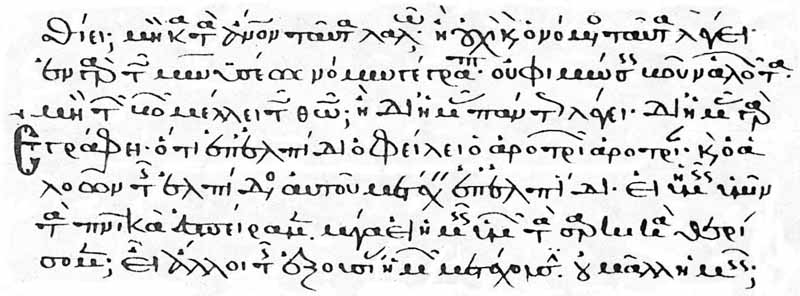
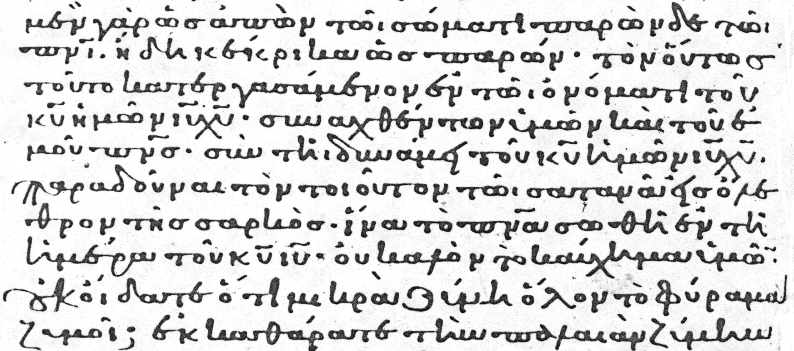
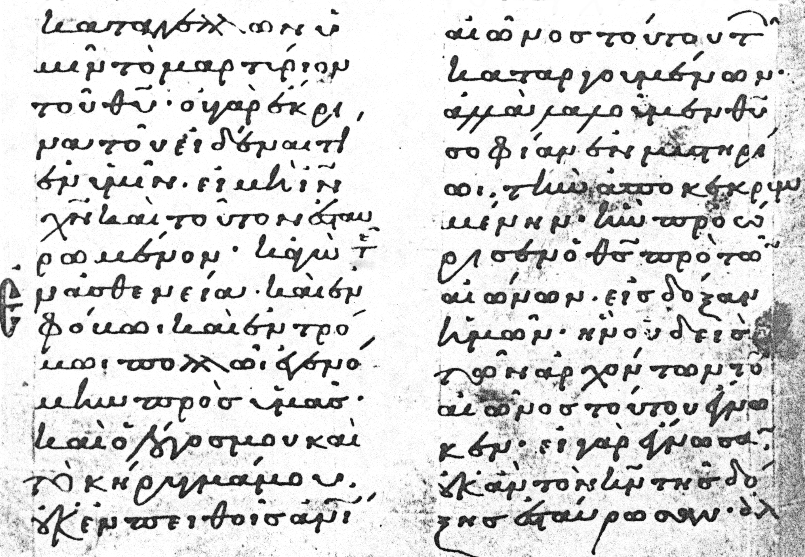
MS 927. I Corinthians 9:8-12. date A.D. 1133.
...sqiei? mh kata anqrwpon tauta lalw h ouci kai o nomoj tauta legei.
en gar tw Mwusewj nomw gegraptai ou fimwseij boun alownta.
mh twn bown mellei tw Qew? h di hmaj pantwj legei. di hmaj gar
Egrafh oti ep elpi di ofeilei o arotriwn arotrian. kai o a
lown thj elpidoj autou metecein ep elpidi. ei uÌmeij umin
ta pneumatika espeiramen; mega ei hmeij umwn ta sarkika qeri
somen? ei alloi thj exousiaj hmwn metecouisin; ou mallon hmeij
--- Thank you David Robert Palmer, for your correction! and your sharp eye! ---
The film of the above manuscript is available from the Library of Congress. The
actual manuscript is currently lodged in the J. Paul Getty Museum in southern California,
where for all intents and purposes it is inaccessible.
Just below the image is a transcription (with the ligatures "resolved")
of the numerous tachygraphical forms seen in the seven lines as shown of this minuscule:
Much can be discerned from just this small sample. Note that this scribe
used a low dot for a comma, he occasionally spells phonetically mellei for melei, it is also
apparent that he is an expert scribe. In fact we have several of his works surviving.
Certain ligatures can signal much information. An expert palaeographer can determine which
school of writing the scribe was trained in, and can often determine where the scribe was
trained. Several scriptoriums were famous for their styles, this present writer finds
the scriptorium at the Grottaferrata (north of Calabria, in Italy proper), to be of
great importance, it had a wide influence on the writing styles seen in numerous
minuscule manuscripts of the New Testament.
One interesting, and fairly common mark is the double "slashes" seen above
the mh in line #1. No one knows for sure its exact meaning, but the late
Professor John Chadwick of Cambridge, suggested to me that it may just indicate
a pause before the word, or that it affected the pronunciation. Whatever its
precise use, it does not affect the semantics.
Other scriptoriums which leave marks and clues
via their scripts and styles are (in or at): the Stoudios, Sicily, Laconia, Rome,
Calabria, Capuae (and Grottaferrata), Athos, Crete, Cyprus, Chalce and others.
Below are a few samples of ligatures, as seen in MSS (in particular in the text of I Corinthians)
of the NT. Other such charts can be found in the standard works on Greek palaeography.*
It is suggested that you make your own charts as you study each MS. To accurately read or collate
Greek MSS which contain numerous tachygraphical conventions, the critic MUST be familiar
with this type of writing.
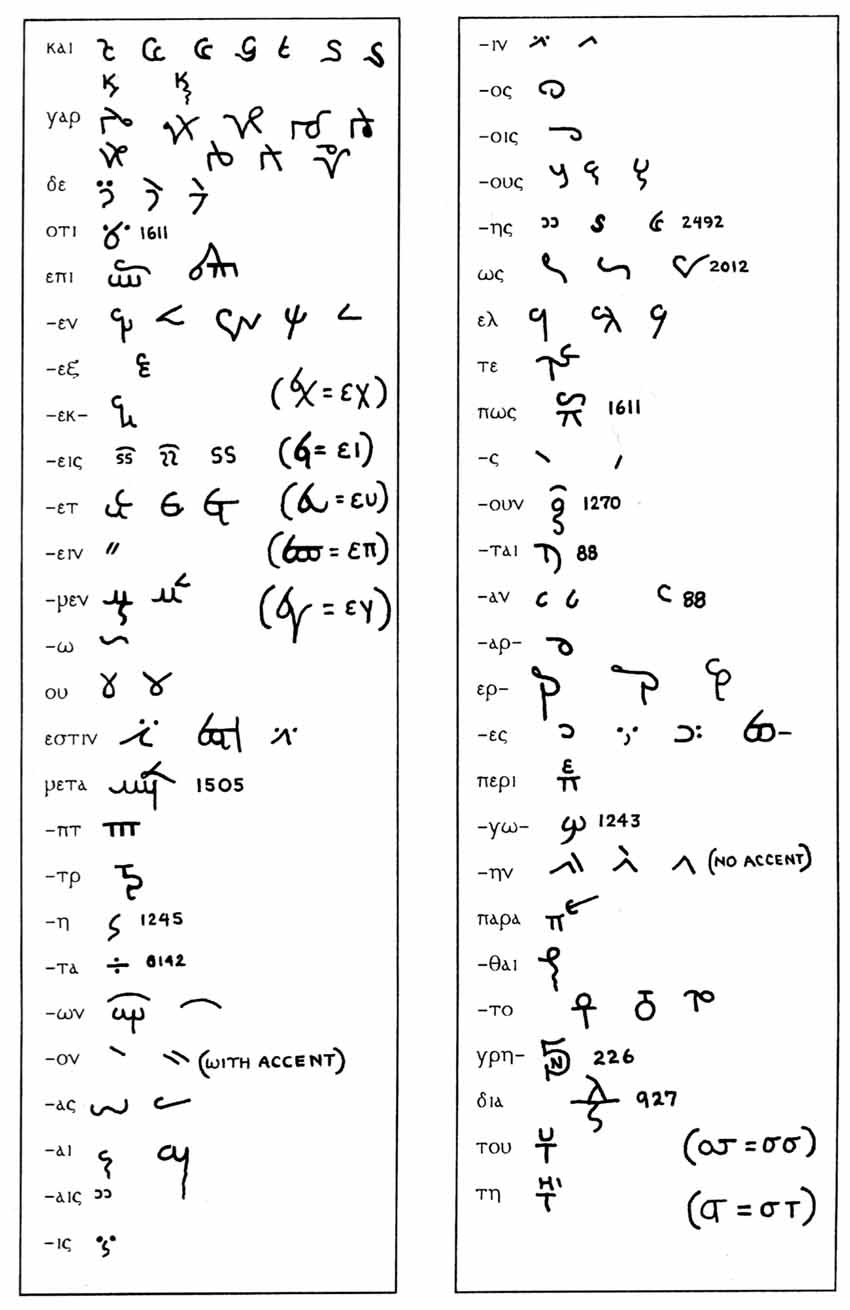
In the above, several numbers after some forms are seen, these are the
Gregory numbers of the MSS which display that form.
|
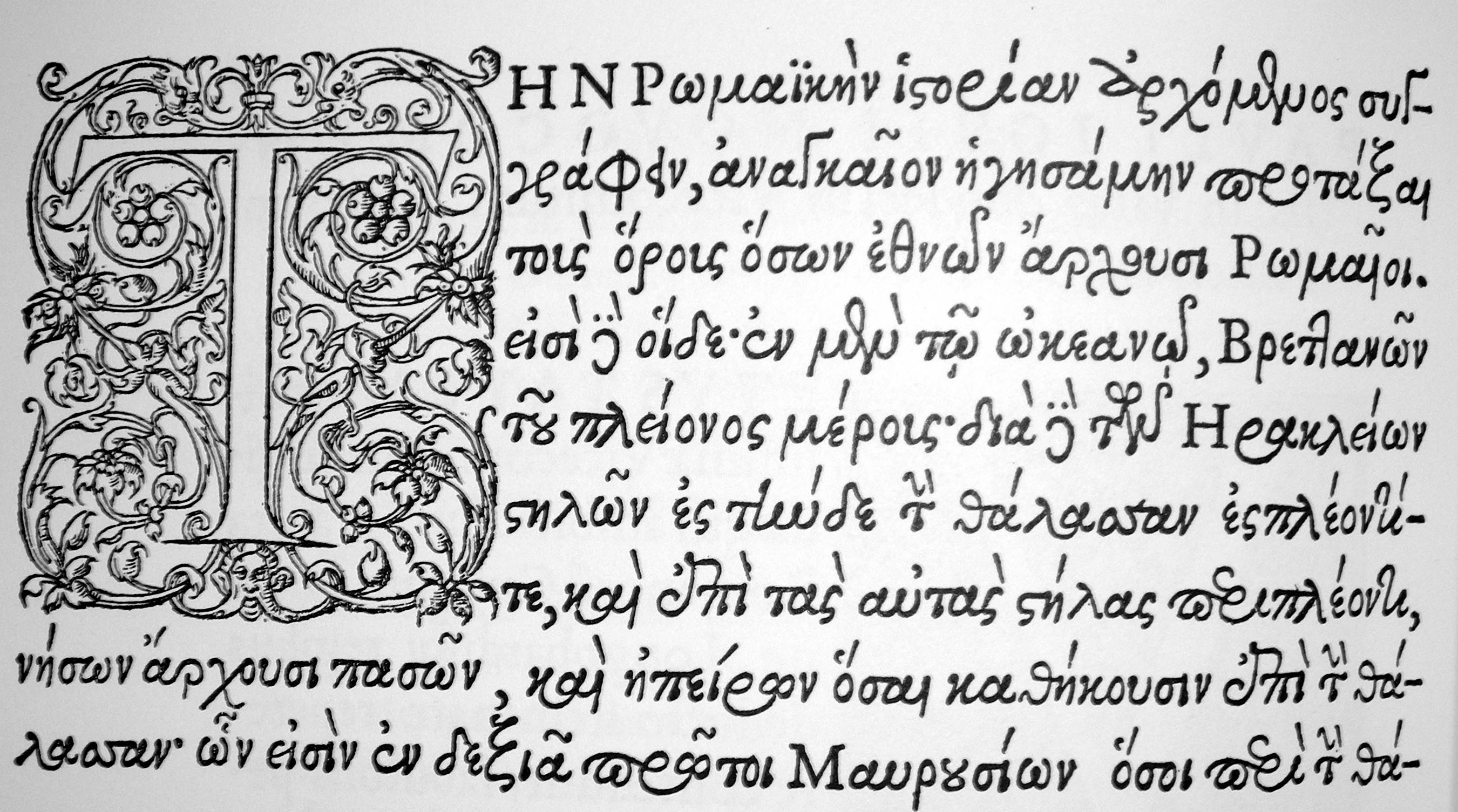
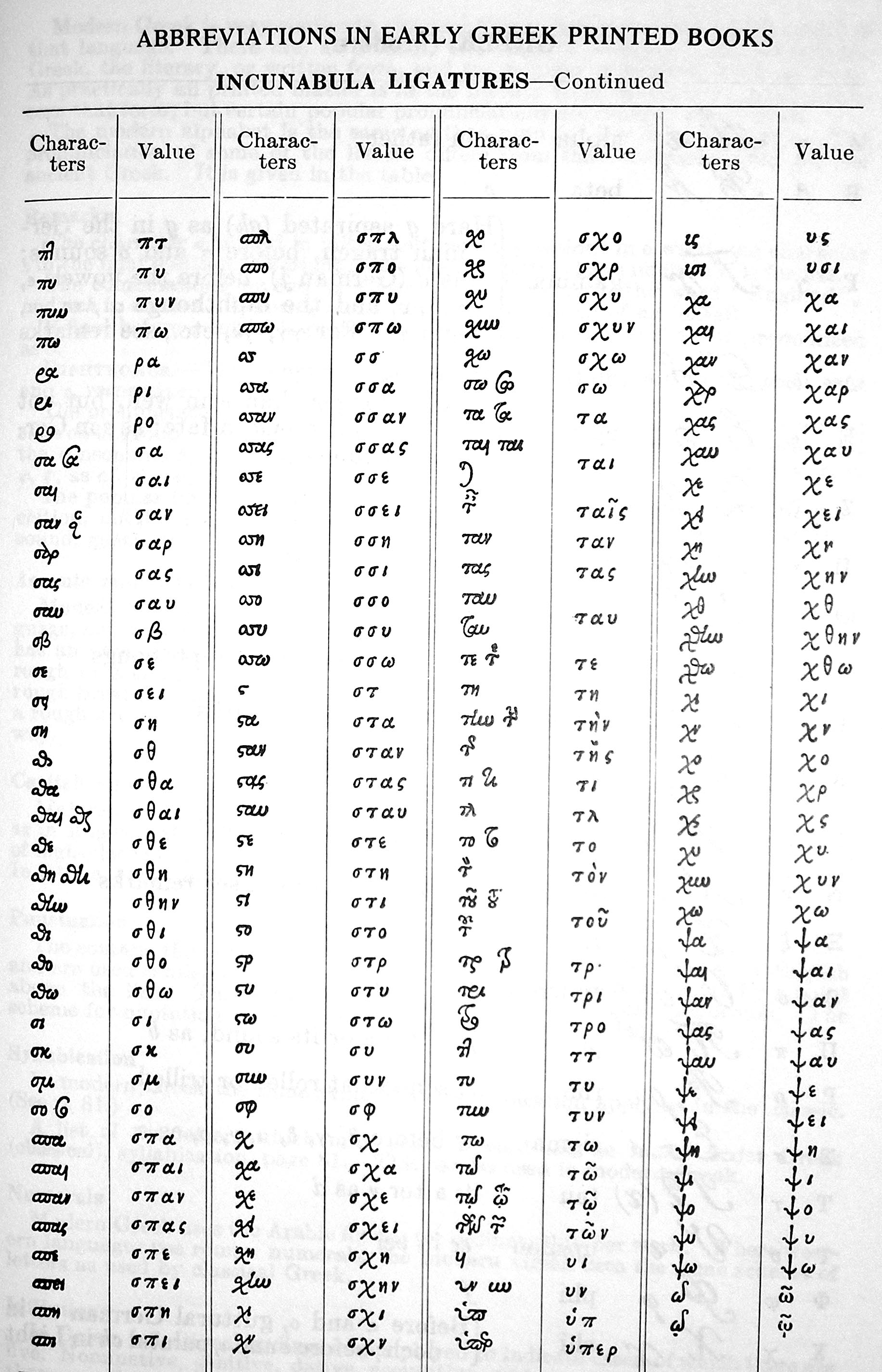
EARLY PRINTED
GREEK LIGATURES
|
|
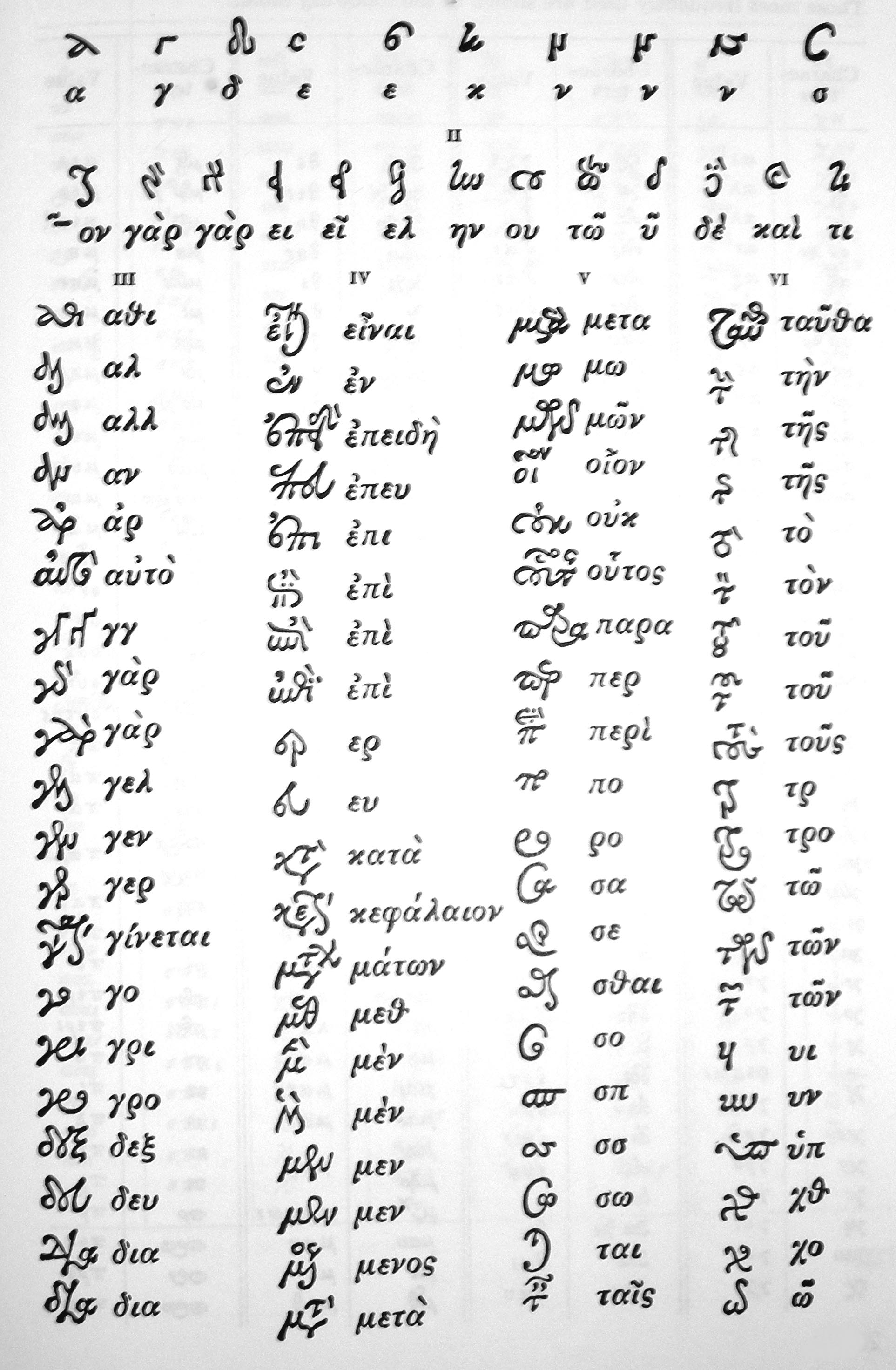
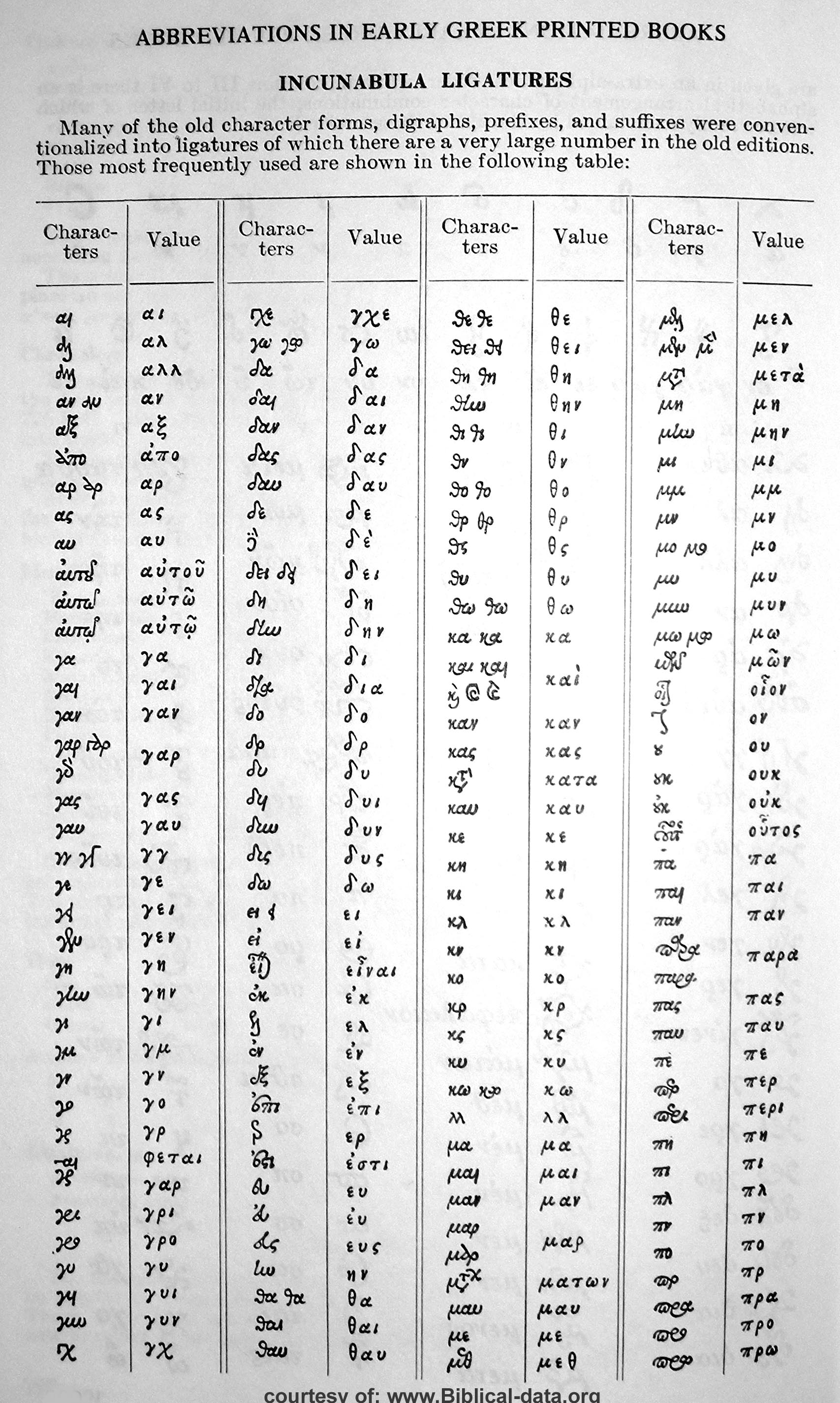
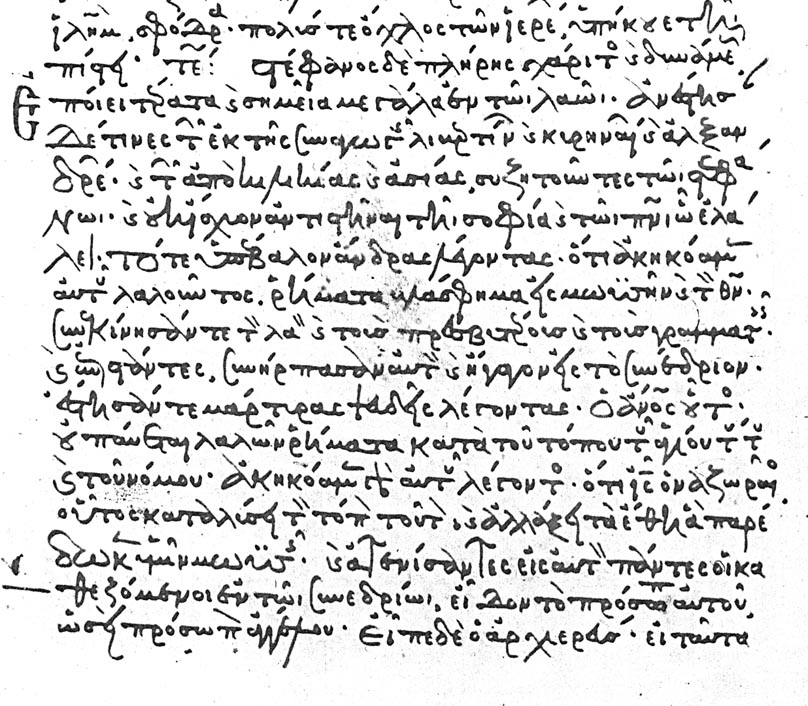
In 1541 early typographers strived to reproduce the beauty of handwritten manuscripts, thus they copied certain exemplars as best as they could. The above copy of a copy, is of the famous "Appian Alexandrini Romanarum Historiarum" printed in Paris in 1551 by the Estiennes. The font was cut by Garamond. Many judges consider this one of the best Greek fonts ever cut! It also contains the fullest assortment of Greek ligatures of any other known cut font. The font is called "Grecs du Rois". Garamond carefully copied the handwriting of the professional writer - Angelos Vergetios. As time passed, the number of ligatures diminished, readability improves and we evolve to the present state where few if any are employed today.
However, to assist those who may have some difficulty reading older printed Greek New Testaments I supply the images below. Thumbnails are included so that you can click on the thumbnail and download the image, to print.
|
* perhaps still one of the best (though dated) resources for ligatures and abbreviations in the Greek
manuscripts would be:
Abbreviations in Greek Inscriptions: Papyri, Manuscripts, and Early Printed Books.
compiled by, Al. N. Oikonomides. Reprinted by Ares Publishers, Chicago, 1974
Microsoft® has made available as a free download a PDF file with a portion of this
volume, that one wherein minuscule tachygraphical forms and ligatures are indicated.
By no means comprehensive, but covers many forms especially of the
South Italian scriptoriums. Click title to download PDF file:
file is a PDF of about 3.5 MB

ESTIMATING THE DATE OF A MINUSCULE
NEW TESTAMENT MANUSCRIPT
This is not meant to be an exhaustive treatment, but just a collection of tips which can assist with
the estimation of the date of various minuscule manuscripts of the New Testament.
It is probably best to divide the minuscule manuscripts into several time periods, each with some basic
identifiers. One common division (W.H.P. Hatch) is to break up the mass of surviving
minuscule witnesses into four periods, based solely upon the scripts:
|
HATCH'S PERIODS |
SAMPLE |
SAMPLE |
|
(1) FIRST PERIOD:
|
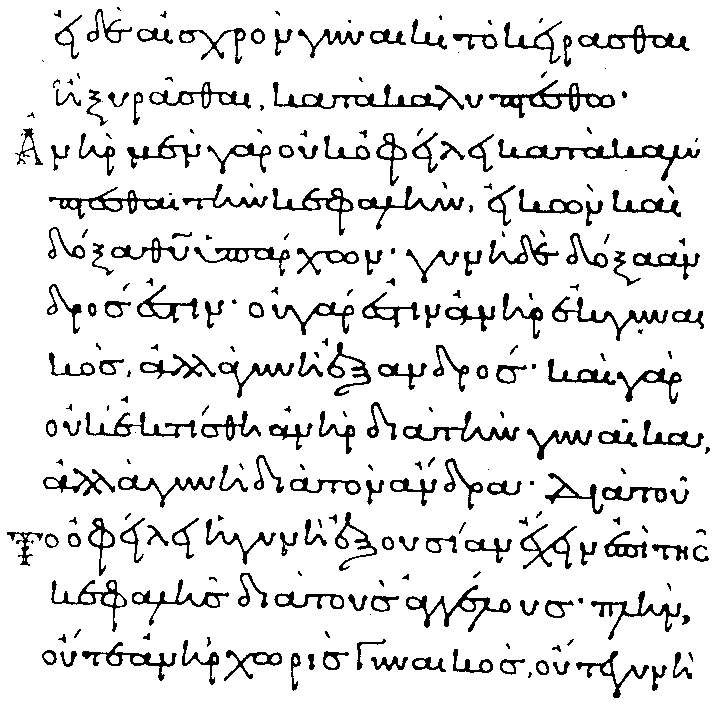 MS 1900-circa 875 |
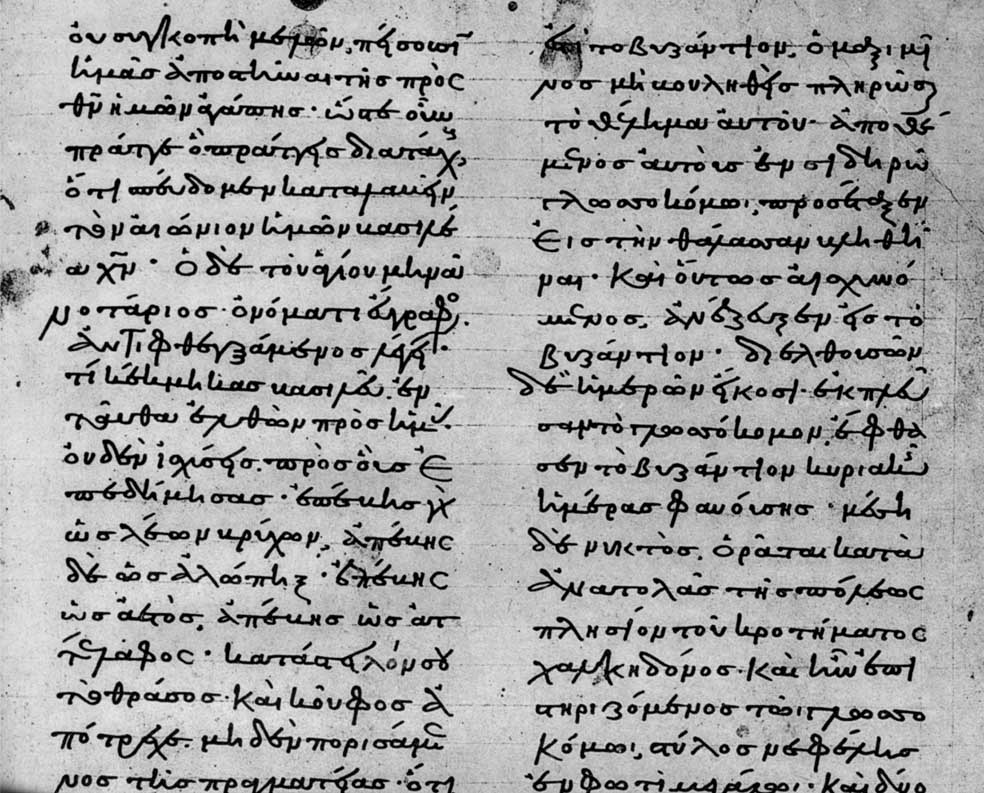 Homily-dated 1004 |
|
(2) SECOND PERIOD:
|
 MS 1270-circa 1050 |
MS 1734-dated 1015
|
|
(3) THIRD PERIOD:
|
|
Aland's date for this MS (945) is an error: it is not 11th century. There is seen, in another later hand, a brief note dated at A.D. 1591 on folio 344v. |
|
(4) FOURTH PERIOD:
|
 L 1029-dated 1594 |
A lectionary MS, now in Walters Art Gallery, MS #535. |
Several of the dates extend beyond Hatch's as the styles are known
to linger. William Henry Paine Hatch's entire comments can be
found in his: Facsimiles and Descriptions of Minuscule Manuscripts
of the New Testament. Harvard University Press, 1951.
Besides the above few tips, the style of the ornamentations and of the illuminations (if present)
can also add dating data, which is the subject of the next page - (below, which is being created).
The liturgical apparatuses also add hints: some calendars mention various
"saints days" which can play a factor in
dating a text, especially if the liturgical apparatus
is current with the production of the primary Biblical text.
Certain ligatures and letter forms, themselves, can also serve to validate a dating estimate.
A certain style (or, ductus) as shown in the above samples, also suggest a date.
It should be borne in mind, that we are attempting to estimate the date, so we are
looking to be within 100 years of the actual date. Such estimates are often easy to make.
However, some scripts are so singular
and devoid of hints, that an estimate based upon the script
is a total conjecture, of course in such cases other factors are considered.
OTHER DATING FACTORS: illuminations,
and ornamentations.
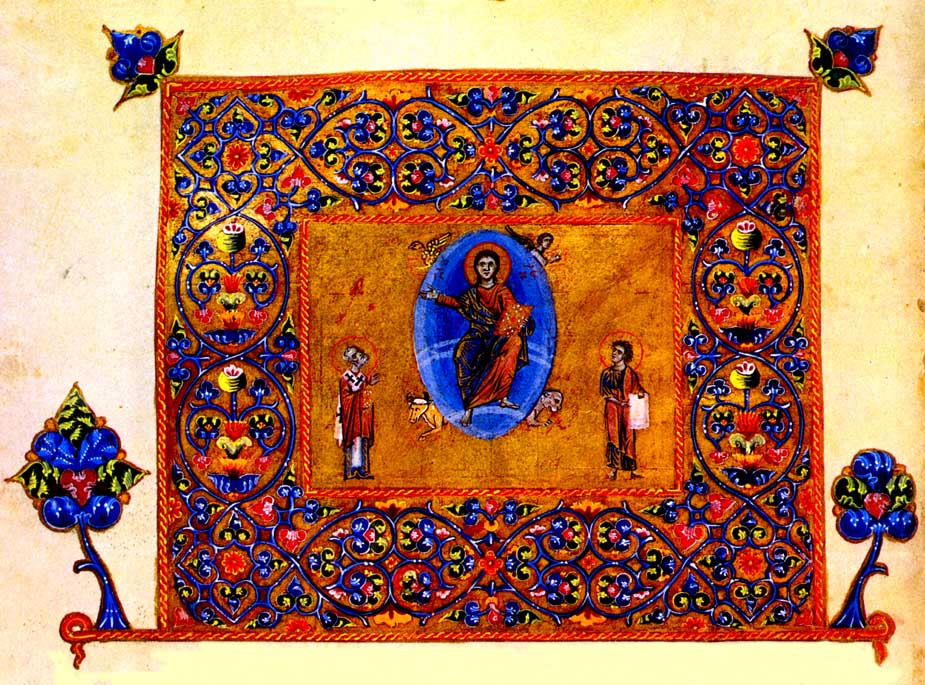
We begin with viewing an image. An image taken from a Greek manuscript,
Sinai 339, dated to about 1136-1155. It consists of 16 Liturgial Homilies of
Gregory of Nazianzus. The monk who created the beautiful manuscript was
Joseph Hagioglykerites, and it was made apparently at the Pantocrator in
Constantinople. In 1550, it was brought to the Monastery at Mt. Sinai. It is
featured in: The Monastery of Saint Catherine at Mount Sinai; The
Illuminated Greek Manuscripts. Volume One: From the Ninth to the
Twelfth Century. Kurt Weitzmann and George Galavaris. Princeton
University Press, 1990. In this work it is MS # 56.
I reproduced a portion of this image from the above publication, (hopefully
under fair use). I selected this color image for one primary reason. It is a fine
sample of the artwork seen in typical Constantinopolitan ateliers. Thus, it
is presented so that the viewer can see the rich colors and the detailed
art work. These colors and their fine craftsmanship are important features of manuscripts
produced in Constantinople, or by an artist trained in Constantinople.
The bright blue, and bright gold colors are seen in the best of the
manuscripts produced in Constantinople. Their quality provides a clue as to
the origin of any manuscripts with such illuminations!
CLICK ON THE THUMBNAIL TO VIEW THIS GLORIOUS SAMPLE: