A selection of sample images, and a few of archaeological interest. Some of these
sample images are seen in numerous and multiple publications, I try to give
credit, but some have been on file for so long I cannot recall
where the sample came from! Items specifically dated show the dates in BLUE bold type.
|
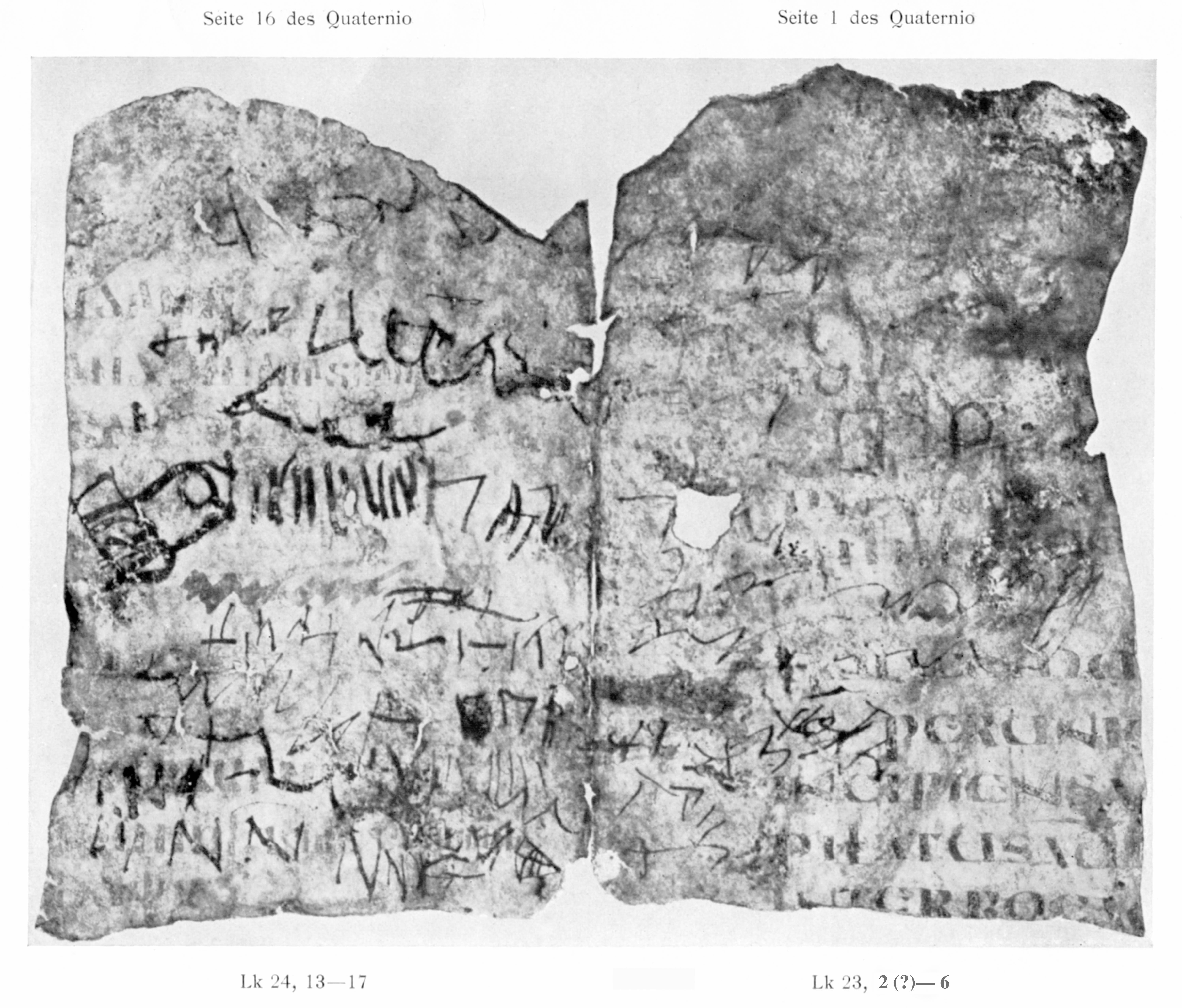
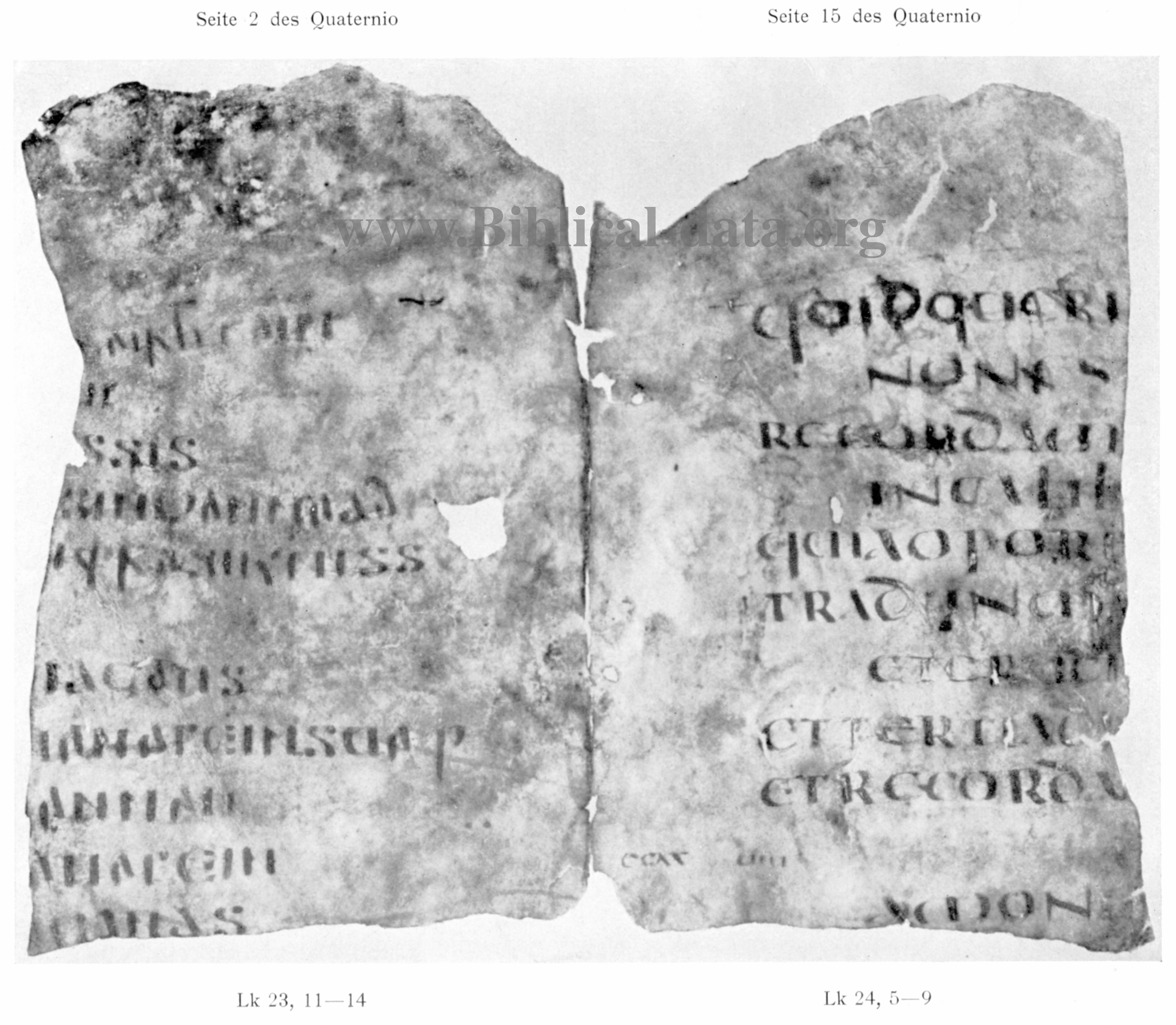
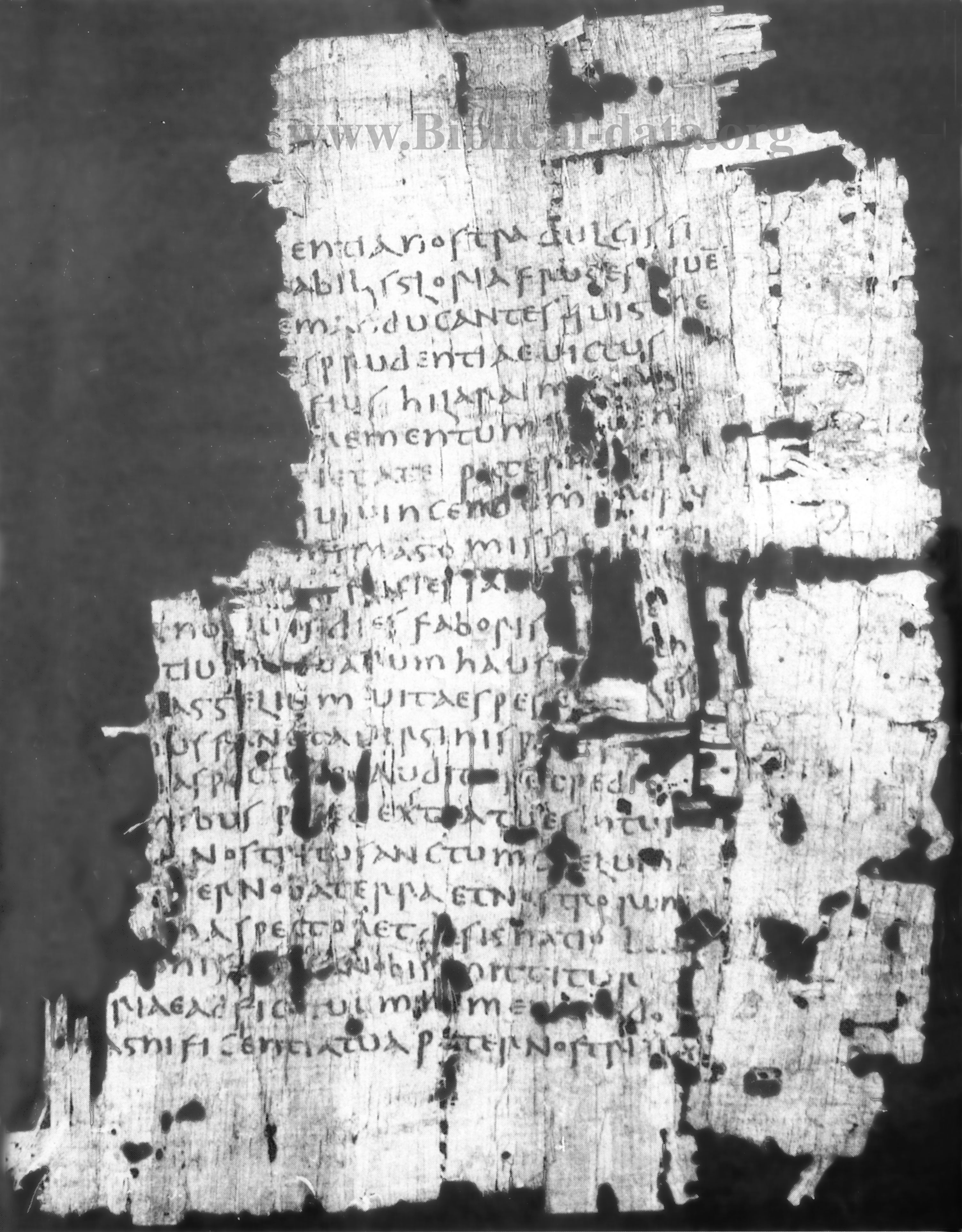
Giessen Fragment. Gothic-Latin bilingual. DATE: circa A.D. 450. Provenance: a village near Antinoë, Egypt. Parchment. Luke 23:11-14, and on the verso, 24:13-17 [for the Gothic], the Latin displays Luke 23:3-6 and 24:5-9. Text is Old Latin. A very interesting fragment, which fragment is now lost. During WW II, it was completely destroyed in a bank vault it was placed in, water seepage did the deed. These images are all we have left! (Lowe has also a script sample, viii, 1200). it seems that a child practiced some writing on the recto side. This is also a rare sample of a Gothic text without being a palimpsest. (Images exclusive to this site). Diessman reminds us that Frankish soldiers did visit Egypt. This fragment bolsters Burkitt's contention that the Latin texts developing in N. Italy were impacted by the Gothic version! The Latin script seems to have been executed by an Egyptian scribe in my opinion! Text and transcription, available on my main Latin page.
|
|
|
John Rylands, Papyrus 472. DATE: circa A.D. 350. Provenance: probably Egypt. Liturgical text. According to Bischoff this presents an old "eastern half-uncial" type of Latin script. Now resides in the Rylands Library, Manchester, England. [image sample from Bernard Bischoff, Latin Palaeography: Antiquity & the Middle Ages. Translated by Daibhi O Croinin & David Ganz. Cambridge University Press. 1990].
|
 |
|
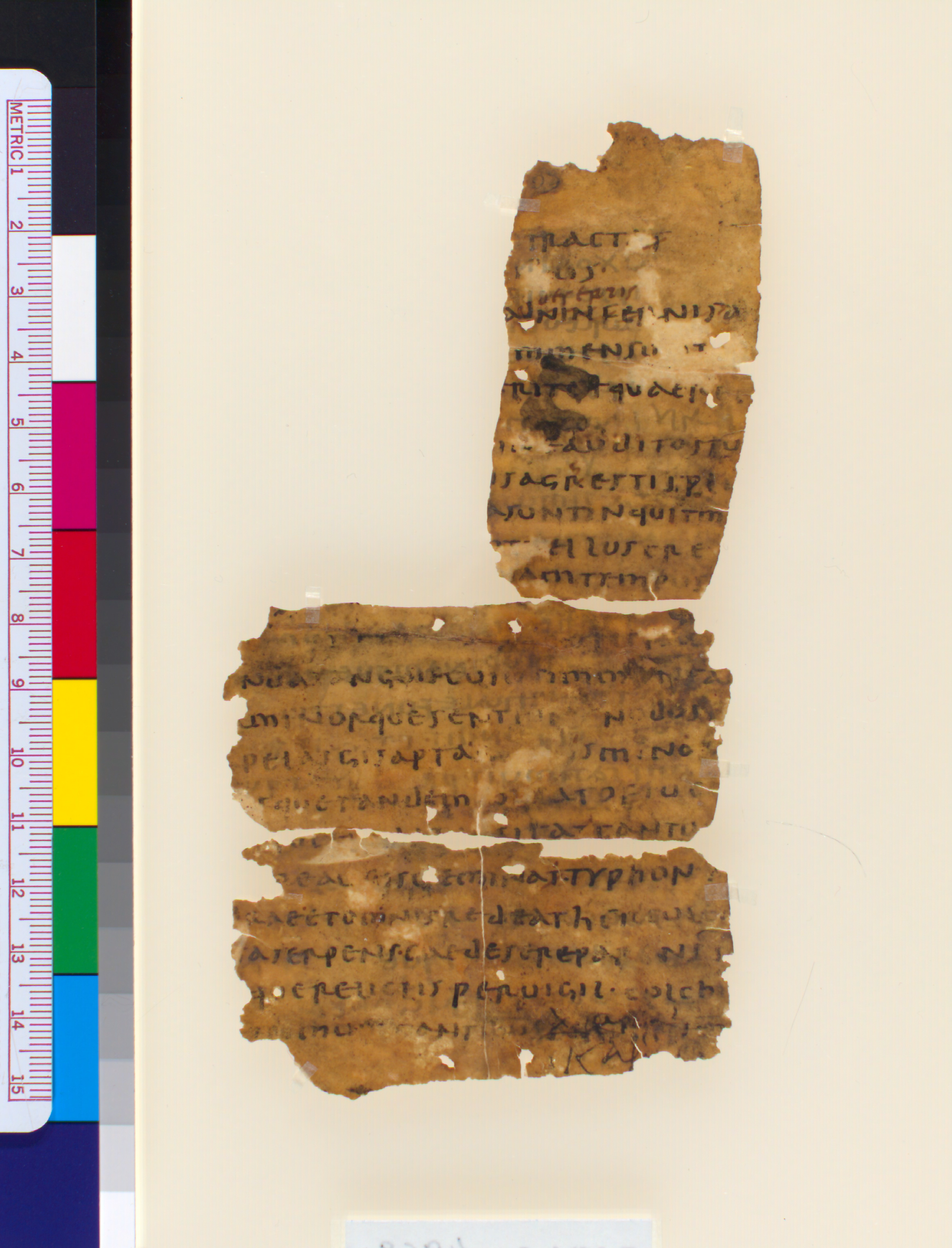
P. Michigan 4969. Seneca, Medea 663-704. DATE: circa A.D. 350. Provenance: probably Egypt. Parchment.
This
sample borrowed from the APIS database (on-line, Michigan.APIS.2364),
I only display one side here. Which side shows also some corrections
in a lighter rust colored ink. |
 |
|
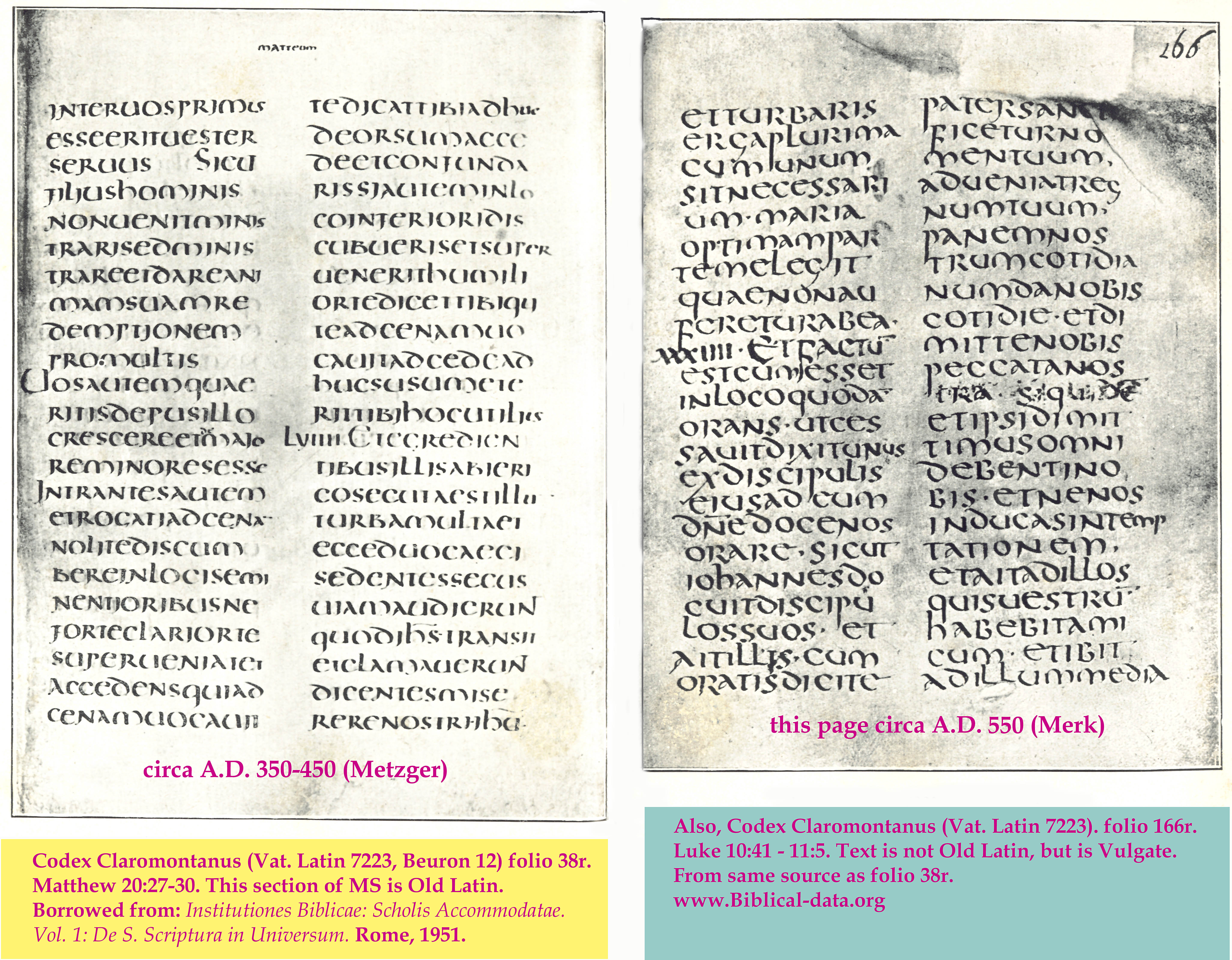
Codex Claromontanus, Vatican Latin 7223, Beuron 12. DATE: from A.D. 350 to 550 (see image). Sample images are from the gospels of Matthew and Luke. Credit on image. Matthew is of the Old Latin text.
|
 |
|
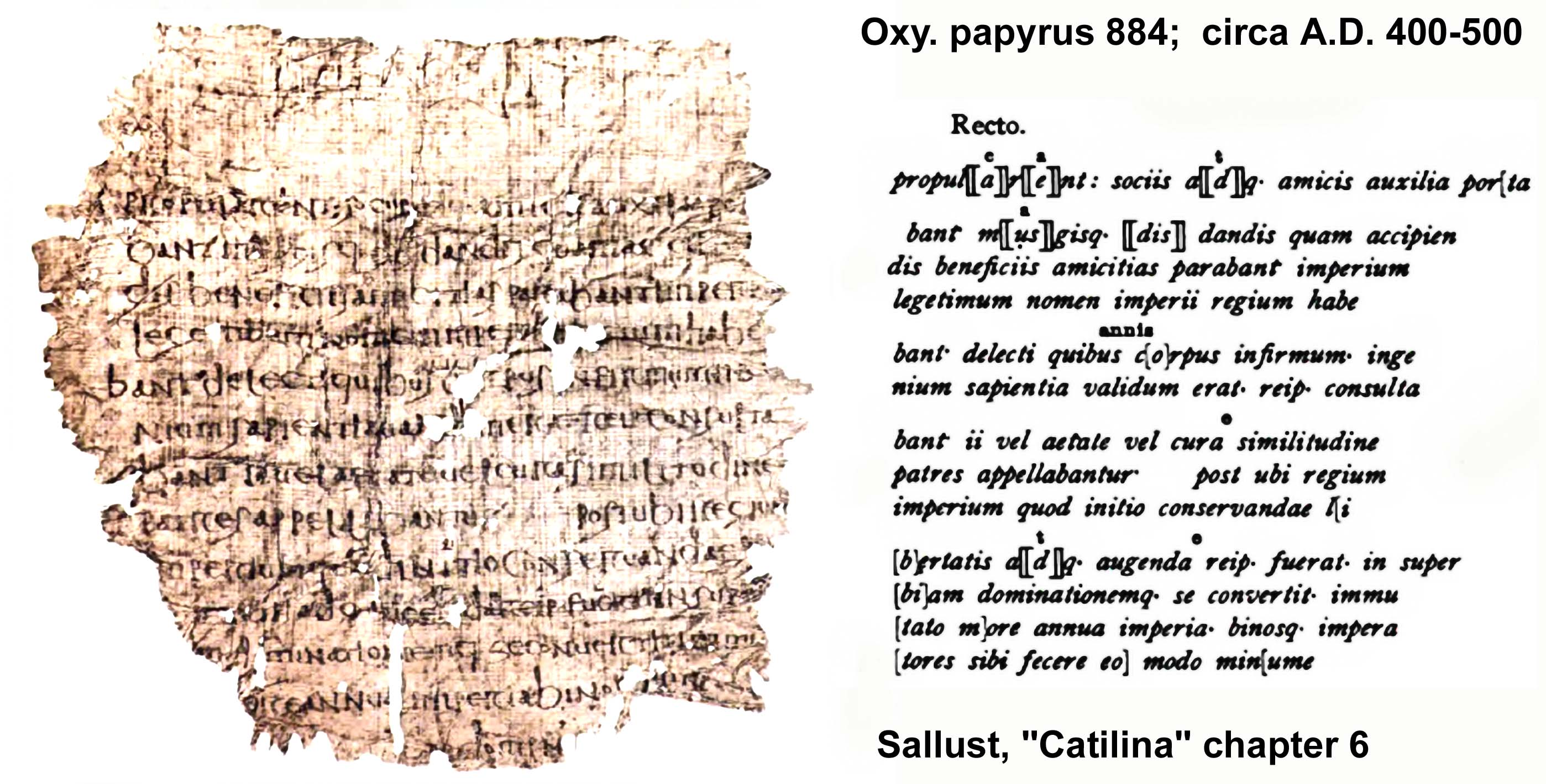
Oxyrhynchus papyrus 884: Sallust, "Catilina" chapter 6, recto. DATE: 5th century. Recto side of a single leaf, from a CODEX. Script has numerous cursive aspects. Leaf measures 15.8 x 15.4 cm.. Transcription and sample image is from the Grenfell/Hunt publication, Oxyrhynchus Papyri, part VI, of 1908. Not many Latin papyri found in Egypt contain classical texts as does this fine sample!
|
 |
|
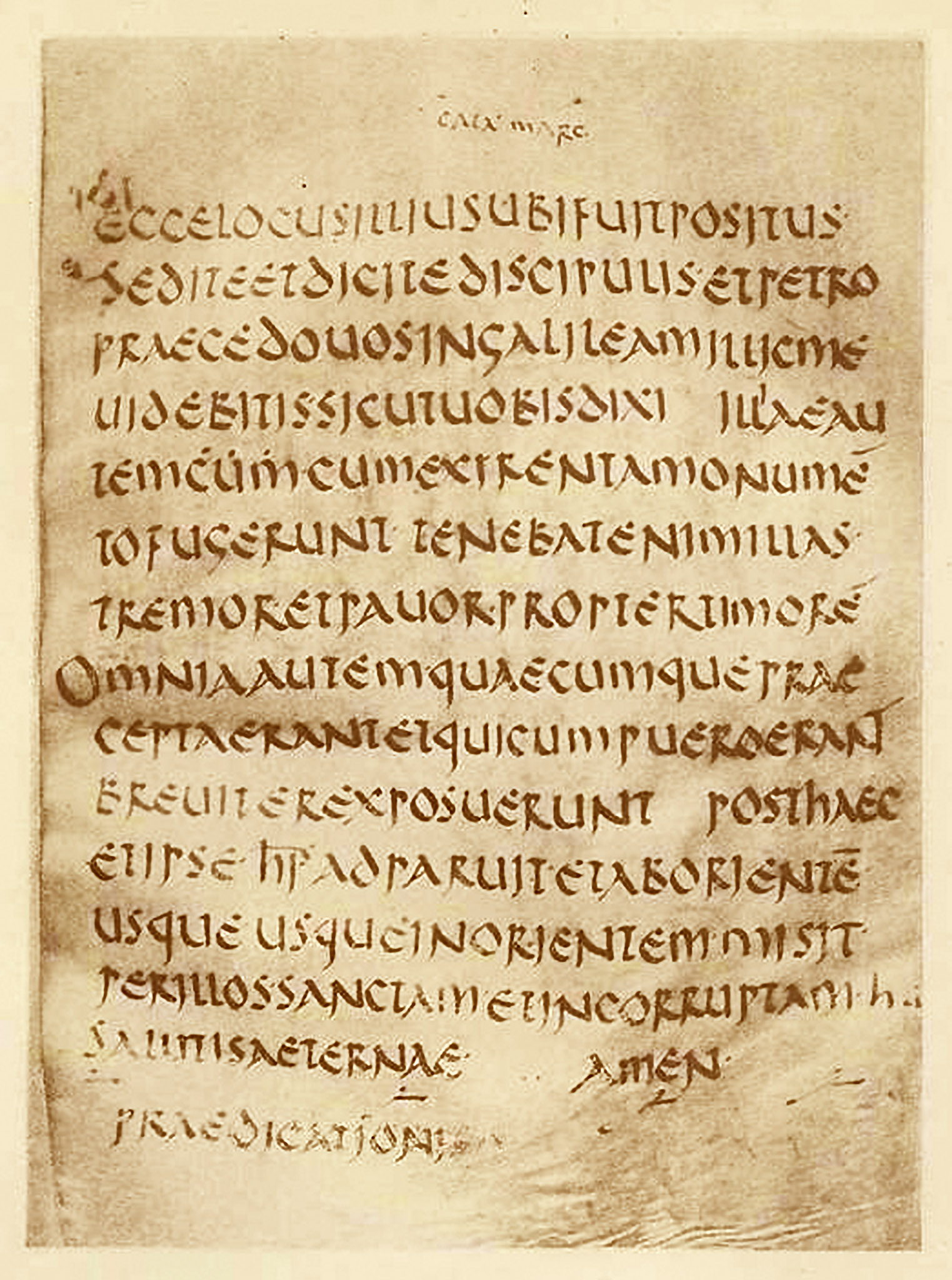
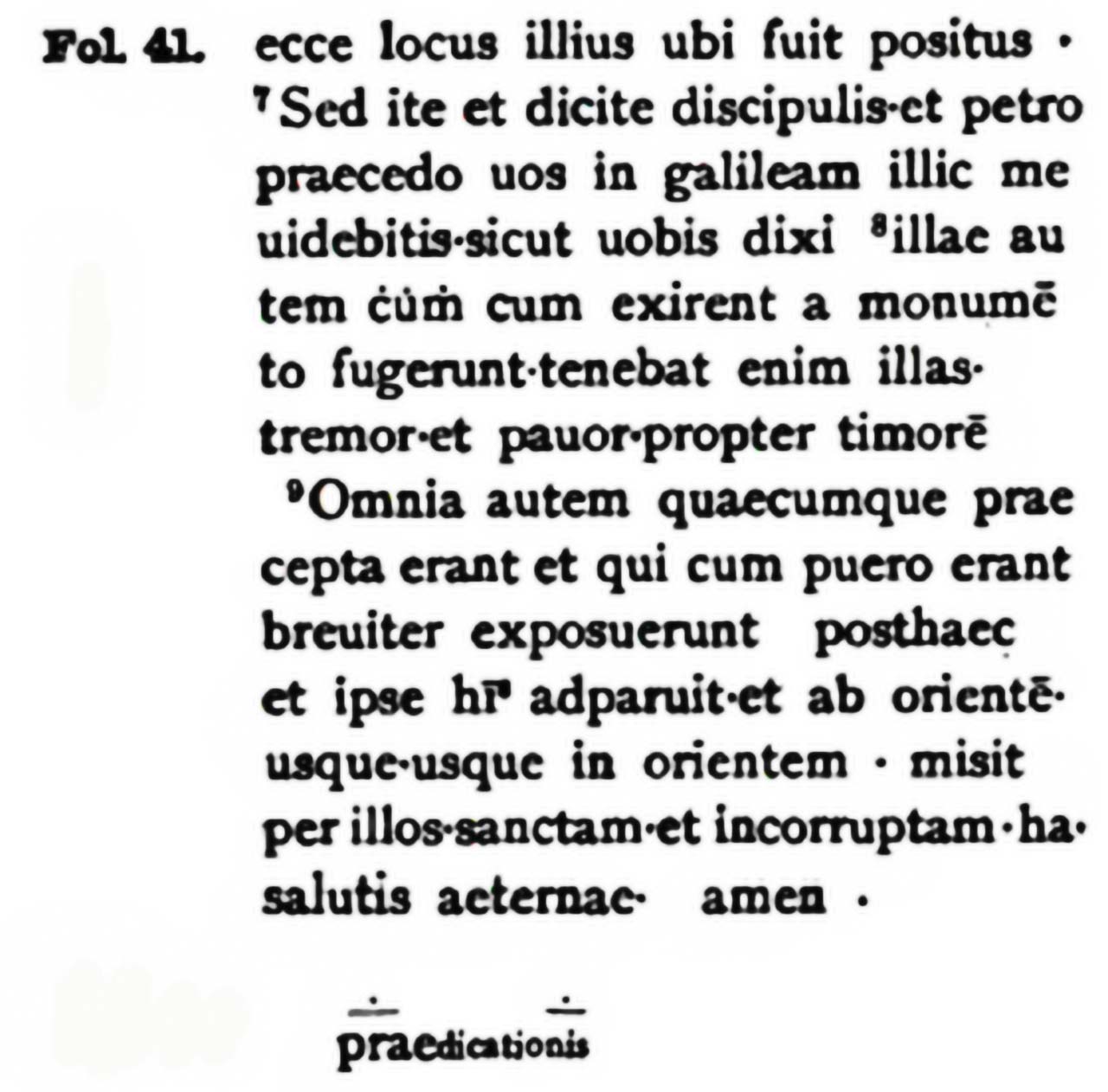
Codex Bobiensis (Beuron 1): DATE: circa A.D.350. Contains portions of Mark and Matthew, having a total of 96 pages. Text is Old Latin. A notable witness to the African type of Latin manuscripts. Apparently made via an Irish monk who left it to the Bobbio Monastery in N. Italy upon his death. A very important manuscript illustrating the very literal translations made before the Jerome/Vulgate recension. Note the form of the "A", its pinched bowl is similar to those seen in the later manuscripts of Tours, France; though these in Bobiensis are simpler and older.
|
transcription of sample (ending of Mark) |
|
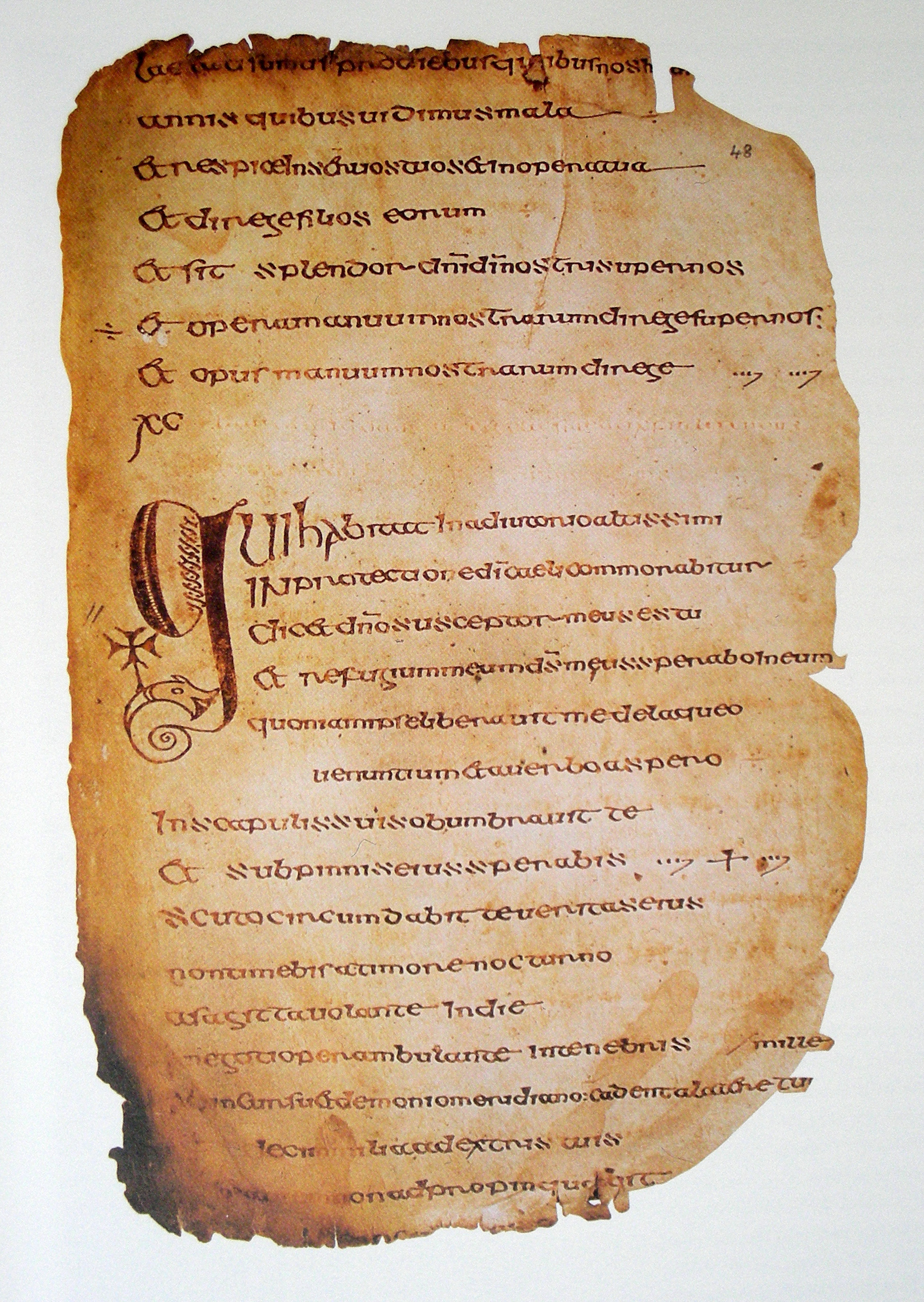
The Cathach of St. Columba: Dublin, Royal Irish Academy, s.n., folio 48r. DATE: circa A.D. 625 Sample image shows beginning of Psalms 90. A manuscript often thought to have been written by St. Columba. An example of very early Irish writing (here Insular half-uncial script). Note the cross attached to the enlarged initial, it is very similar to crosses seen in the Book of Durrow. Both MSS have the typical habit of Irish scripts in that the letters begin large and gradually diminish in size, known as diminuendo motif. According to Julian Brown, these enlarged initials in the Cathach are "proof positive that Italian influence did reach Ireland by the middle of the seventh century". [A Palaeographer's View; The Selected Writings of Julian Brown. pp. 193 f.. 1993].
|
 |
|
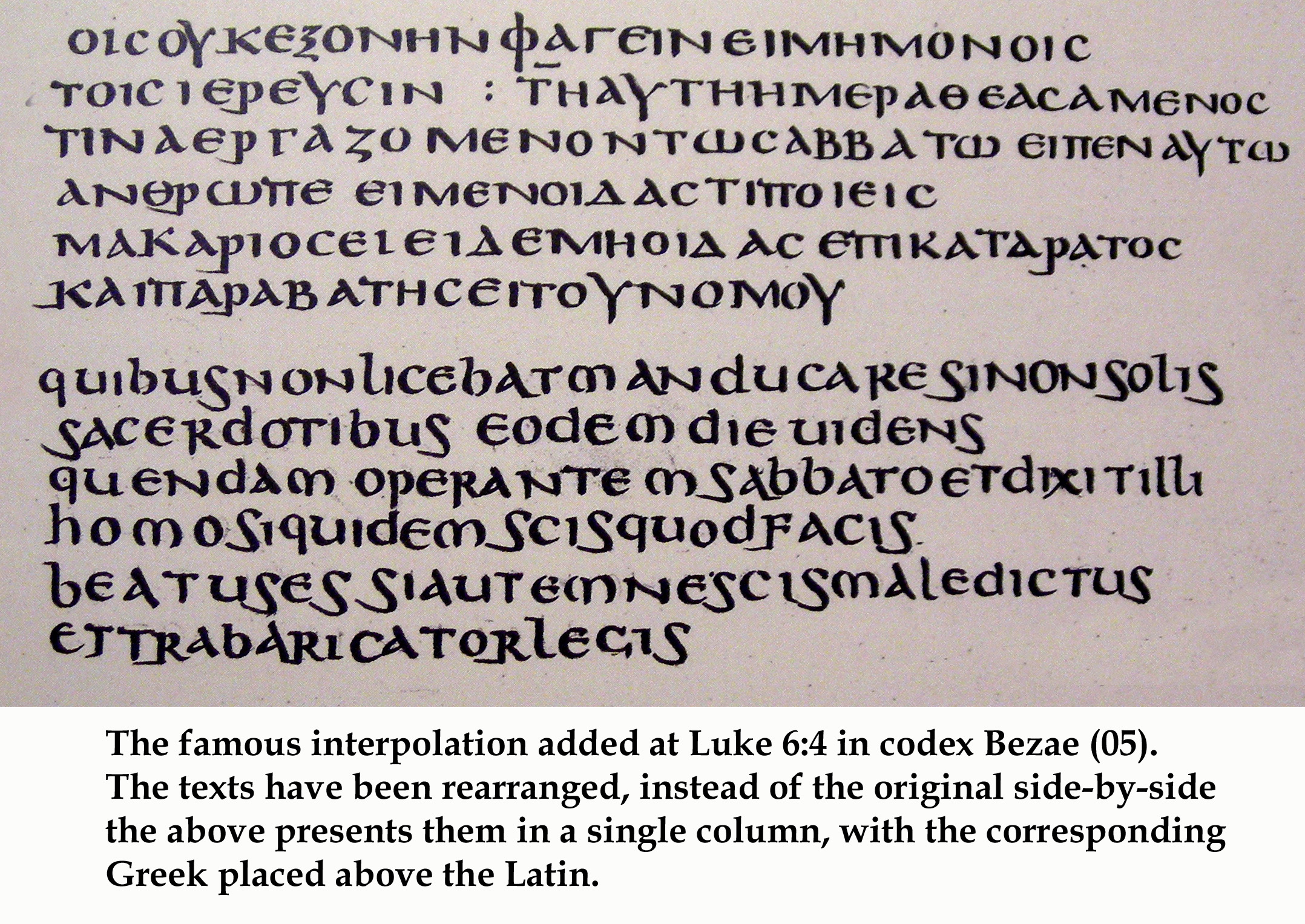
Codex 05, Codex Bezae. DATE: circa A.D. 350-600. Contains the Four Gospels and Acts, with one leaf containing I John 3:11-15. Beuron 5 Greek/Latin bilingual. Tons of literature available for this MS. Has gospels in the Western order, Matthew, John, Luke, Mark. Its Latin side is typically classed as Old Latin. In the sample image, I rearranged the texts so that you can easily view the two scripts. No one knows where it was written. Greek and Latin texts are on opposite pages, [the sample image says "side-by-side" but actually on opposite pages] written in sense-lines. Aland suggests North Africa or Egypt as origin locale, I agree. Mercati (J.T.S. vol. XV, 1914) argues convincingly, that it was not produced in a Greek scriptorium. I also suggest that the original Greek text of 05 was probably written by Dr. Luke and then annotated by Paul while in a Roman prison, when Dr. Luke visited him. Later, Paul's notes were moved into the main body by later copyists. (This is my theory).
|
 |
|
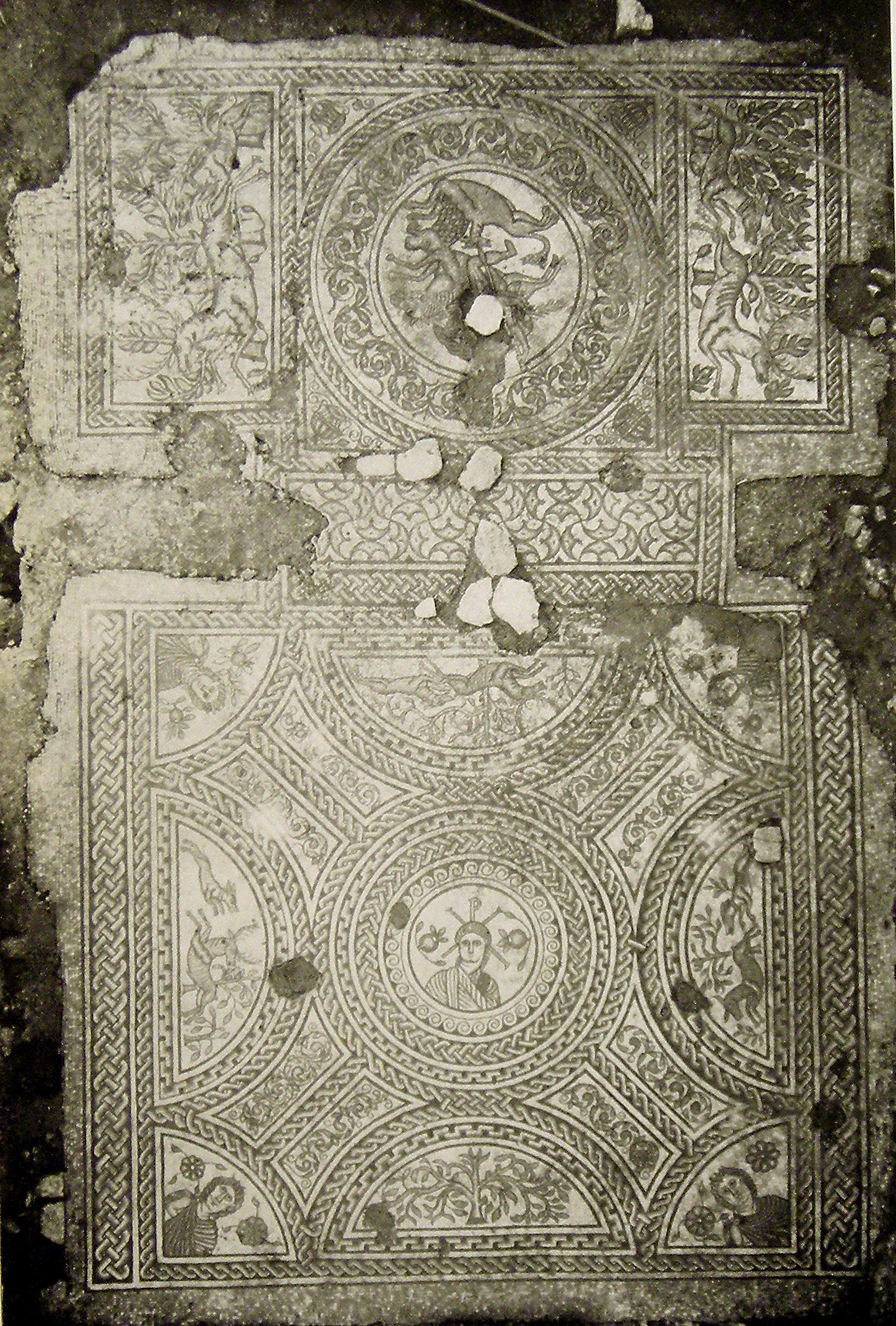
Mosaic floor: Dorset, Britain. DATE: circa A.D. 350 Perhaps little to do with Latin MSS, but this mosaic floor uncovered in England is amazing. Proof that Christians were living in Britain circa 350. Note the Chi-Rho symbol on/near the head of Christ.
|
 |
|
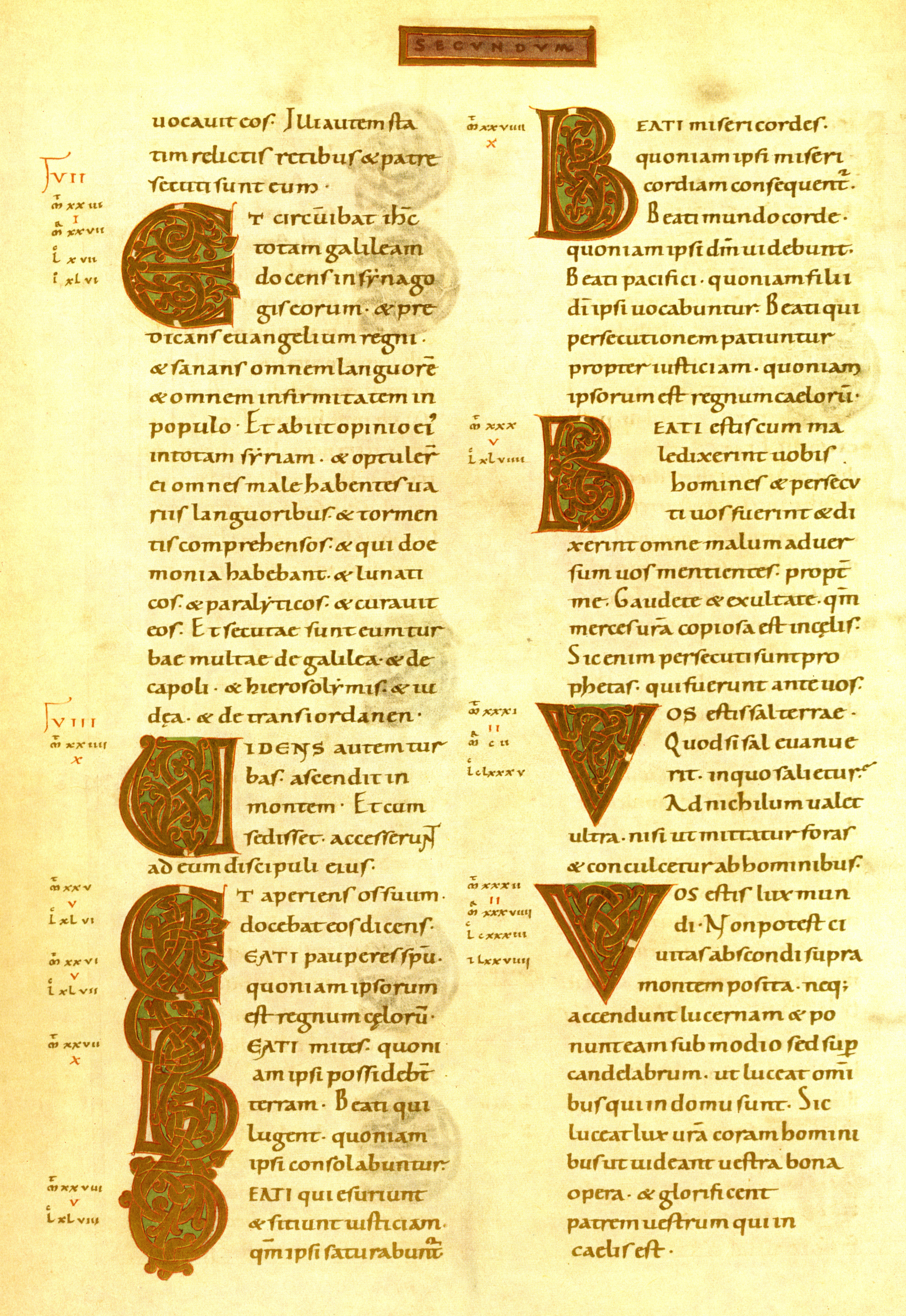
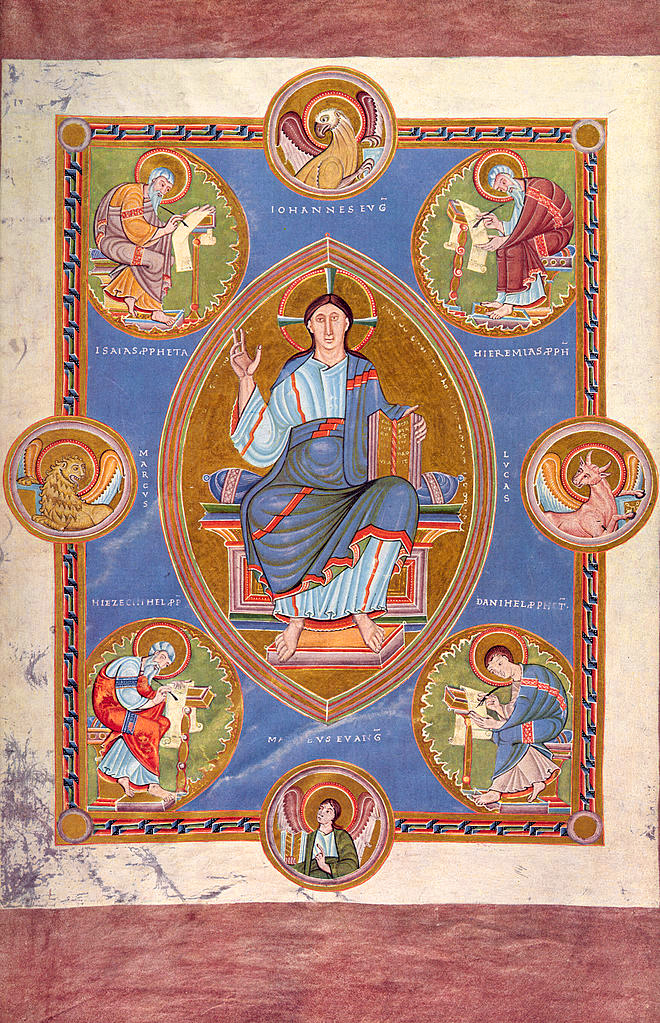
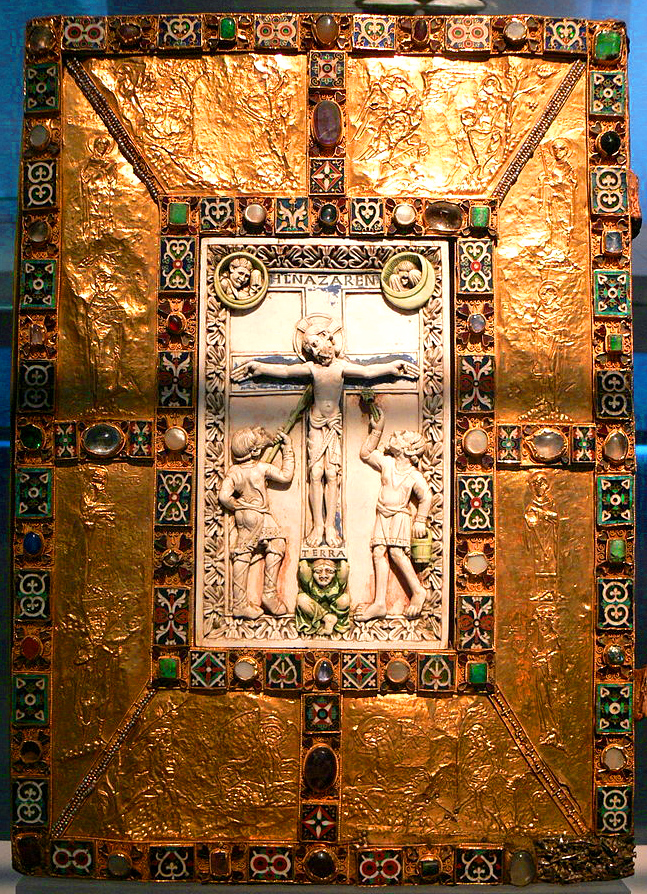
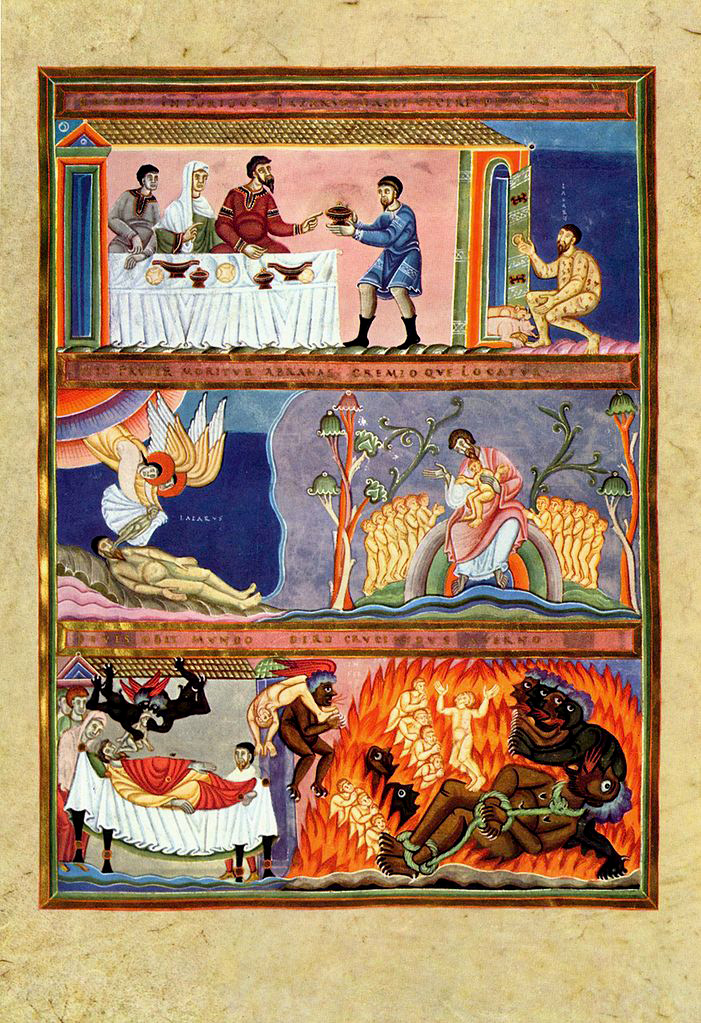
Codex Aureus Epternacensis. DATE: 1050 -1055 A.D. (per Metz). CONTAINS: Four gospels. In the Germanisches Museum, Nuremberg, Germany. Not to be confused with the other codices named Aureus or the Paris Epternacensis. This is a Latin manuscript with lots of gold in its images and ornate cover. A deluxe edition! and probably osculated by many of Europe's nobilities. Codex contains 135 pages. Parchment, size of page, 17 3/8 x 12 1/4. Commissioned by the Dowager Empress Theophano. Manuscript made in Echternach, Luxemburg (in eastern Luxemburg). The monastery was an Anglo-Irish foundation. However, this manuscript has major Byzantine affinities, as the Empress greatly emulated Byzantium, and possessed some of its artworks. The text varies somewhat from the Vulgate. The script is a very nice Caroline minuscule. Manuscript was partially reproduced in the work by Dr. Peter Metz, translated into English by Ilse Schrier and Peter Gorge. 1957. Title: The Golden Gospels of Echternach: Codex Aureus Epternacensis. The ornate cover was made earlier for another manuscript. The present manuscript was trimmed to fit this new reused cover, (i.e. some of the original jewels were removed and others added). Its existence validates the fact that even in a Latin (Benedictine) monastery, we can find not only Vulgate and Irish based works incorporating Old Latin MSS, but also Byzantine influences. Some of the readings seen in the manuscript reflect the Greek Byzantine text-type. Some of the full page images, on purple vellum, with lots of Gold foil, are beautiful Byzantine "images", as can be seen. The website below (in German) was the source for several of the images. http://de.wikipedia.org/wiki/Codex_aureus_Epternacensis
|
Matthew 4:21 - 5:16
cover |
|
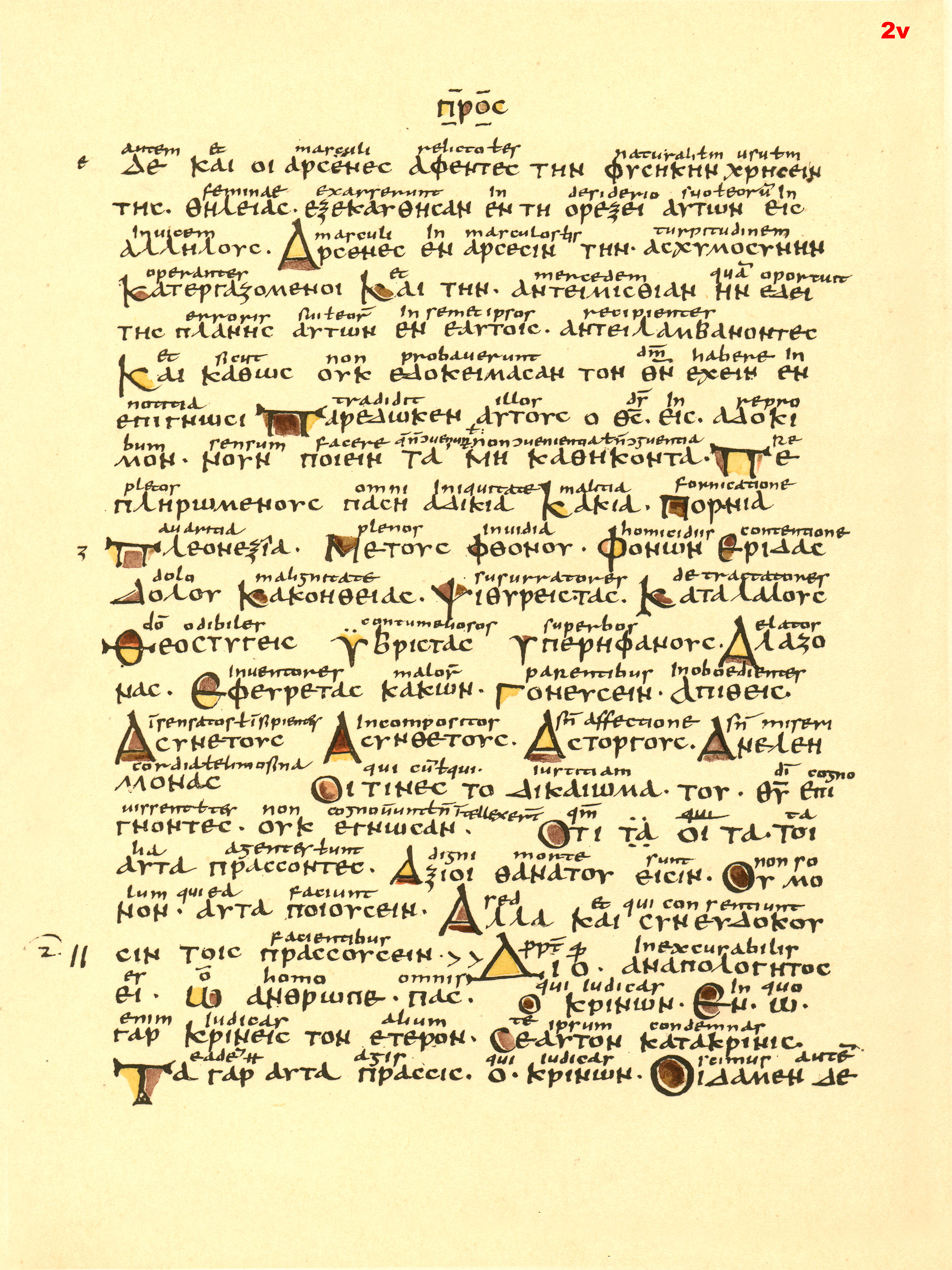
Codex Boernerianus (G, 012). DATE: circa A.D. 850. CONTAINS: Pauline epistles Beuron 77. A Greek/Latin bilingual MS. Probably copied or created in the St. Gallen monastery, and is (most likely) part of the Gospel Codex 037 [shown below]. Latin text is Old Latin, Greek text seems to be a translation of the Latin side (so thinks yours truly). Now lies in the Dresden Library, Germany. In my opinion, this is the best of the Latin bilingual MSS of the Pauline epistles, with a good O.L. text too. Complete manuscript available for viewing on the Center for the Study of New Testament Manuscripts website [www.CSNTM.org]. The MS, in its present water damaged condition, is also fully available for viewing at/on the Dresden website. http://digital.slub-dresden.de
|
|
|
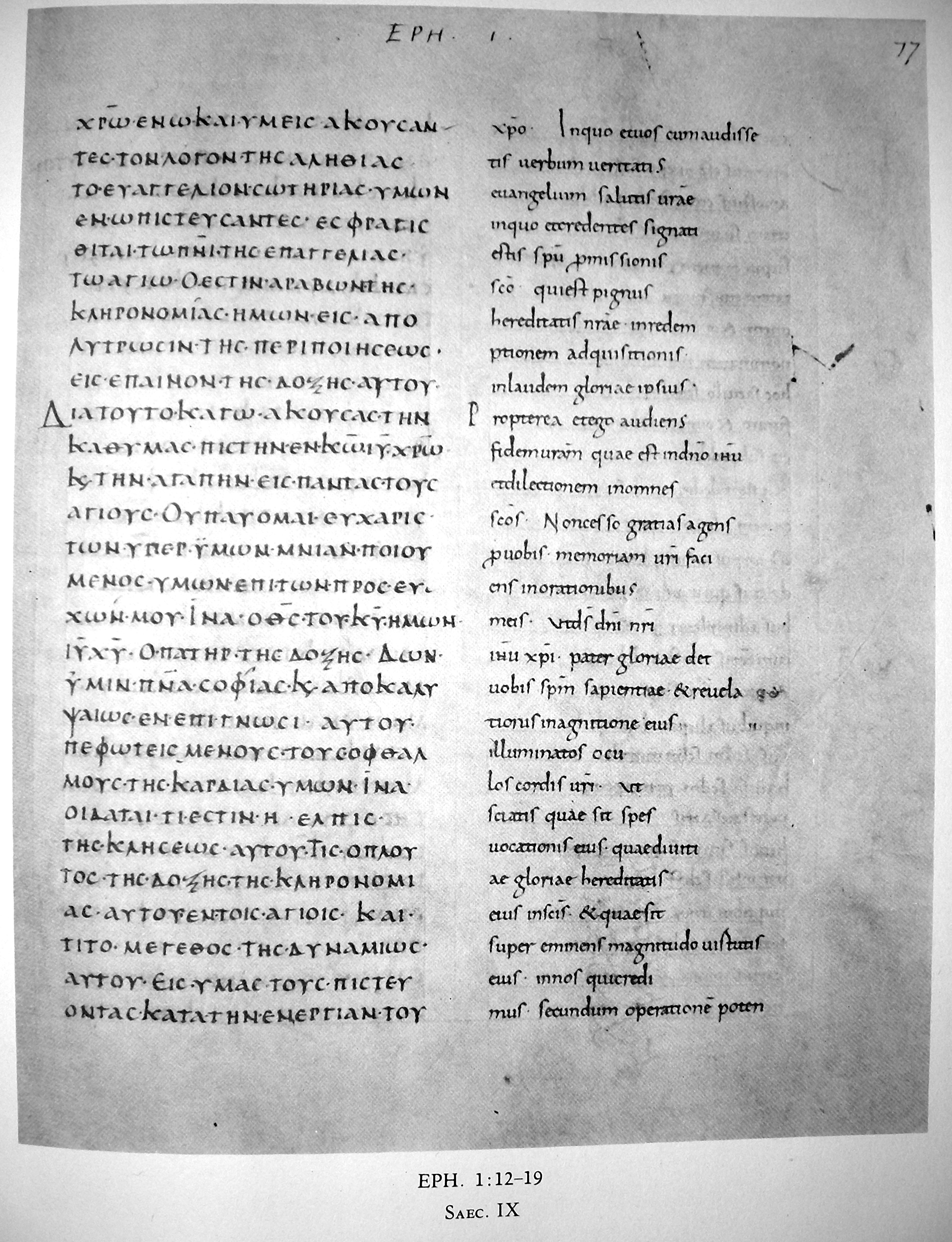
Codex 010 (F, Cambridge, Trinity College. B. XVII.1). DATE: A.D. circa 850. CONTAINS: Pauline epistles with Hebrews. Beuron 78. Textually very close to 012 (above) both from same grandparent. This MS has poor Greek word divisions. Latin text is Old Latin, similar also to 012 above. The somewhat elegant Latin script is Caroline minuscule. Text is written in sense-lines.
|
 |
|
Codex Cavensis, Beuron C. DATE: 9th century. CONTAINS: 303 folios, parchment, the descriptions list it as a full Bible. Usually three columns per page, page size is circa 270mm x 215mm. A MS written in Spain. Resides now in Salerno, at the Benedictine monastery of La Cava. Scripts reflect capitalis, rustica, uncial, half-uncial and bd uncial. Per Lowe. Typically classed as a Vulgate witness, but has numerous OL readings in the NT portion. A PDF file on the manuscript (by E. A. Lowe) can be read here, click on the PDF icon. Sample image is also from Lowe.
|

|
|
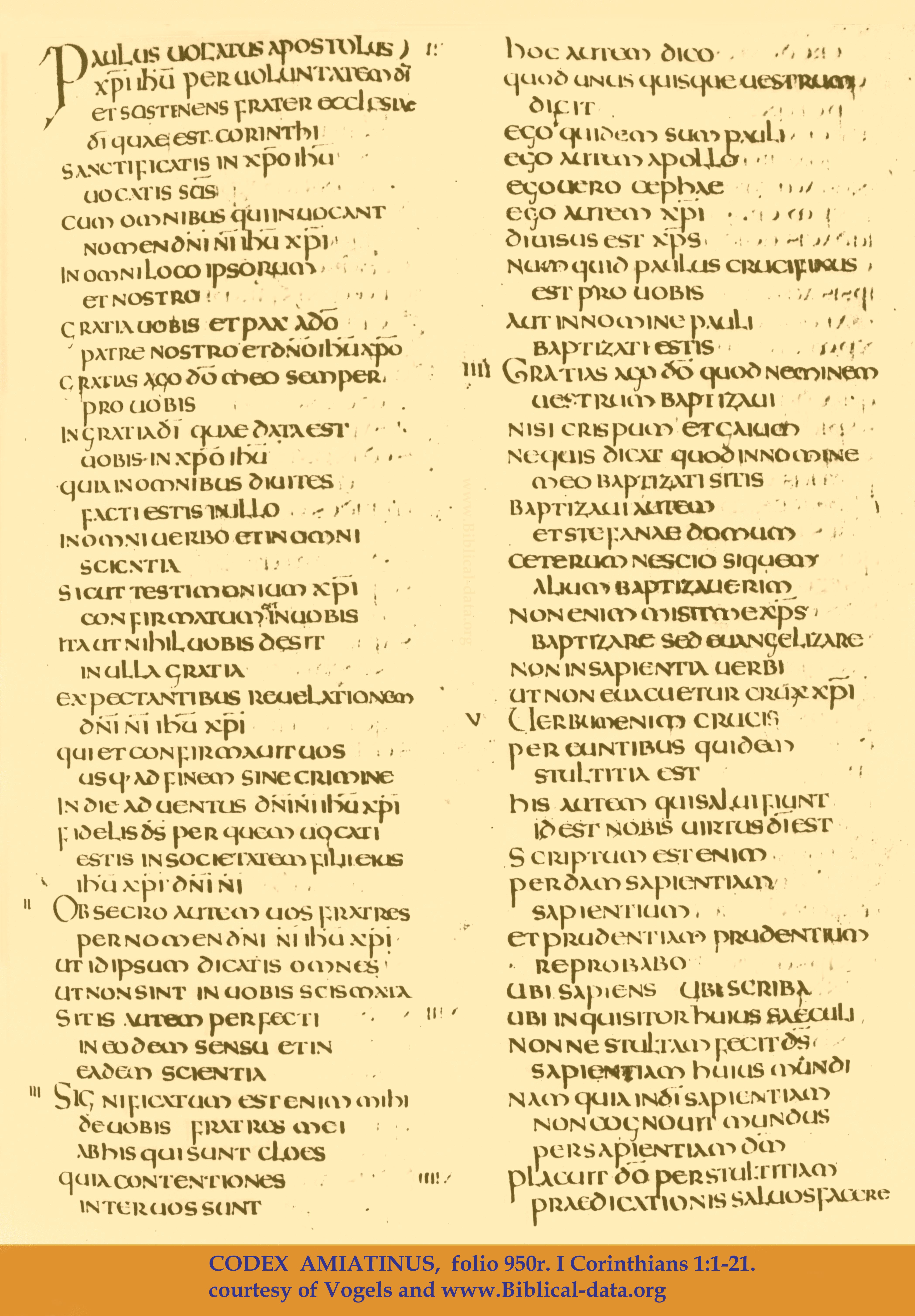
Codex Amiatinus, Beuron A. DATE: circa A.D. 730. Contains entire Bible. Considered the best witness for the Vulgate version of the Bible. This Pandect contains 1,029 leaves, on parchment. Written in England (either Jarrow or Wearmouth). Note text is written in sense-lines. It now resides in the Laurentian Library in Florence, Italy. Script is Roman/Italian uncial. Bishop Biscop (628?-690) founder of the famous Jarrow and Wearmouth monasteries made no less than five trips to Italy to acquire books, including many old books from the Vivarium monastery in Calabria (via Cassidorus). Codex Amiatinus is a beautiful copy of one of the Vivarium manuscripts, imported to Northumbria by Ceolfrith, and copied by Biscop's scribes.
|
 |
|
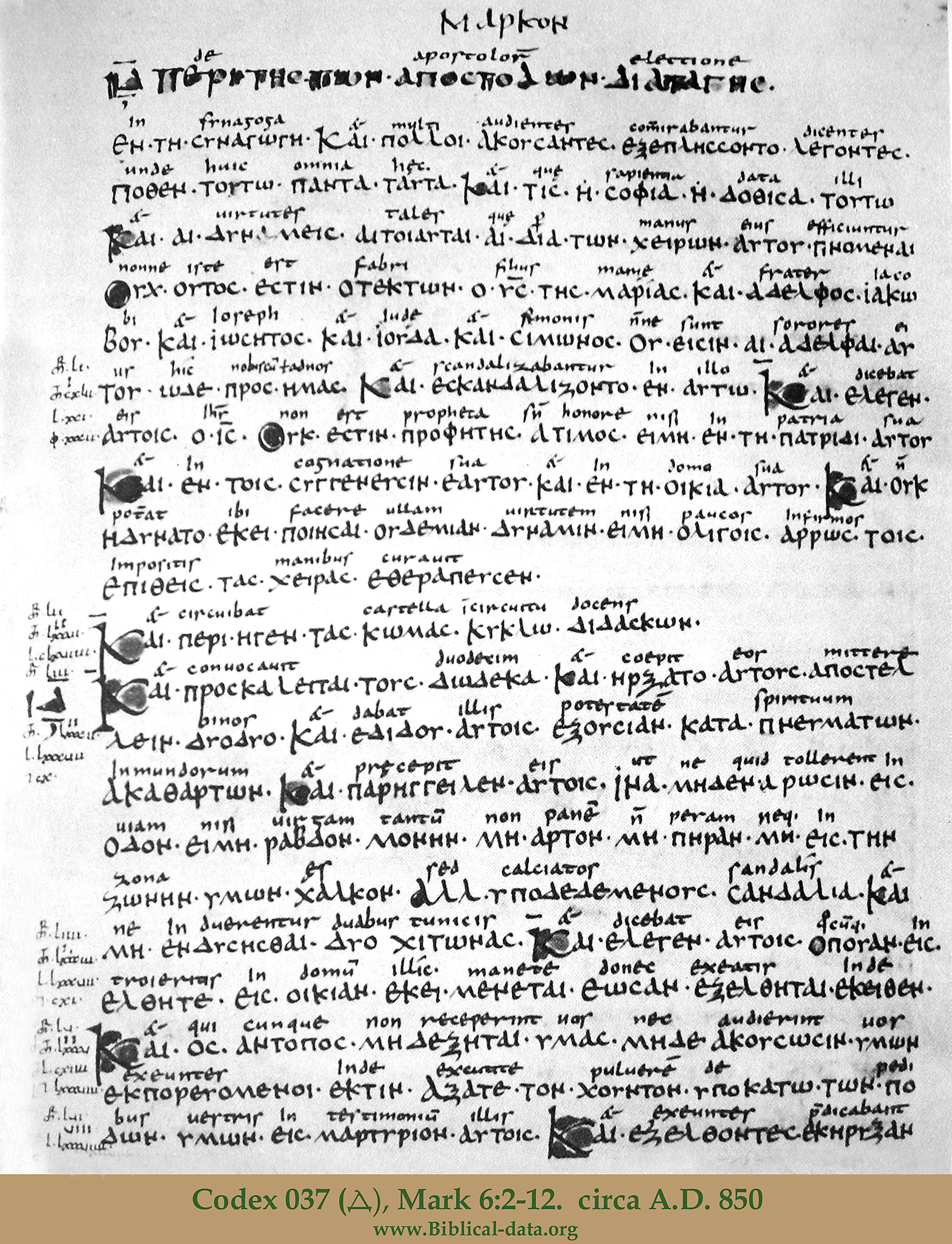
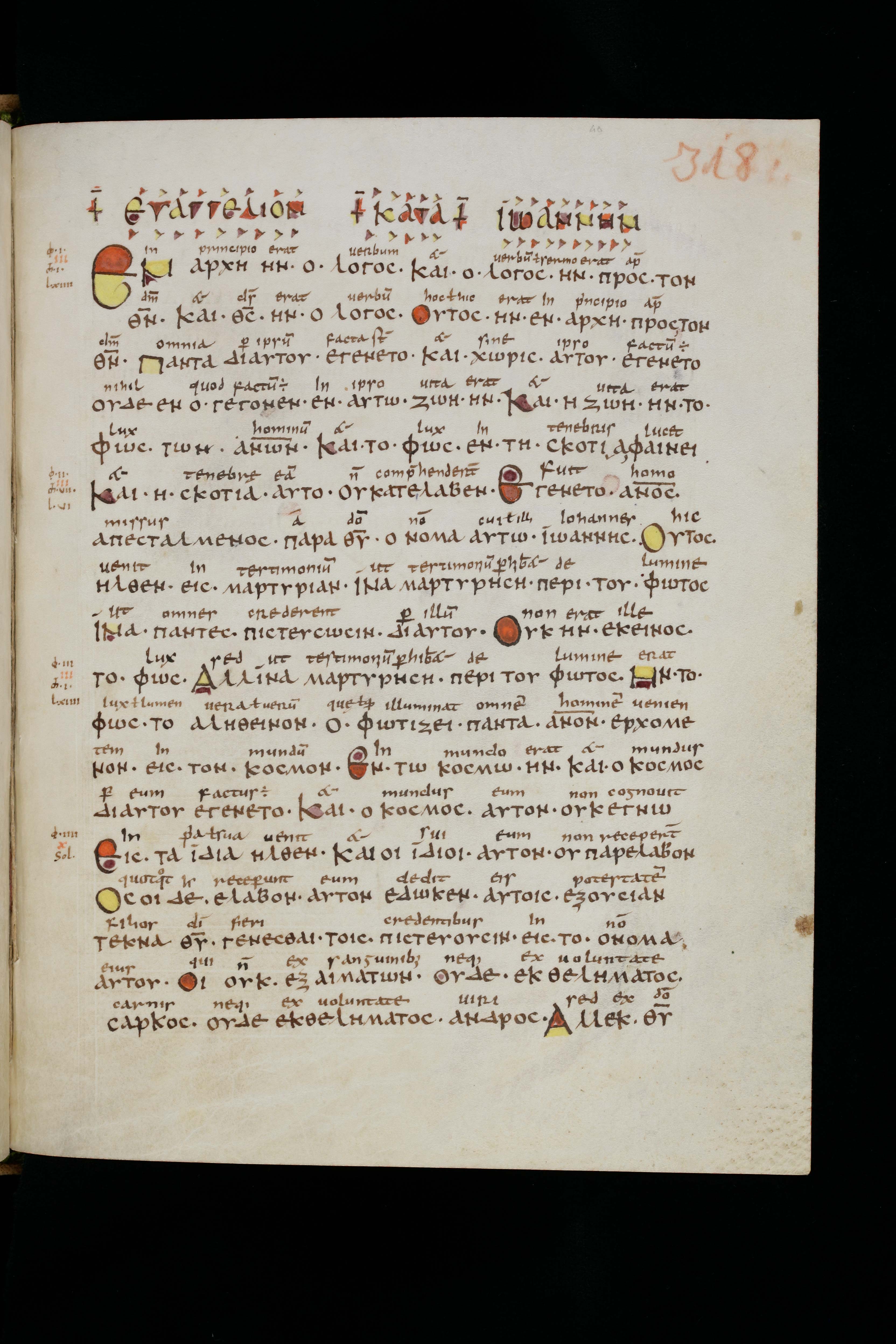
Codex 037, or Codex Sangallensis. DATE: circa A.D. 850. Beuron 27. CONTAINS the four gospels. Most likely the first part of the same codex as 012, above. Written at the St. Gallen monastery, or as stated at the St. Gallen site, written at the Bobbio Monastery. Latin text is considered Old Latin. The first image is a copy of what was available, the second image is from the St. Gallen website, (folio 318, John 1) at which site the entire MS is available in good full color resolution for viewing and copying. http://www.cesg.unifr.ch
|
|
|
Codex Fuldensis, Beuron F. DATE: A.D. 546. CONTAINS: all of NT and epistle to the Laodiceans. Contains a text like a 4-in-1 harmony (Diatessaron). Probably written in Capua. Text is not Old Latin. Script is Italian uncial.
|
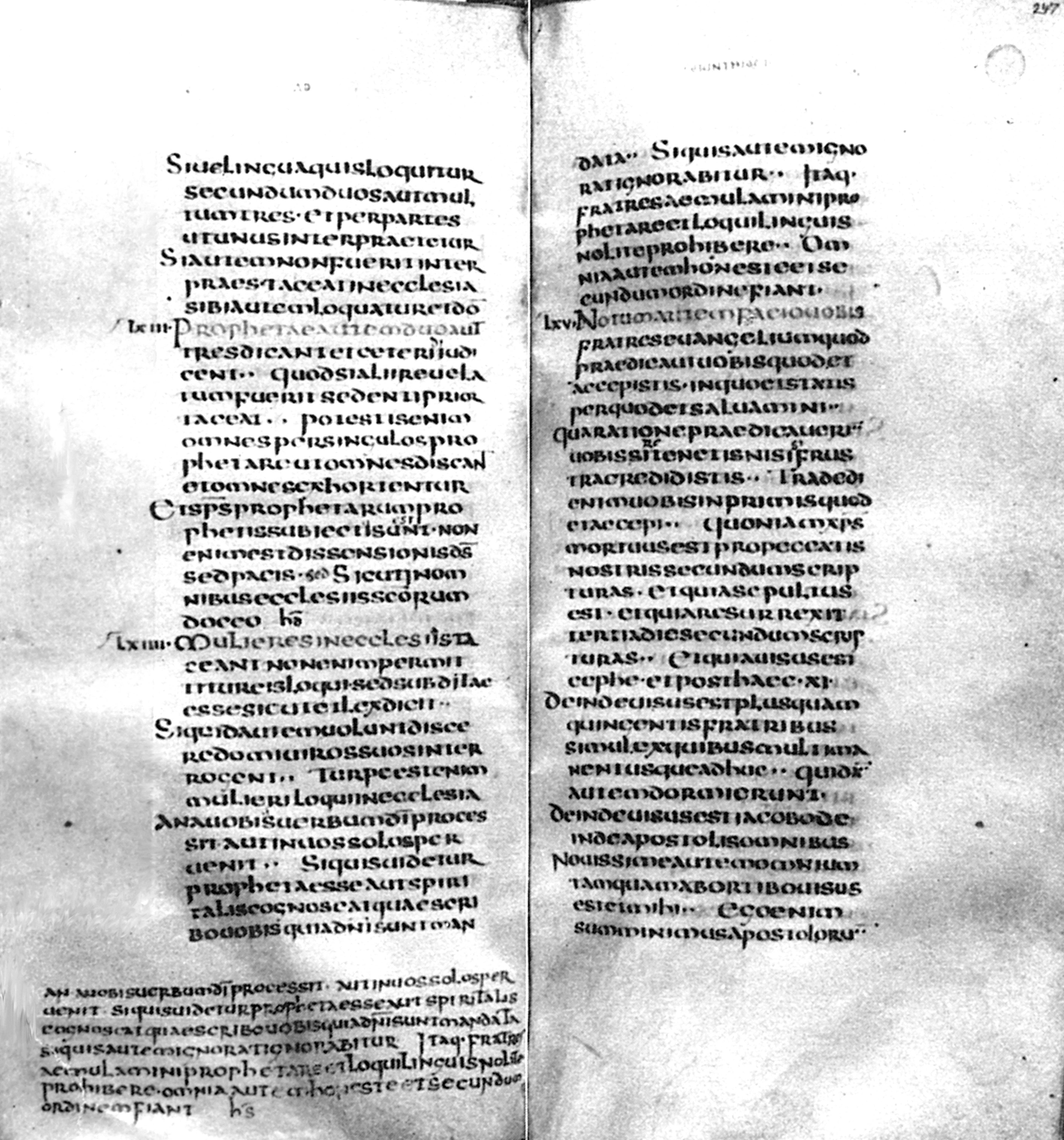 sample
shows I Cor. 14
sample
shows I Cor. 14 |
|
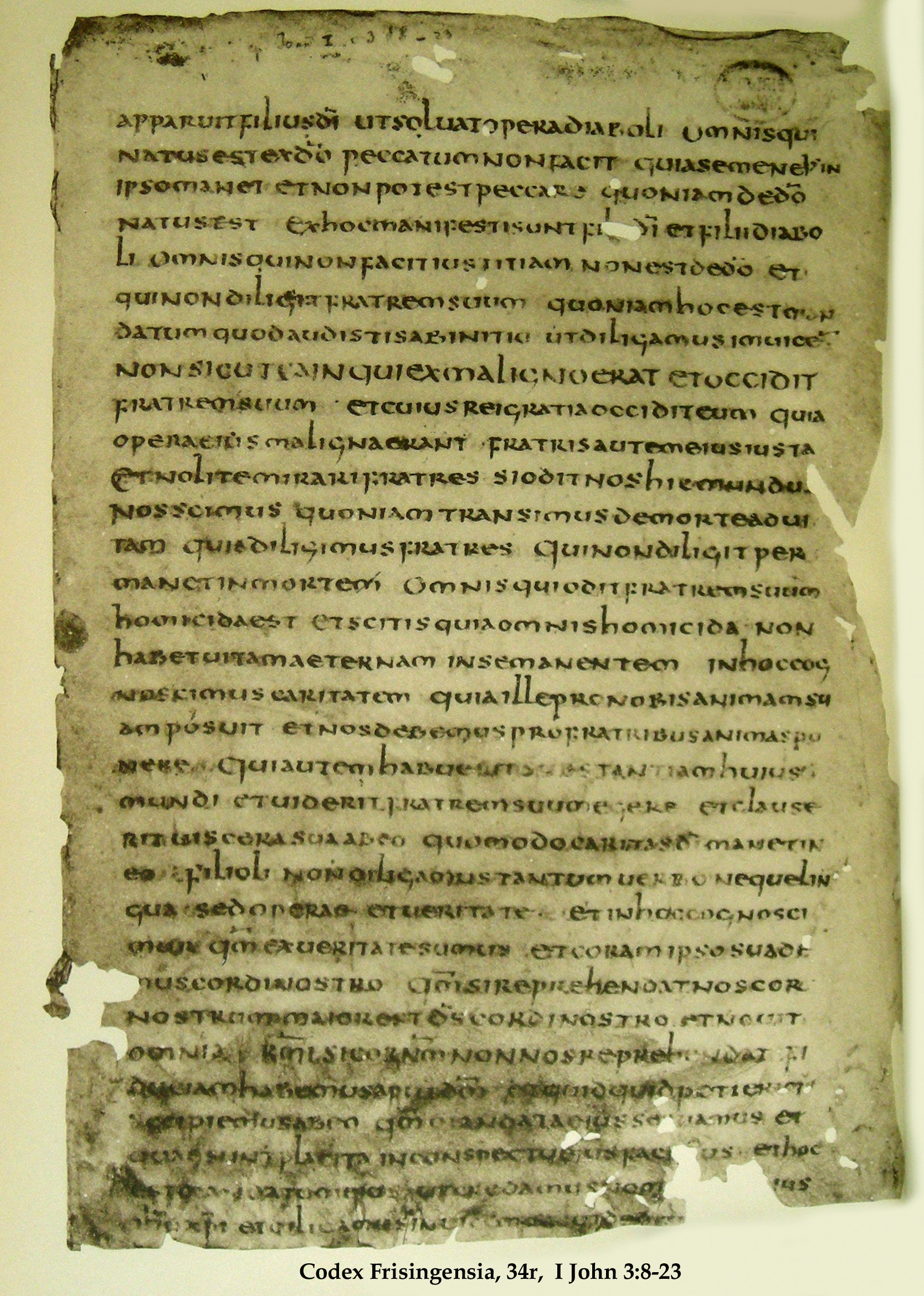
Frisingesia Fragments, Beuron 64. DATE: 450-550. CONTAINS: portions of the Pauline and Catholic Epistles. Good Old Latin text of the Pauline epistles, as well as being a fine specimen of the African text of the OL. Transcription edition is available elsewhere on this website. MS now lies in Munich, Germany.
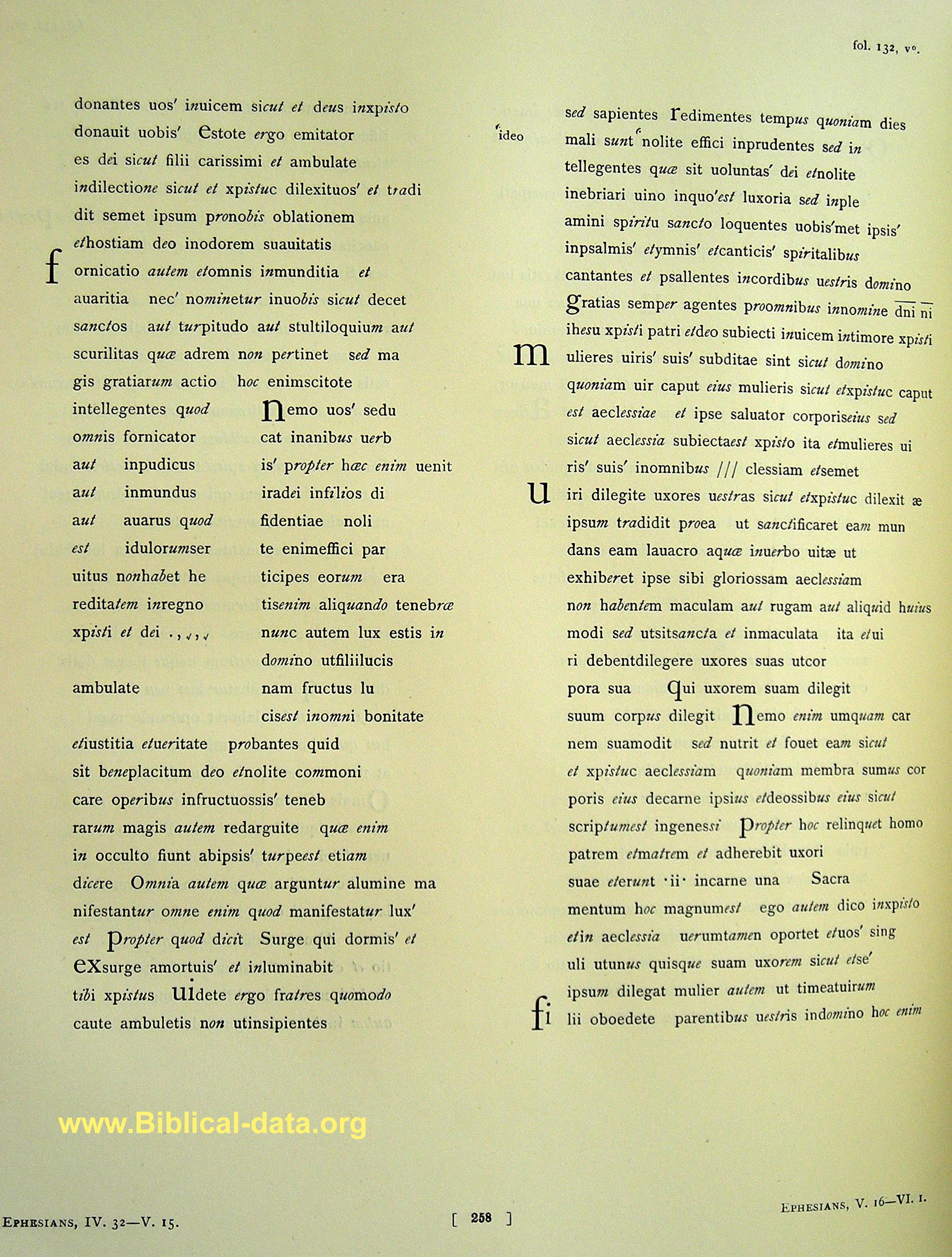
|
 |
|
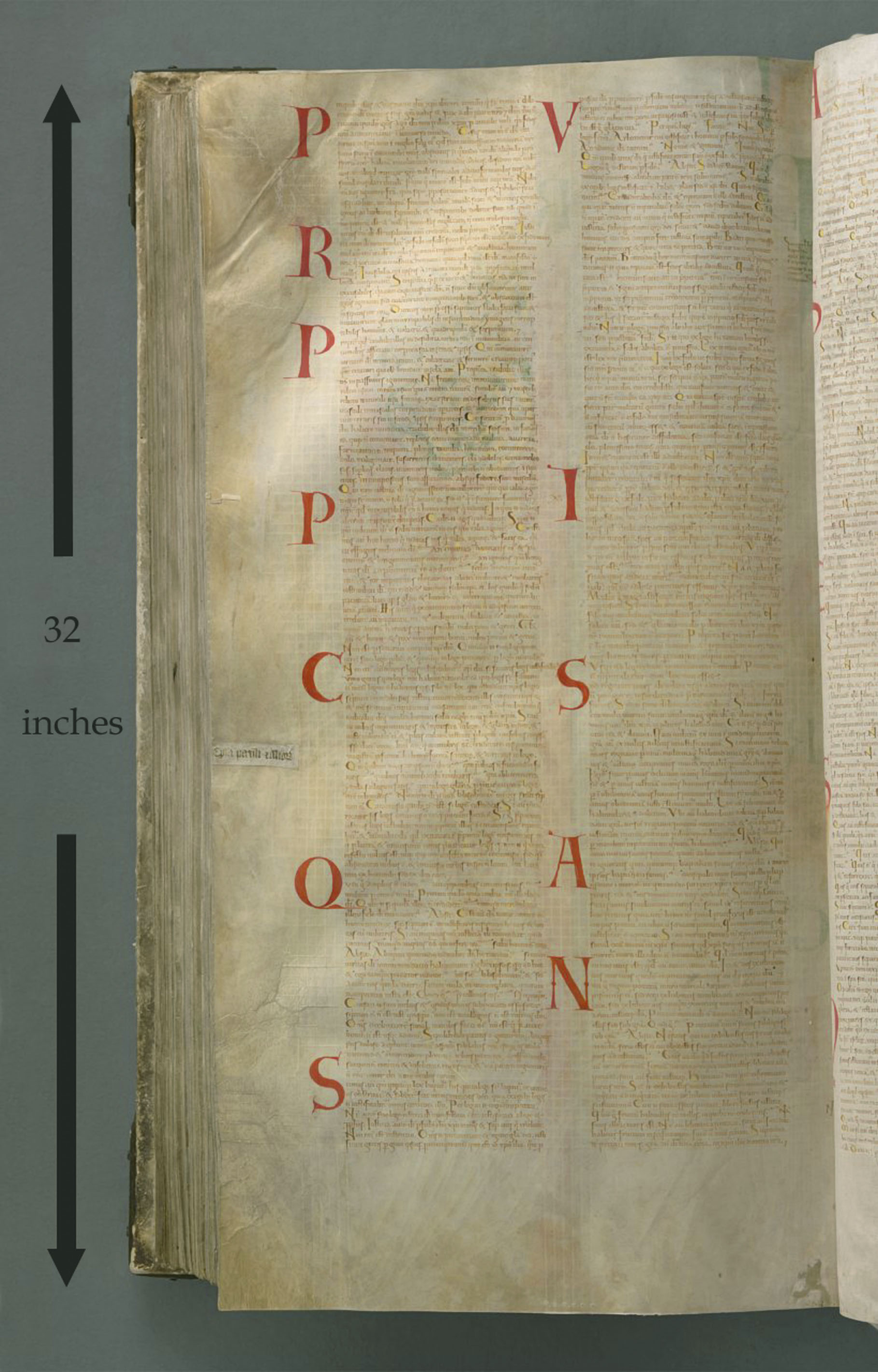
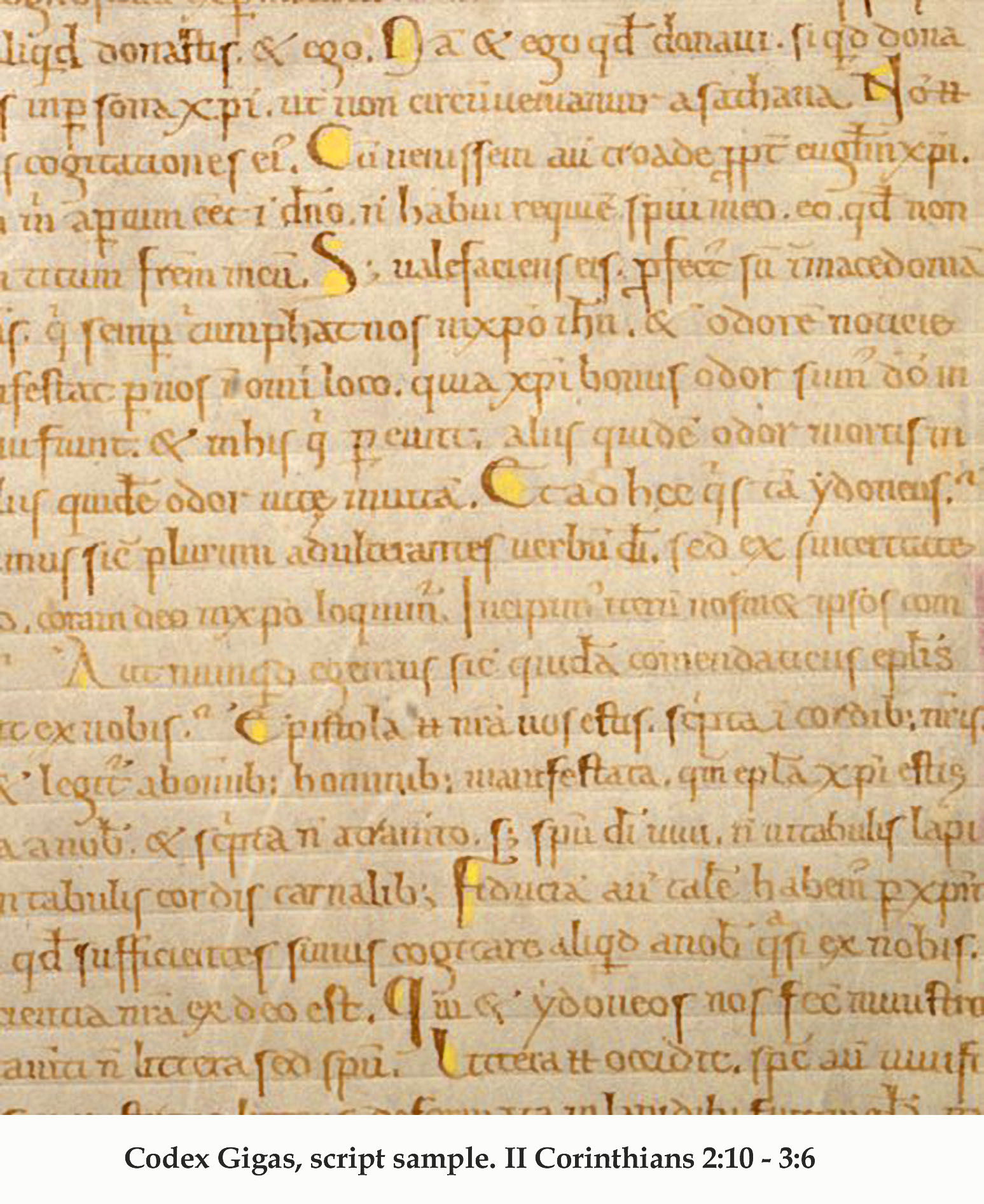
Codex Gigas, Beuron 51. DATE: circa 1250. CONTAINS: the Vulgate Bible. Acts and Revelation are Old Latin. A giant manuscript, see images. Now lies in Stockholm, Sweden. Images are available on the Swedish website, but after zooming-in resolution is not very good. Script is a form of the Insular half-uncial. |
|
|
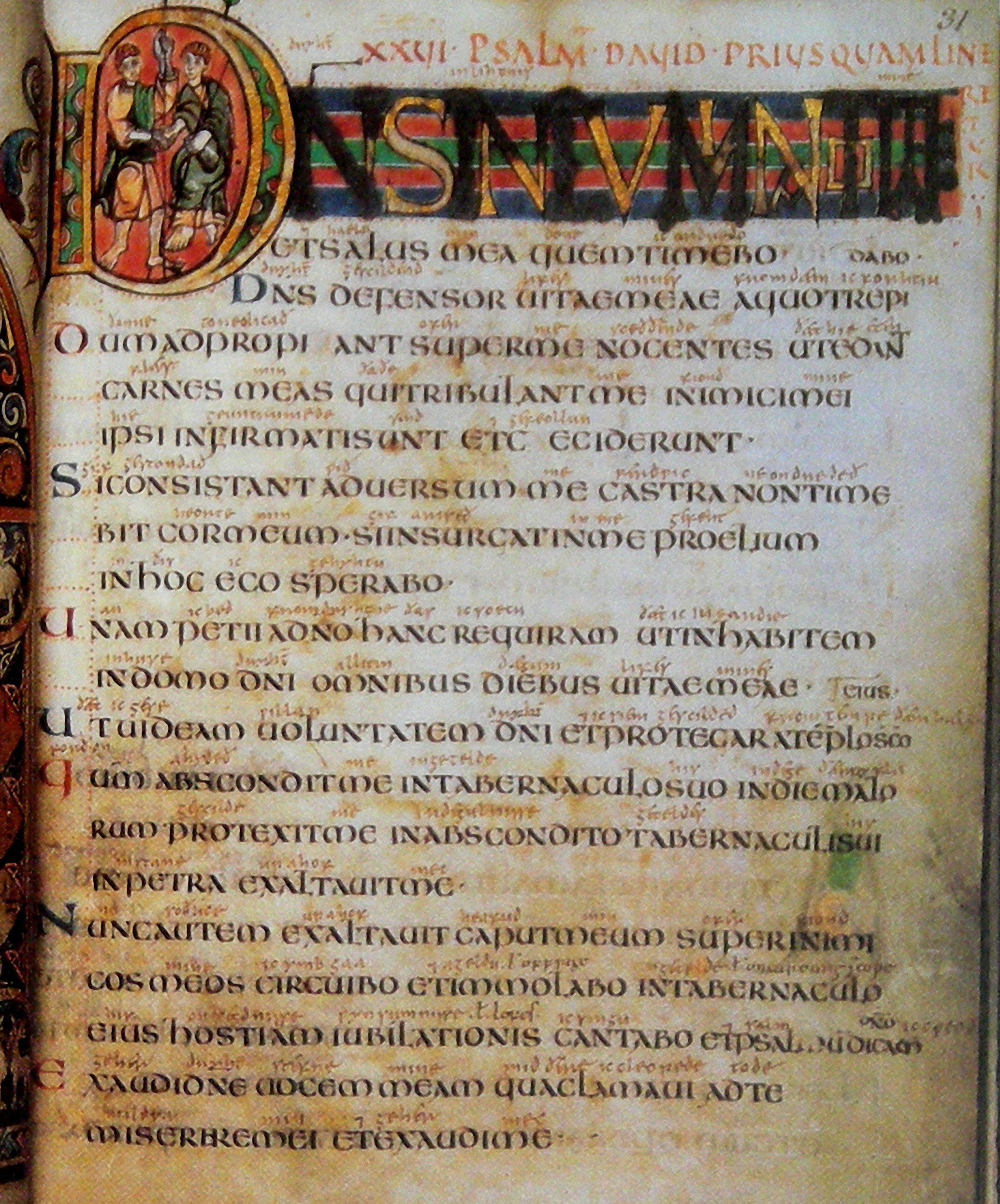
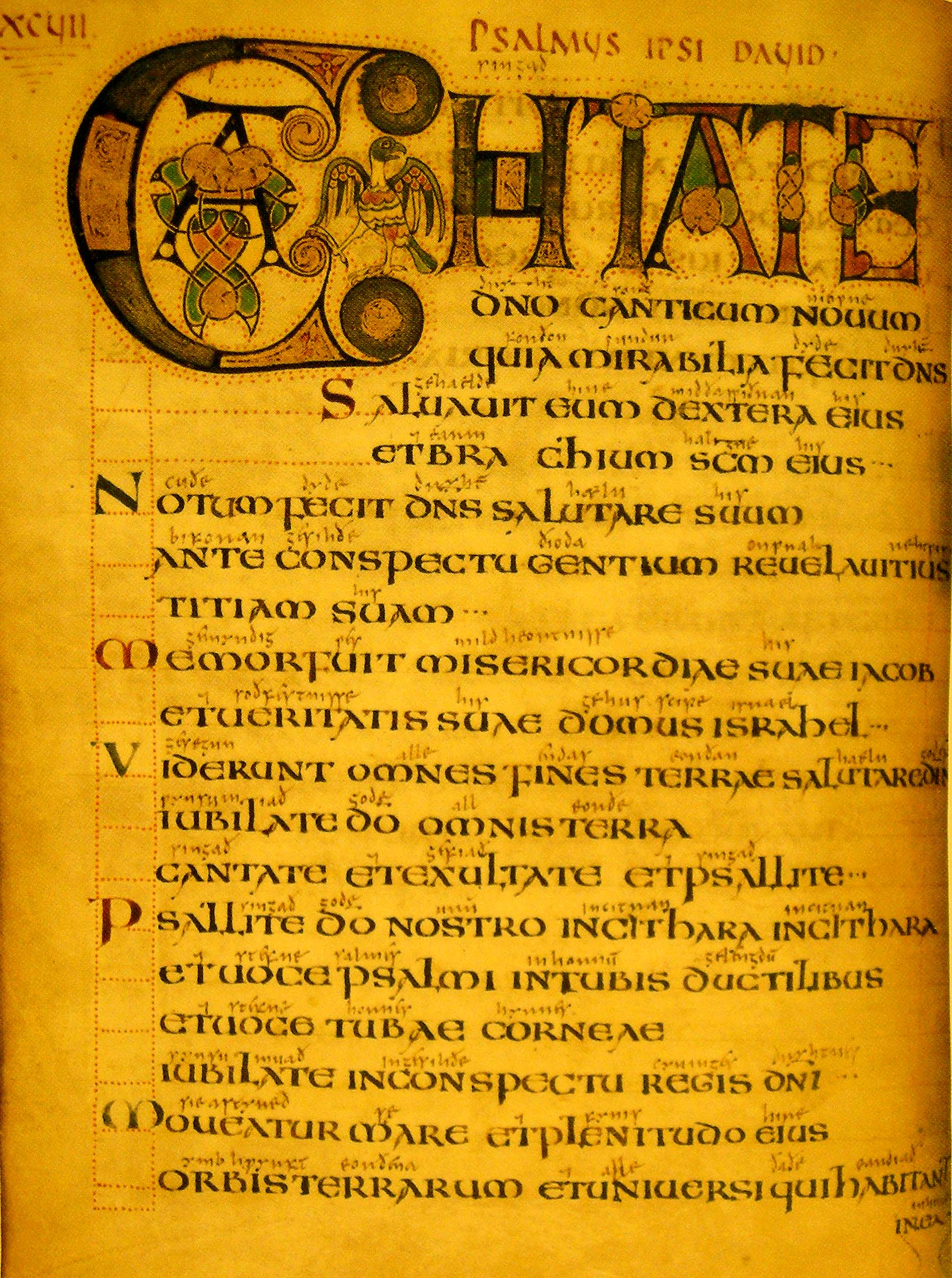
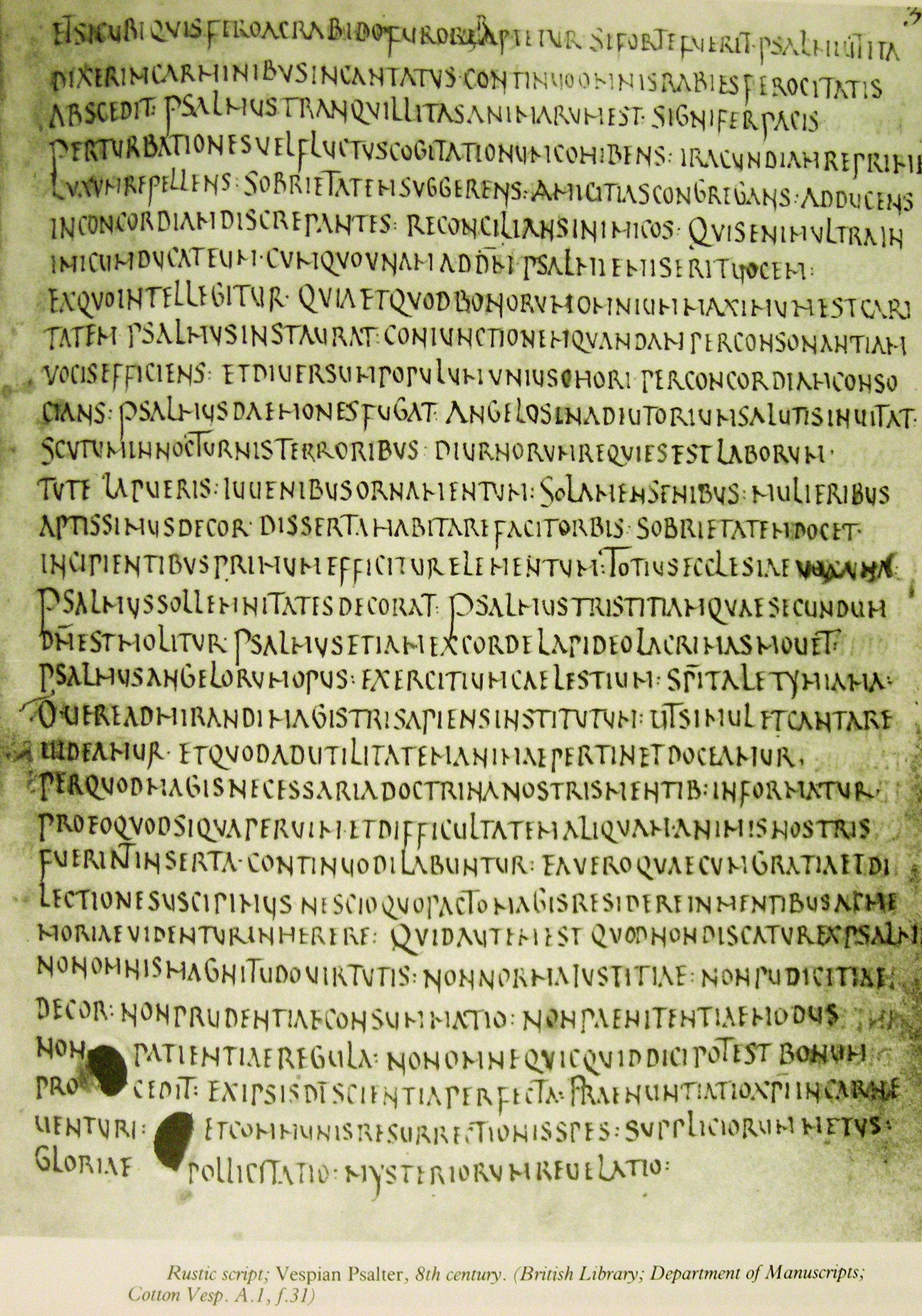
The Vespasian Psalter. London, British Lib. Cotton A.1. DATE: 810--850 Latin text is in an "Uncial script", the glosses are in Mercian, a form of Anglo-Saxon. Both images of same manuscript, from different sources. The third image, in the Rustic script is a page from the same manuscript (borrowed from A History of Writing, Albertine Gaur). |
of Psalms 98 - (97 per Vulgate)
|
|
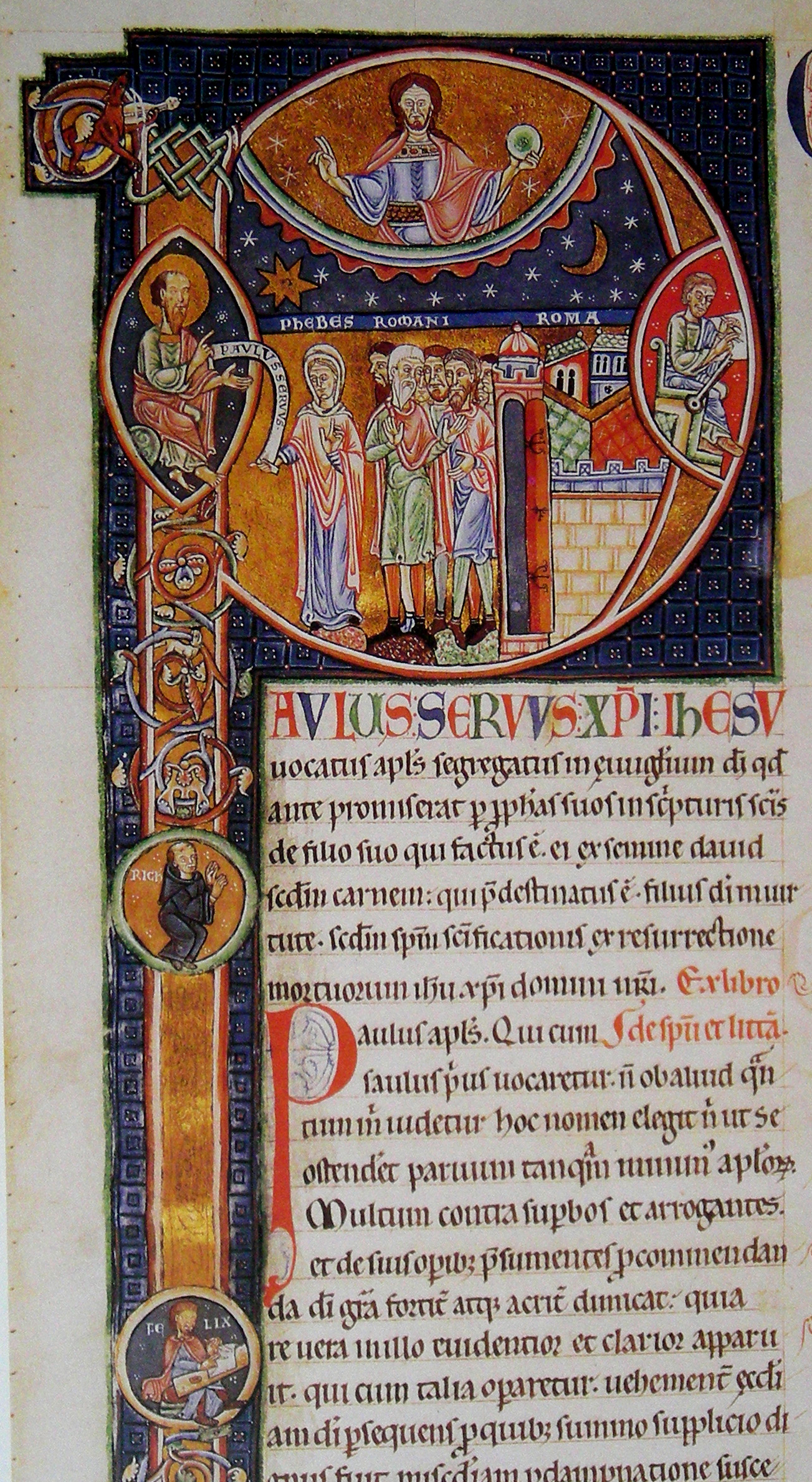
Paris Bibliothèque Nationale. MS Lat. 11575, folio 1r. DATE: 1164 By the scribe Johannes Monoculus. Contains a commentary by Florus on the Epistles of St. Paul. Once was in the Corbie monastery. The script is what Brown would term as "proto-Gothic minuscule". Image shows beginning of the Epistle to the Romans. The big enlarged initial is a fine sample of a "historiated" initial. The name seen in the initial "Felix" was the artist, and the name "Richard" who probably commissioned the MS.
|
 |
|
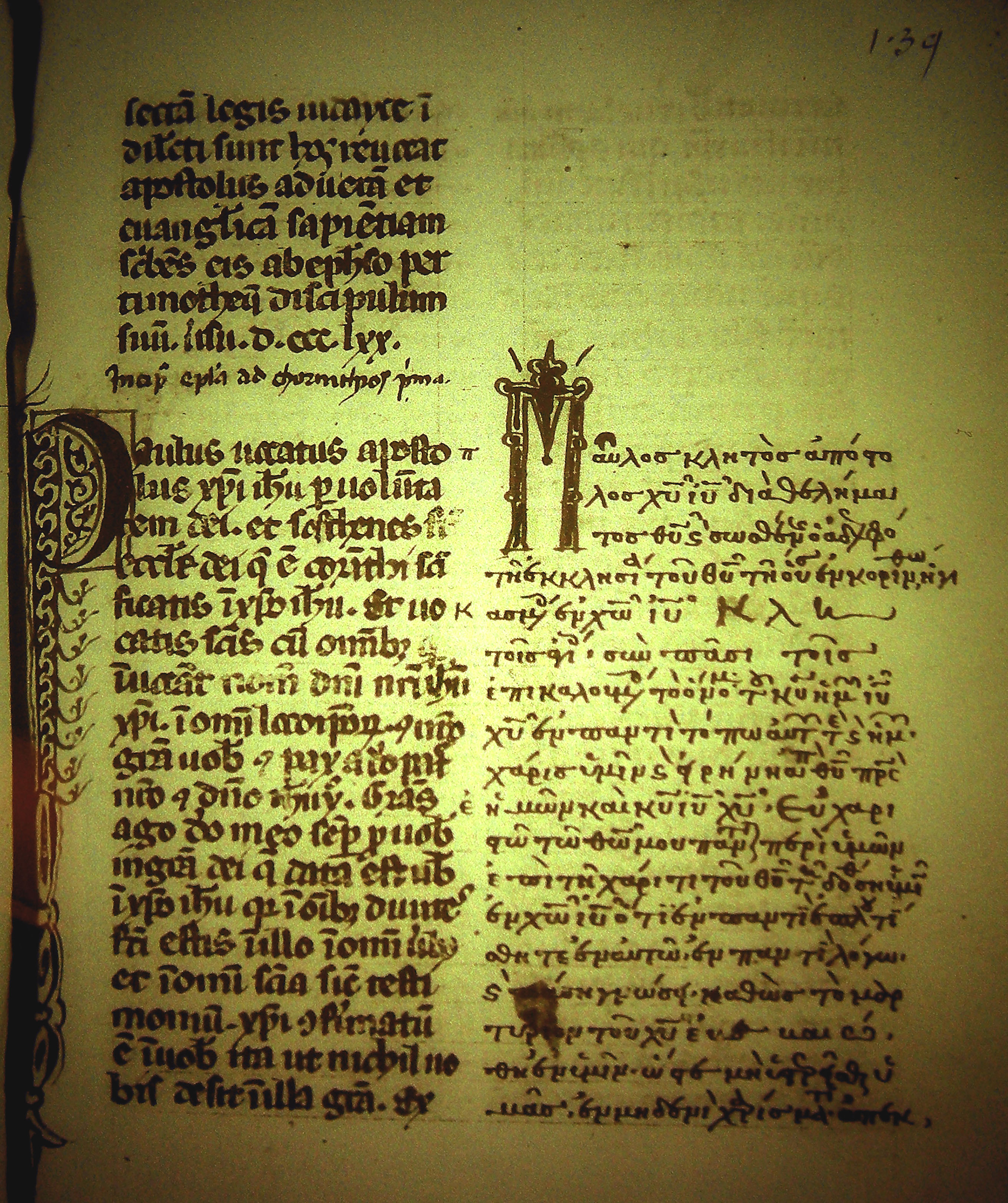
Manuscript 629. Rome, Otto. Gr. 298. DATE: circa A.D. 1350 Nestle/Aland Greek MS 629. Greek/Latin diglot. The Latin script is very close to Brown's "Gothic textura rotunda" often seen in France in the 14th century. Which may assist with identifying the MS provenance. Via my research, the Greek text was written after the Latin, the Latin seems to have a preference, and it is almost pure Vulgate. The Greek text seems to conform to the Latin! Image is from a microfilm, shot on a viewer. Text is I Cor. chapter one.
|
 |
|
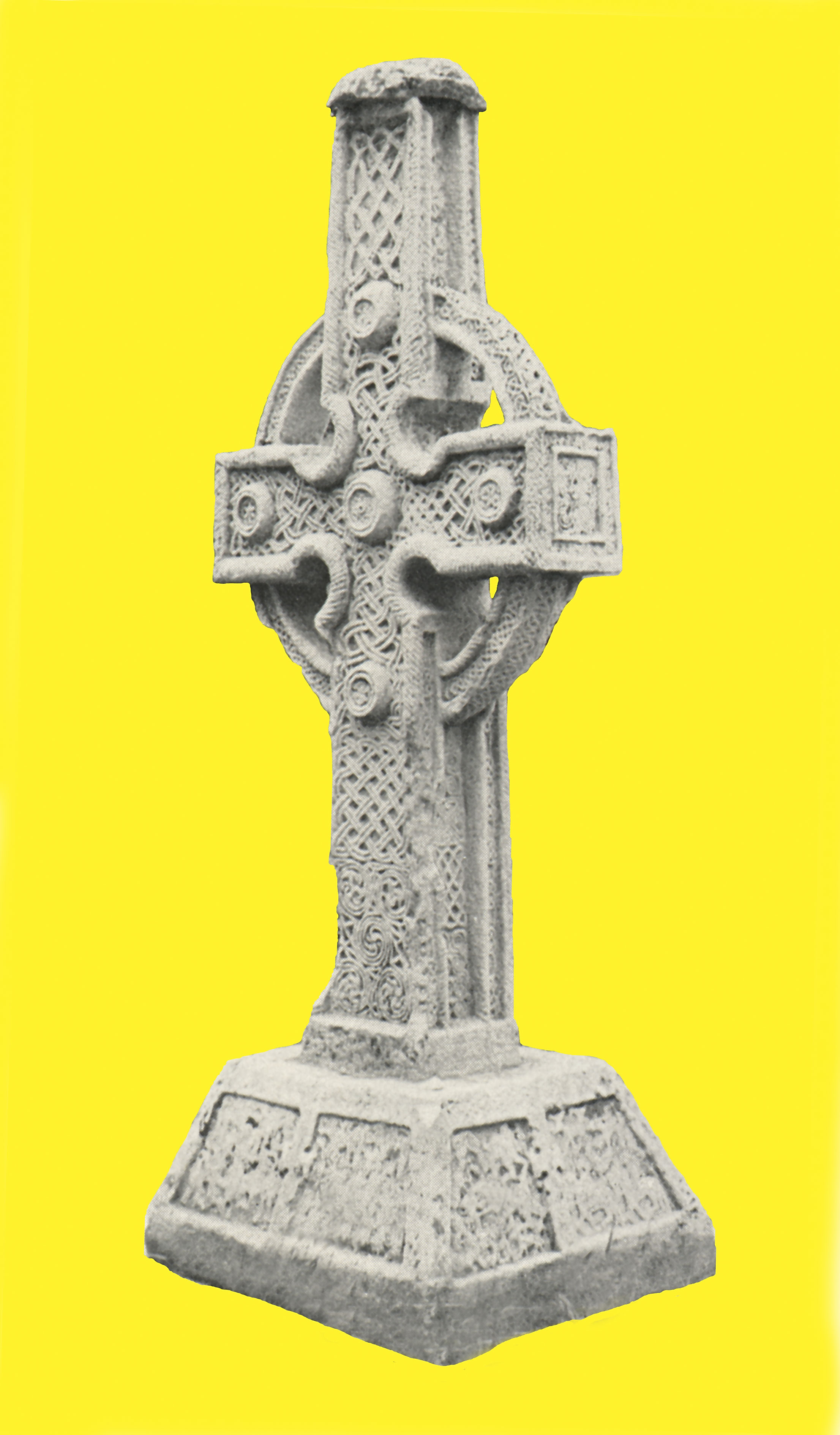
Celtic Cross, Ireland. Date "old", Christian One of many illustrations which demonstrate the closeness of ancient Celtic art, imagery and artwork seen in Irish and Anglo-Saxon Biblical manuscripts. Some similar "interlacings" are seen in an illumination/artwork in the Glazier Coptic Codex, from Egypt. Did Egypt influence the Celts, OR did the Celts influence the Egyptians? OR are these chance similarities?? In my opinion, this reflects early Egyptian influence up into Ireland. Do read my essay "The Origin and Value of the Western Text-Type..." on my main Latin Resources page.
|
 |
|
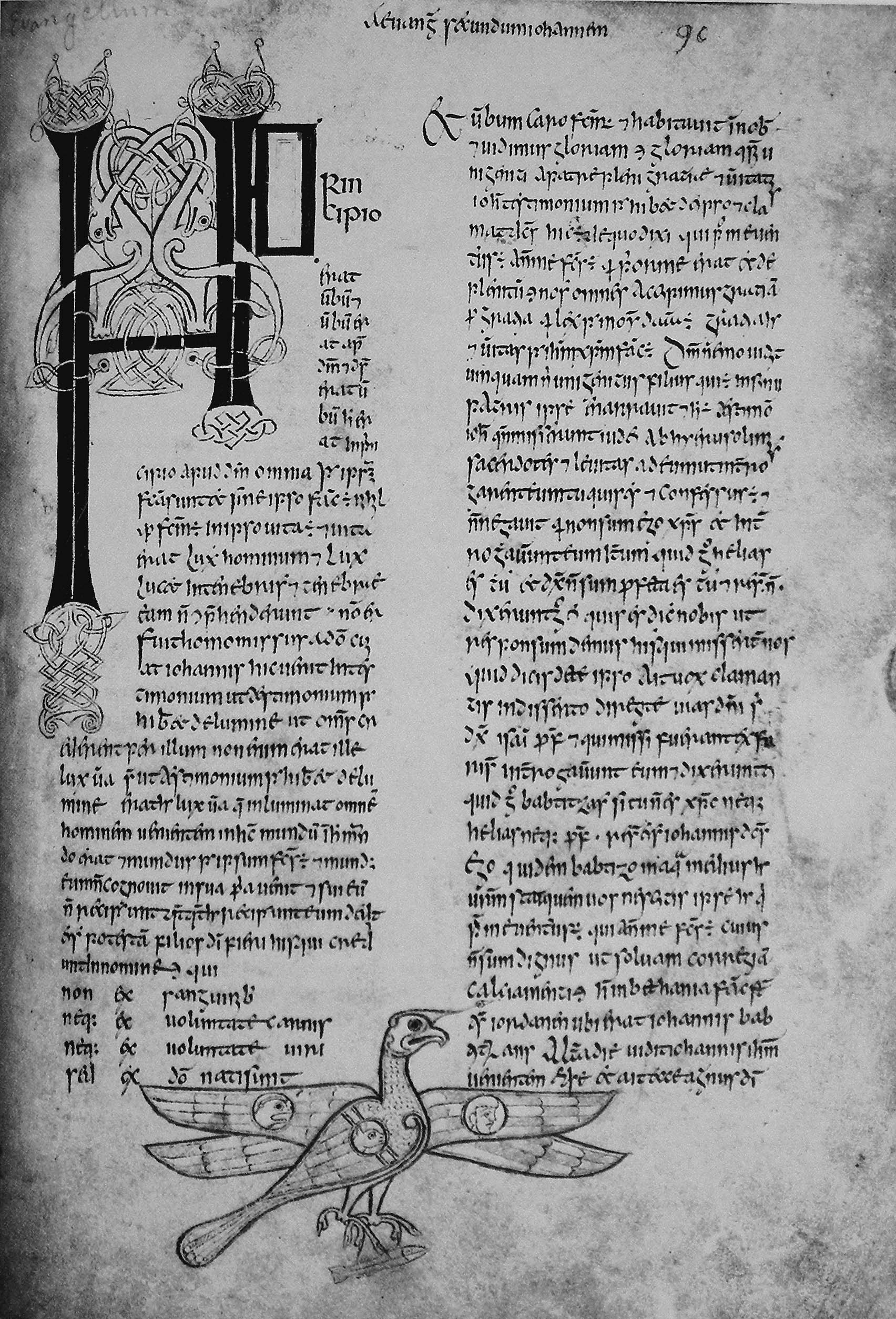
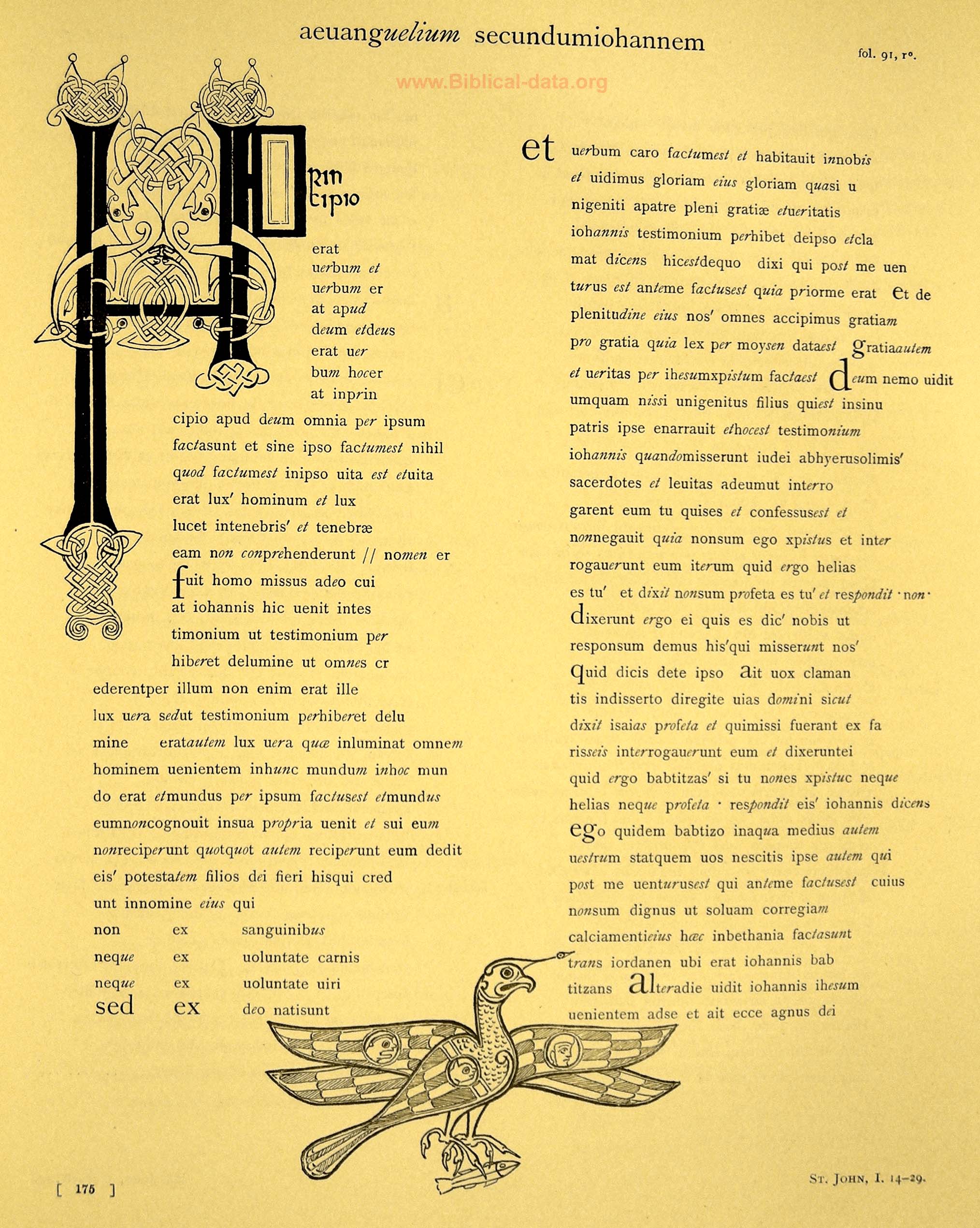
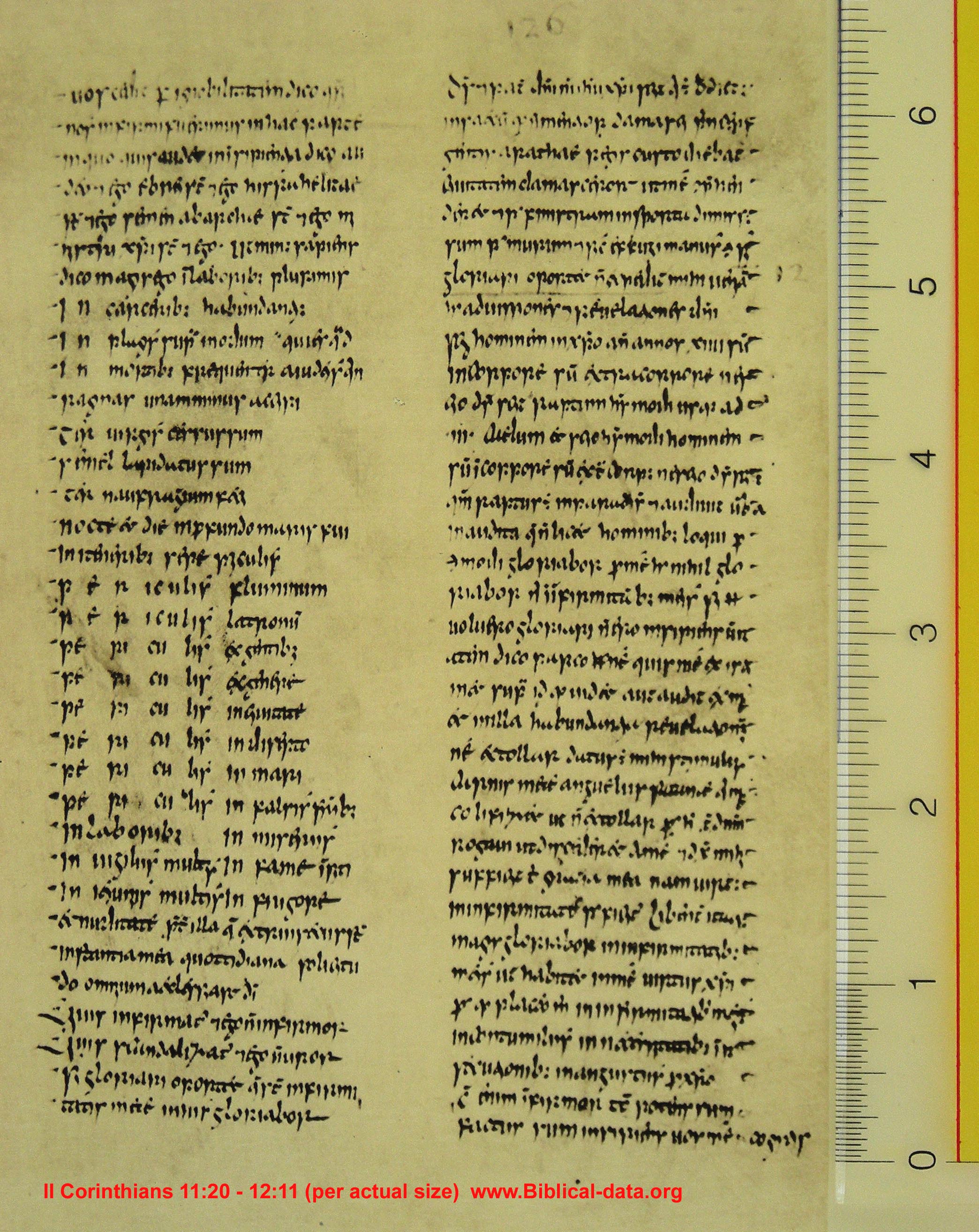
Book of Armagh. Dublin, Trinity College 52. Beuron 61. DATE: 807-808 Scribe: An Irishman, Ferdomnach. Written at the Armagh monastery, Ireland. Small pocket sized book, text measures roughly 1.75 inches x 6 inches (per column). 217 folios per T.J. Brown, 222 leaves per the editor - Gwynn. Most images of this MS show script which is very small and hard to read. Script is basically a Caroline/Irish minuscule, which occassionally lapses into cursive. Gwynn refers to it as "pointed-Irish". An important Irish manuscript. Souter feels that the basic text is OL, with Vulgate intrusions. Whereas Gwynn, declares, the basic text is Vulgate with OL intrusions. Souter's judgment here seems more reasonable. MS contains the 4 gospels, (in Vulgate order), the Pauline epistles, the Catholic epistles, the Apocalypse, and ends with Acts. Prior to the Biblical texts are two "volumes" one on St. Patrick and another on "Life by Muirchu". The Biblical portions may have been produced in 3 separate sections, then later joined into one volume. My evaluation of this MS is that it is a good OL MS, with Vulgate intrusions, in the Pauline epistles. A microfilm, from Claremont, (California) has images which are nearly impossible to read. Best bet is to use Gwynn's book, of which only 400 copies were made in 1913. Some of the sample images are from a copy of this rare publication. Each sample image is coupled with the transcription made by Gwynn, which matches the MS line by line. Book title is: Liber Ardmachanus: The Book of Armagh. John Gwynn. Dublin. 1913. [folio size]
|
|
|
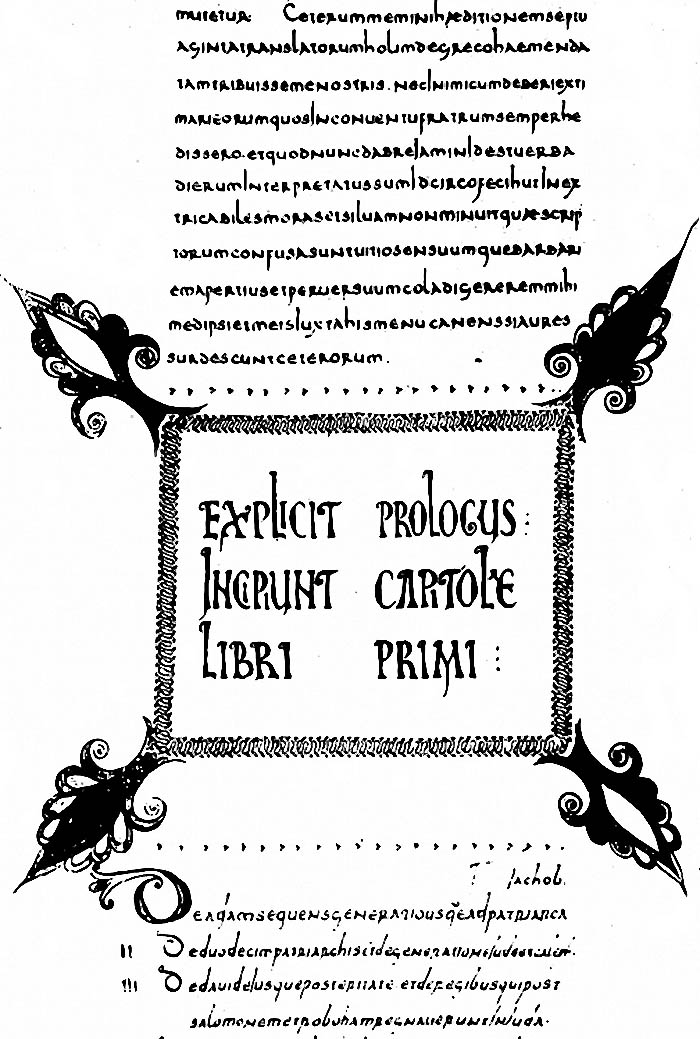
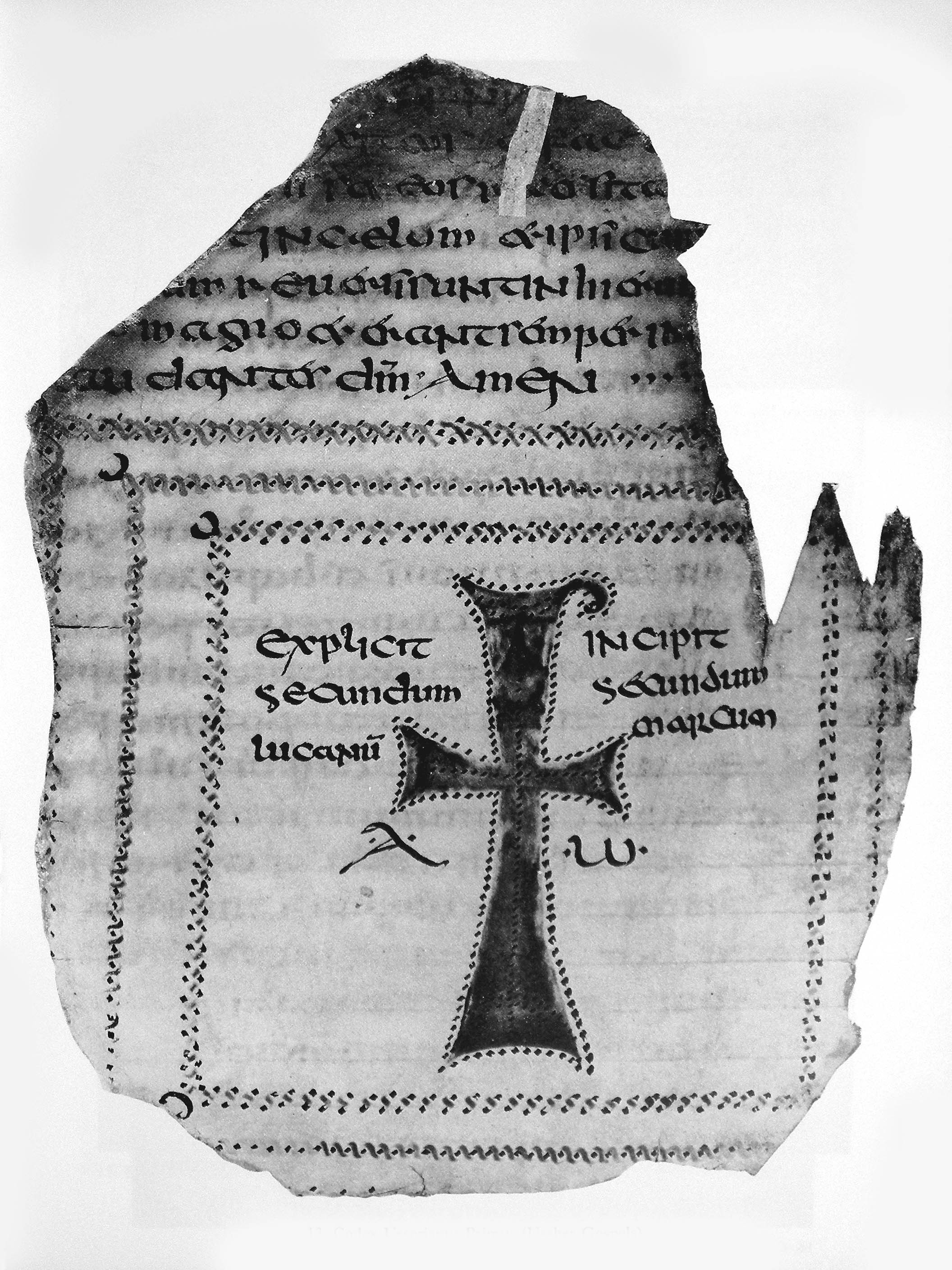
Codex Usserianus primus. Dublin, Trinity College Library, MS 55. DATE: circa 550 Beuron 14. One of the oldest Irish gospel manuscripts. Four gospels in the order, Matthew, John, Luke and Mark, the "Western order". The parchment (membrane) is of the Continental type (not Insular). The Irish minuscule script will often have instead of wedges (at the top of the straight strokes) loops! (as noted in Brown's writings). One such "loop" is visible in the sample image in the word "Explicit" note the "l".
|
 |
|
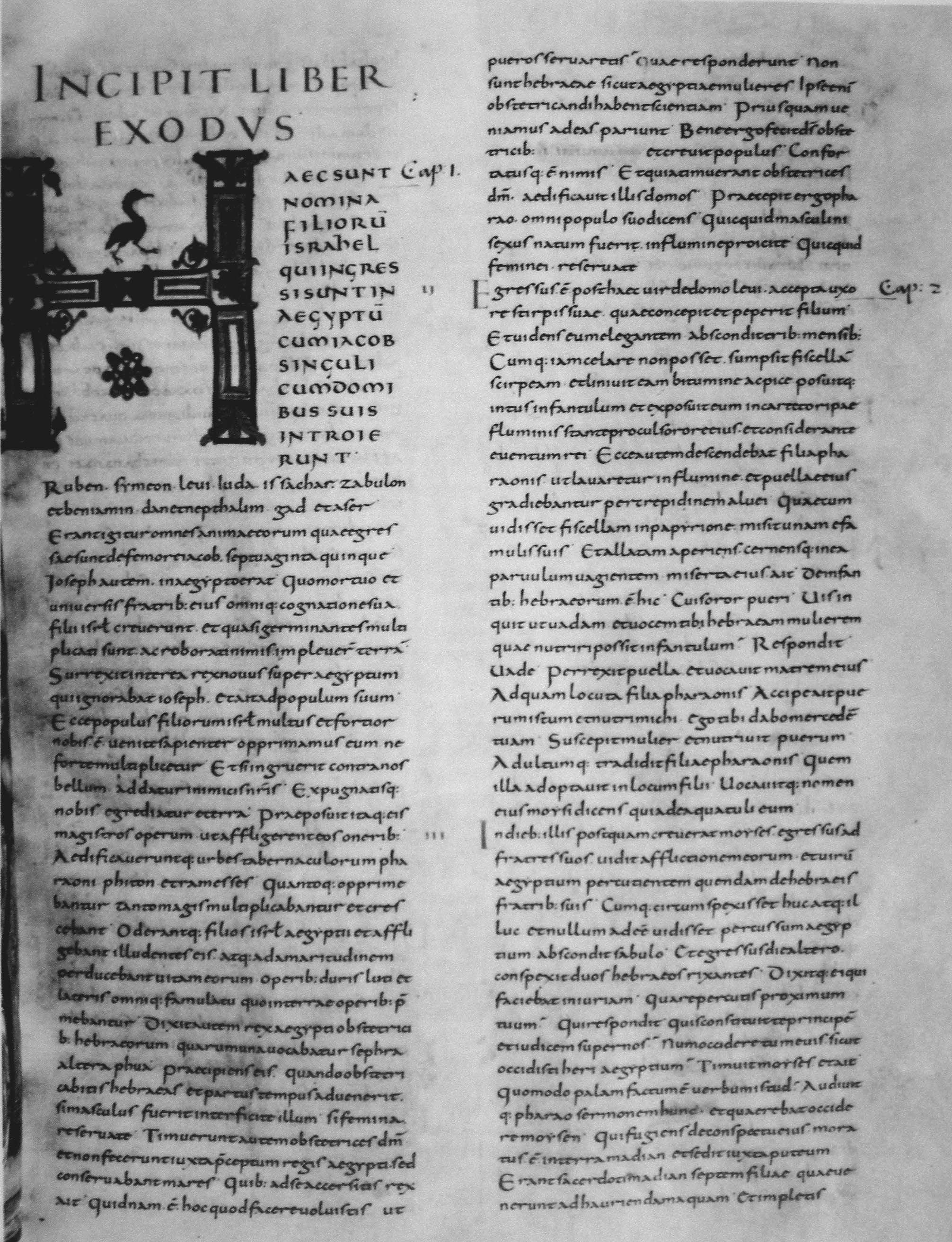
Also known as the "Codex Carolinus", and as "Moutier-Grandval Bible". Written in Tours, France; probably at St. Martin. At this monastery most palaeographers believe the birth of the Caroline minuscule began. This manuscript is a fine example of that script. Most manuscripts made at Tours also were in a two column format. Color image borrowed from the Smithsonian Book of Books. As I understand it, this is a complete Bible, using Alcuin's revision. It is one of three surviving illuminated copies produced at Tours. Note the three scripts, capitals, uncial, and Carolingian minuscule, this display of scripts in this order is known as the "hierarchy of scripts".
|
|
|
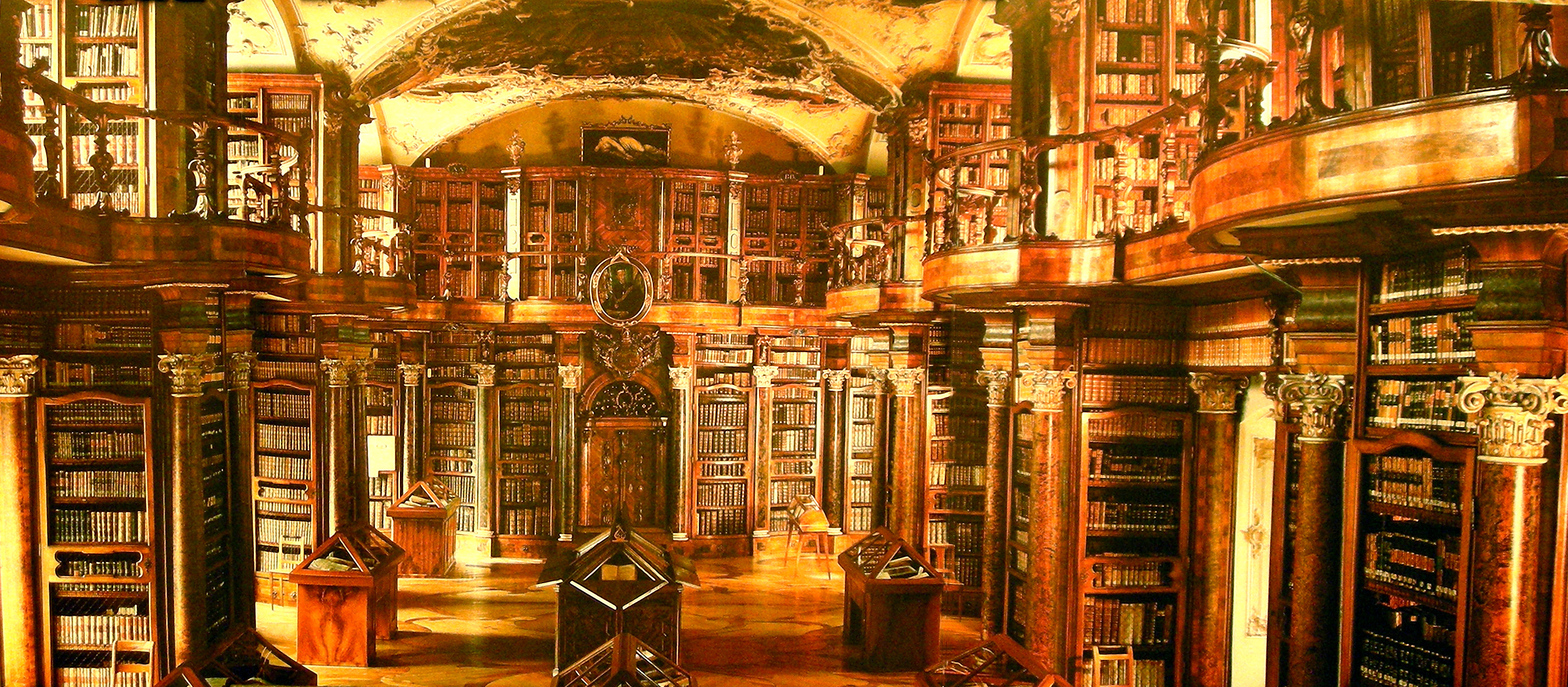
The main hall of the library of St. Gallen. A beautiful and great repository of precious manuscripts. Image is a wide-angle shot, may be best viewed off-site. They display many of their treasures on their website: http://www.cesg.unifr.ch
|
 |
|
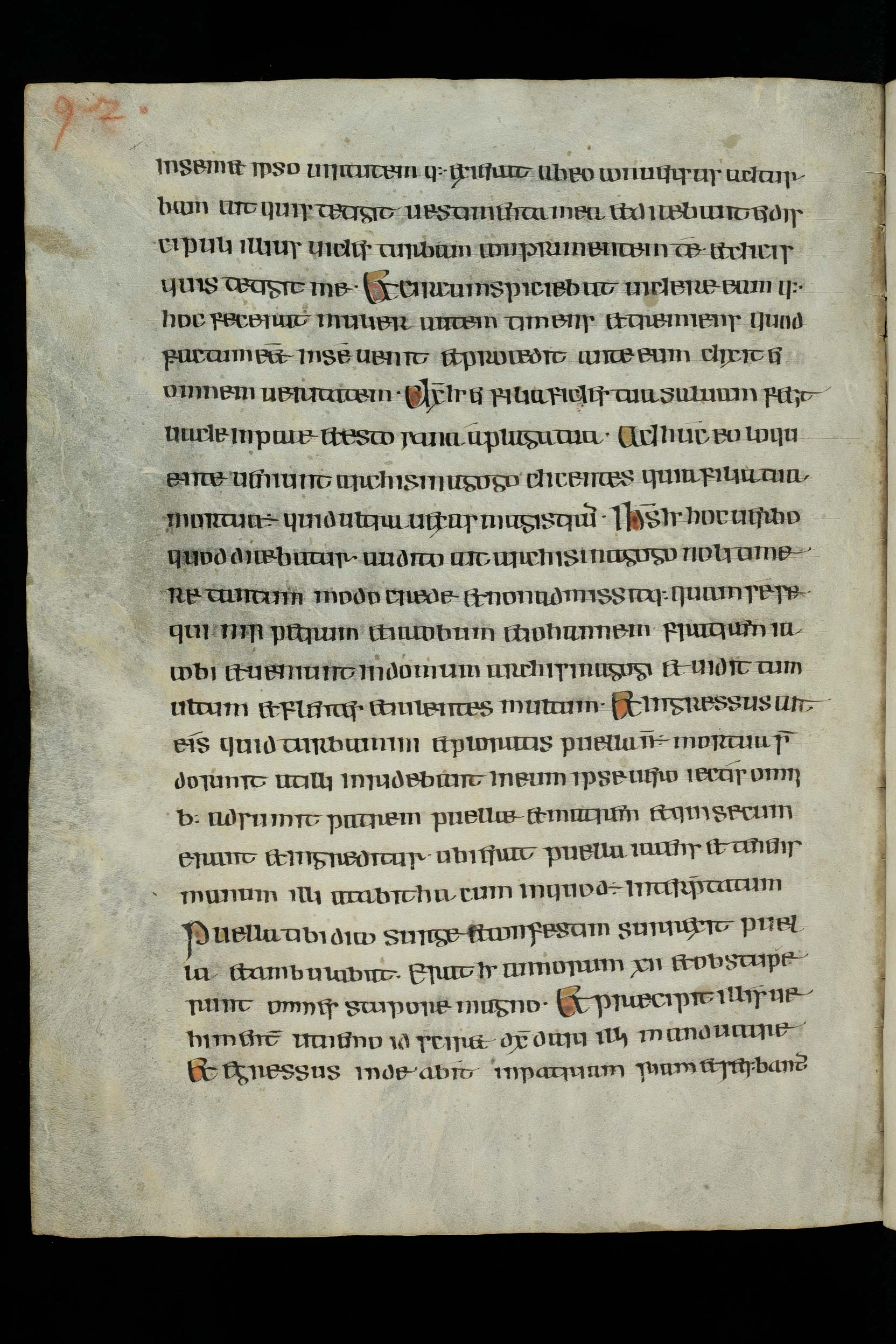
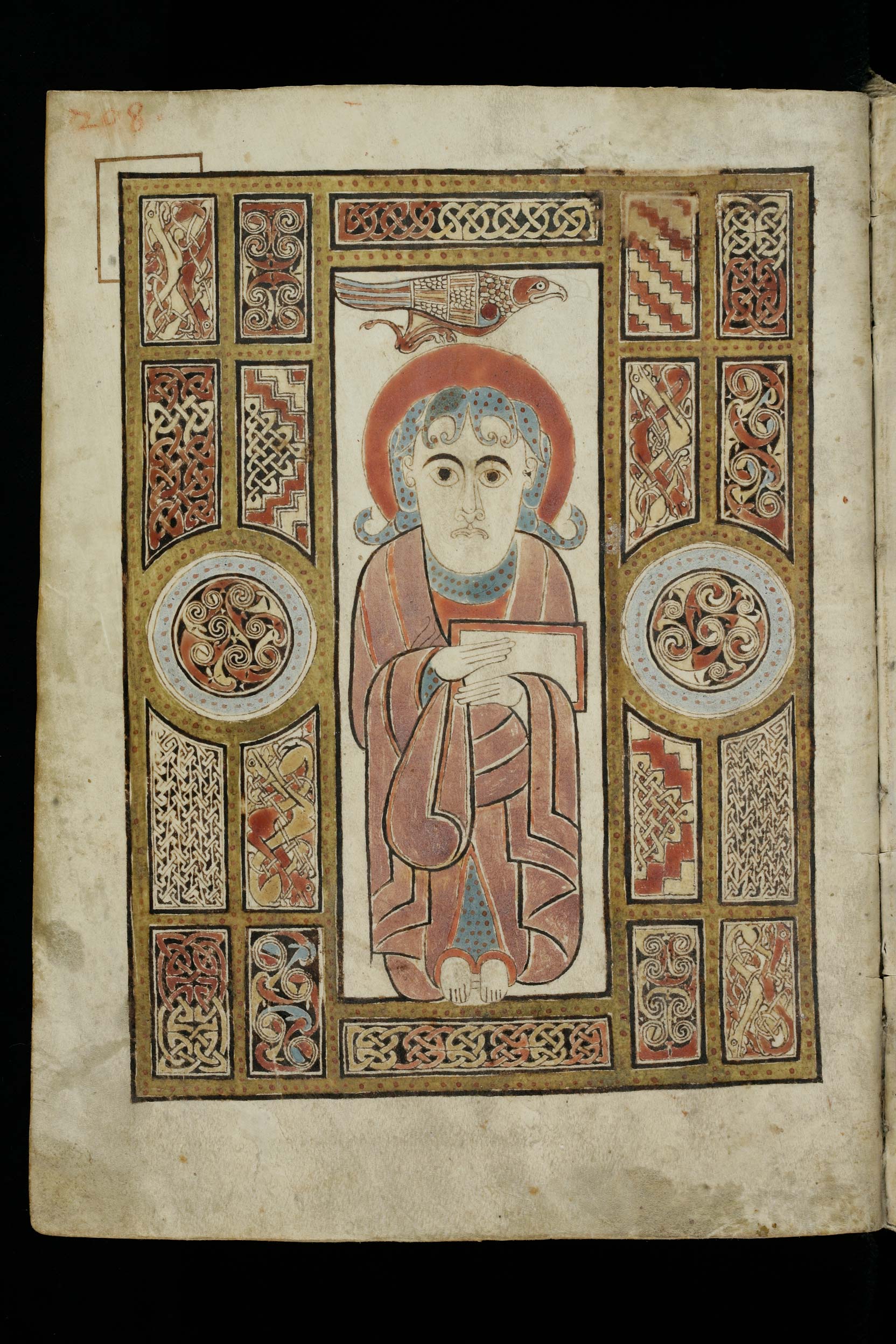
Stiftsbibliothek, Codex 51. St. Gallen Library. DATE: circa 750. CONTAINS: four gospels Text is typical Vulgate. Script is Irish minuscule. Images borrowed from the St. Gallen website. Gospel order is typical Vulgate - Mt, Mk, Lk, Jn. |
|
|
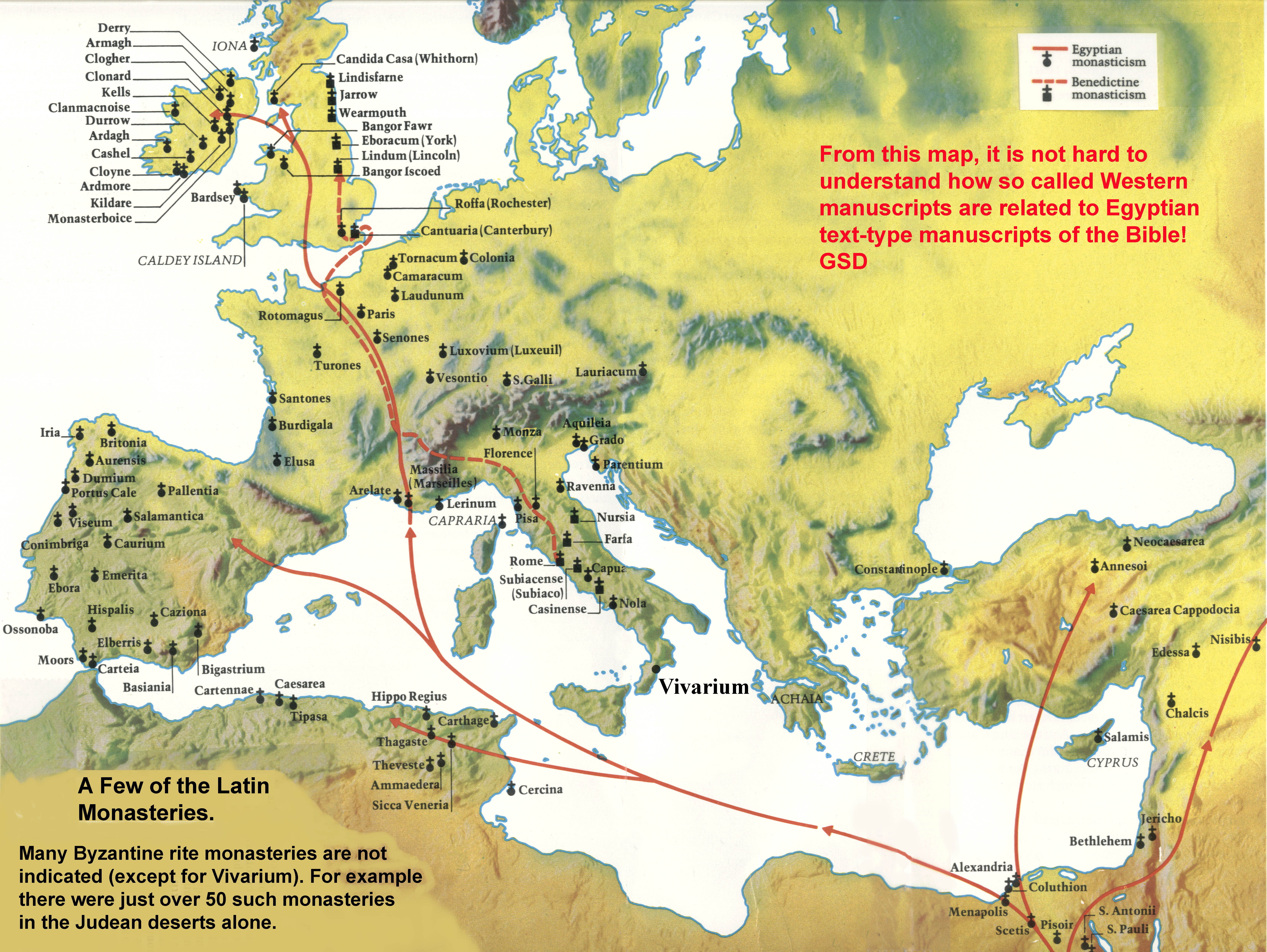
Map showing many Latin based monasteries. This map supplements that one shown on the "main" Latin page on this site. Map is modified from one printed in Atlas of the Biblical World. Joseph Rhymer, 1982. It of course, does not show all of the monasteries, but enough to get a good idea of the spread of Egyptian and Benedectine influences. Many of the earliest Egyptian based monasteries later became Byzantine rite or Benedectine rite. We can also see how the so-called "western text-type" of Greek manuscripts spread from their ORIGIN, which was in Egypt. This western text-type was later completely Latinized over time. One monastery which I added, the Vivarium, in particular spread early Greek readings directly from Egypt into Ireland, via Cassidorius. These readings are a part of the western text-type of Greek manuscripts of the Greek New Testament. One might note the essay, On the Origin and Value of the "Western Text-Type" as Concerns the Pauline Epistles, seen on my "main" Latin page.
|
 |
|
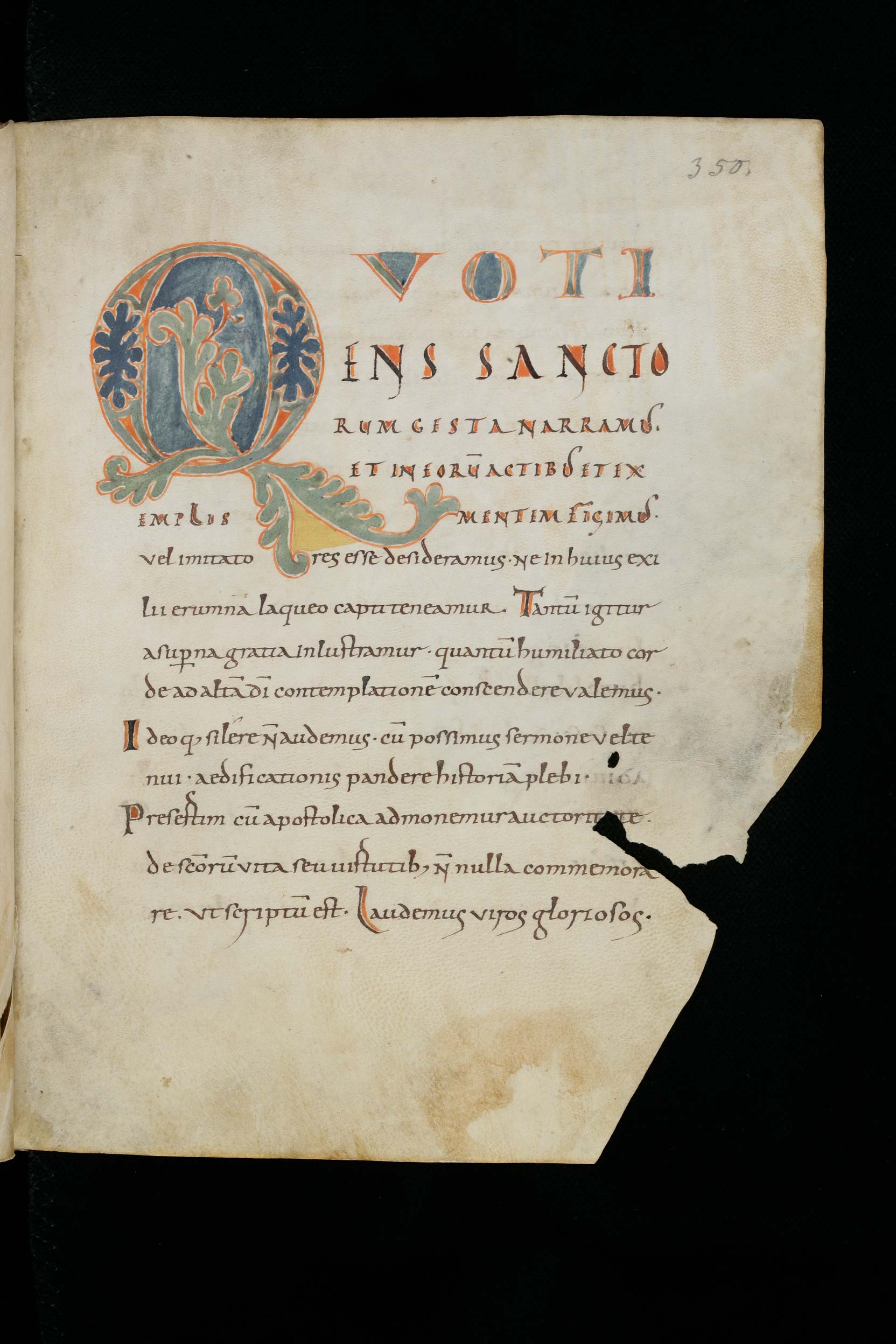
St. Gallen, Stiftsbibliothek, Codex 551. DATE: circa 925. CONTAINS: Lives of the Saints. Another fine sample of Caroline minuscule, with some slight variation. Another reason to visit the St. Gallen website. http://www.cesg.unifr.ch
|
 |
|
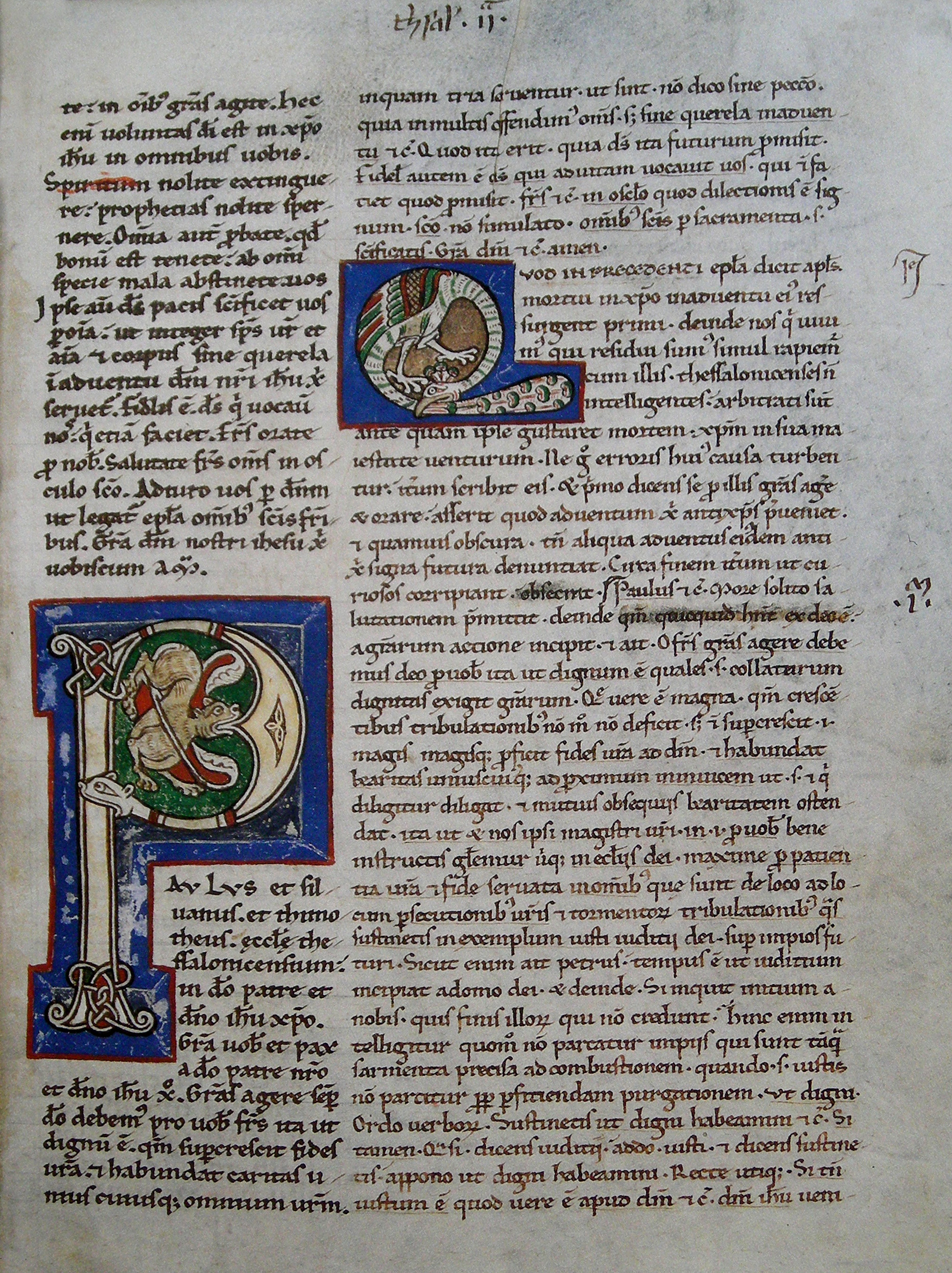
Victoria and Albert Museum, London. PDP 9037 D. Commentary on Pauline Epistles by Gilbert de la Porée. DATE: circa 1150. Copied in Poitiers, France. The darker script is the Biblical text, the lighter script on the right in the sample image, is the commentary, written in a Caroline minuscule.
|
 |
|
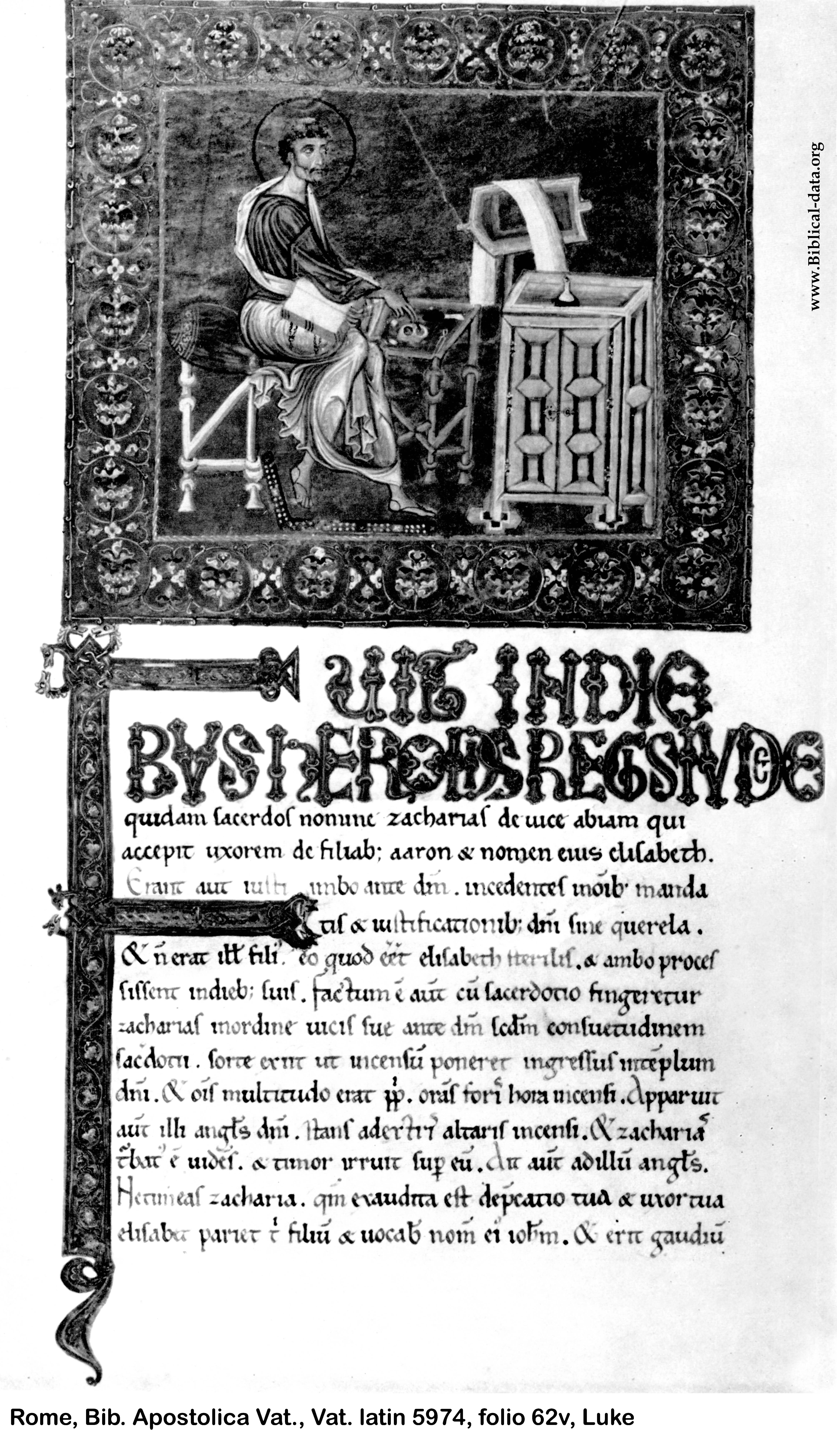
Rome, Bib. Apostolica, Vat. Vat. Latin 5974. DATE: circa 1180. Provenance, Jerusalem. One of three surviving Gospel manuscripts, known to have been copied in the Latin Kingdom of Jerusalem, Crusader Kingdom. Sample image is folio 62v, Gospel of Luke. The other two Crusader - Jerusalem MSS are: Paris, Bib. Natl. Latin 9396 and Paris latin 276.
|
 |
|
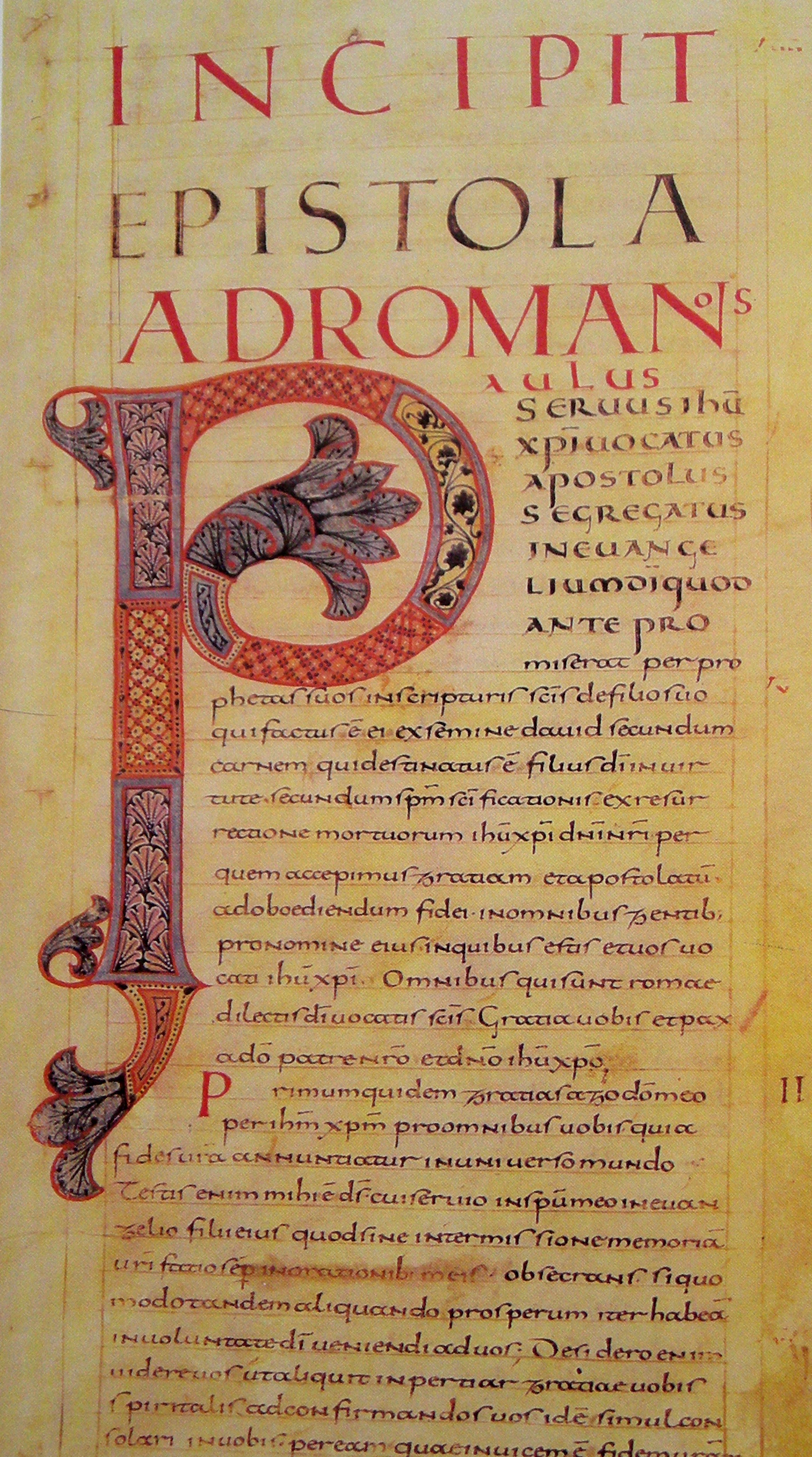
J. Paul Getty Museum, MS Ludwig 1, 1. DATE: circa 845. CONTAINS: Romans 1. A fragment found in bindings at Trier, but originally made or copied at Tours. The folks at Malibu have several surviving leaves, the sample image is folio 7r. Text script is basically a Caroline minuscule, but note the interesting "g" seen several times (line 8 of text et al).
|
 |
|
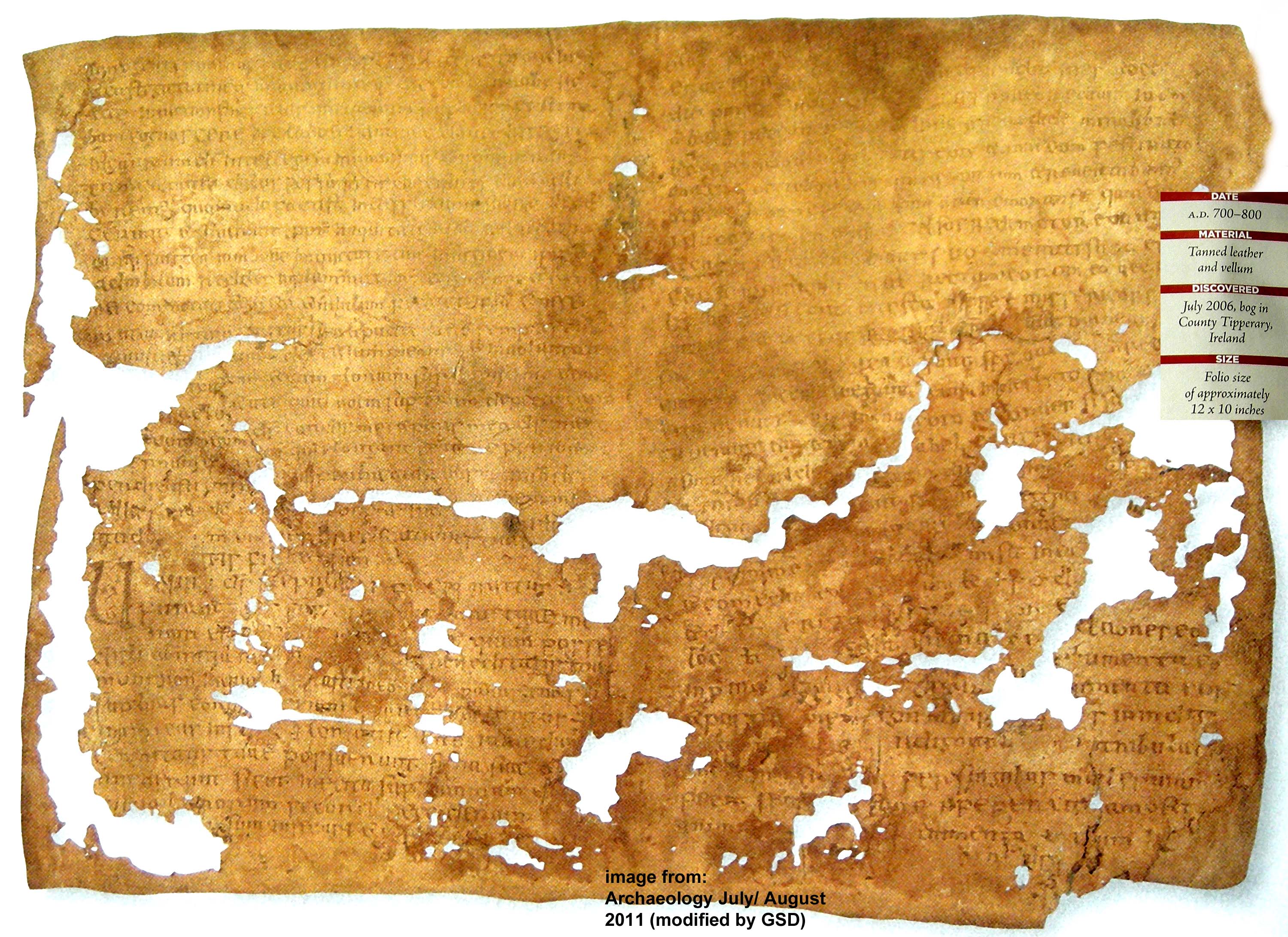
Faddan More Psalter: National Museum of Ireland, Dublin. Miraculously found in an Irish bog. The conservation work has improved its legibility. Script is a fine sample of Caroline minuscule. Chemical tests place it in the 8th century, as well as estimates by professional palaeographers. This is the only image I have yet found, it is difficult to clearly see the script, yet it appears to be circa 850 A.D. in my opinion. The lack of oxygen deep in the bog prevented the leather from decay. It may have been hidden in the bog to save it from raiding Vikings! It has some illuminations seen in some of its folios. On its cover, remains of gold lettering have been found, and papyrus has been used as part of its bindings. I copied the image seen on page 68 of ARCHAEOLOGY, July/August, 2011. I then modified it, to make it suitable for a web page. ARCHAEOLOGY is a useful and very interesting popular magazine. Though the resolution is poor, one can get an idea of its script. Expect more, in the future from the folks in Ireland!
|
 |
|
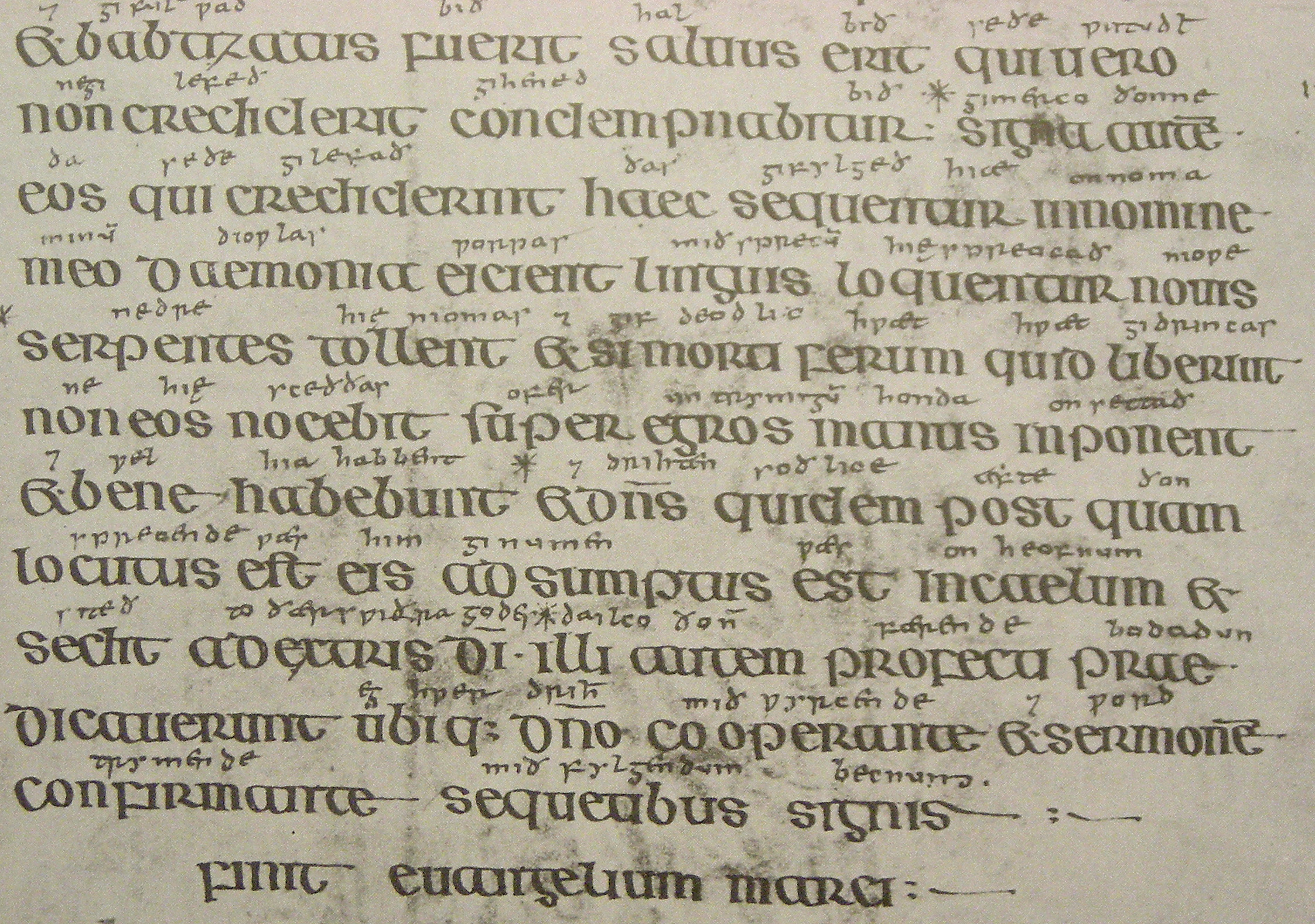
Book of Mac Regol. Oxford, Bodleian Library, MS Auct.D.II.19. DATE: circa 820 Also known as "Rushworth Gospels". Irish provenance, manuscript imitates earlier English types with its double horizontals (not seen in sample) and rulings done on both sides. Script is "half-uncial", Brown's "phase II". In this manuscript, Mac regol, abbot of Bir, was both the scribe and illuminator. The glosses are Anglo-Saxon, sample image shows the ending of Mark. |
 |
|
Ormesby Psalter, Manuscript Douce 366. DATE: 1310. Provenance East Anglia. I believe this now lies in the Oxford Bodleian Library (Douce is a Bod. title). Manuscript has a number (11 pages) of beautiful historiated initial letters as seen in the sample image. A fine sample of Brown's "Gothic bookhand, England".
|
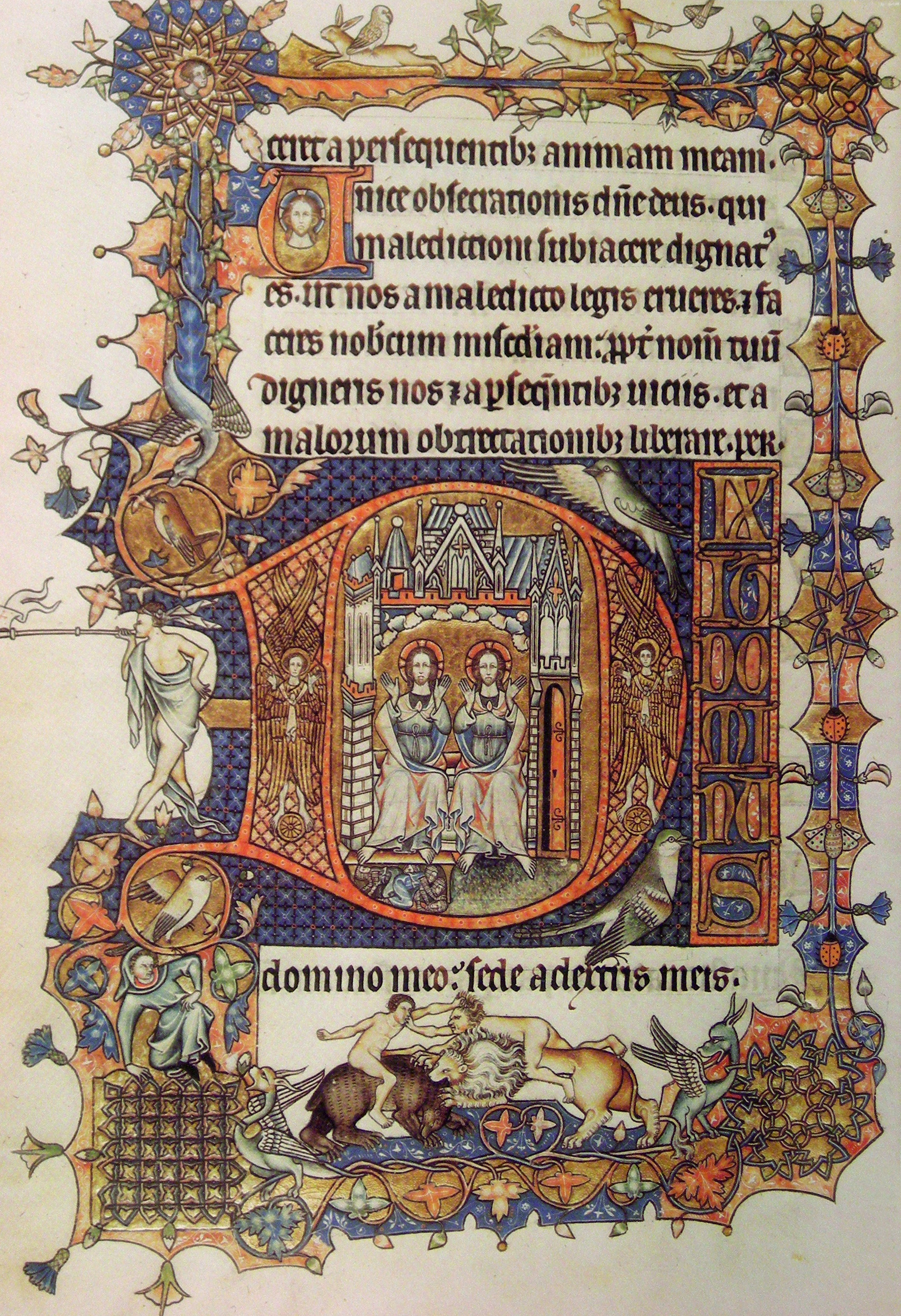 folio
147v
folio
147v |
|
|